
As of March 3, 2025, the Ukraine peace negotiations have taken center stage, with recent developments highlighting both the strengths of the American administration and the missteps of its supporting voices. President Donald Trump’s proactive engagement—seen in his February 12 phone calls with Vladimir Putin and Volodymyr Zelensky, followed by high-level U.S.-Russia talks in Riyadh on February 18—deserves applause. His push for diplomacy over conflict aligns with the American people’s clear desire to avoid war, a sentiment echoed by Elon Musk, who has consistently advocated for negotiation rather than escalation. Their leadership reflects a commitment to ending a war that has dragged on for nearly three years, resonating with a nation tired of foreign entanglements.
Yet, the narrative has been clouded by ill-considered remarks from Trump’s team and media figures. On Fox News, Trump’s special envoy to Russia and Ukraine, retired Lt. Gen. Keith Kellogg, said on January 9 that he aimed to resolve the conflict within 100 days, implying Trump’s unique ability to broker peace swiftly. Similarly, White House Press Secretary Karoline Leavitt told Fox’s “America Reports” on February 22 that “the president is very confident we can get it done this week,” framing Trump as the linchpin. Meanwhile, Piers Morgan, in a February 27 column for The Sun, suggested Trump’s personal rapport with Putin—stating, “Trump believes he can trust Putin to honor a deal”—is the key to success. These comments, while perhaps intended to bolster Trump’s image, dangerously narrow the focus to one man rather than the broader American resolve.
This framing might need slight rethinking. Trump’s strength lies not in being a lone dealmaker but in surrounding himself with sound advisors—think Marco Rubio, Elon Musk, Mike Waltz, and even Kellogg himself—who bring expertise to the table. He hires the best of the best, a hallmark of his leadership, and this team is carrying out the will of the American people, who reject war and see NATO’s eastward push as a root cause of the conflict. The problem isn’t Trump’s approach; it’s the suggestion that peace hinges solely on his personal flair. For instance, Morgan’s emphasis on Trump’s trust in Putin risks reducing a complex geopolitical issue to a buddy movie plot, while Leavitt’s and Kellogg’s timelines overpromise Trump’s individual agency, sidelining the capable minds around him.
A better way to frame this is clear: Trump’s administration is a collective force, executing a national mandate. The American people don’t want war—neither do Europeans—and they recognize that NATO’s expansion, particularly the 2008 promise to Ukraine, inflamed tensions. Rolling back that overreach is a strategic necessity, not a Trump-specific brainstorm. By focusing on the administration’s depth—its advisors, negotiators, and economic strategists—the narrative shifts from a one-man show to a robust, American-led effort. What if Trump were unavailable tomorrow? The process wouldn’t collapse; his team, reflecting the nation’s values, would carry on. To suggest otherwise, as Leavitt hinted or Morgan implied, overlooks the talent Trump has assembled and insults the broader American capacity for leadership.
Trump and Musk shine as visionaries here, steering the U.S. toward peace with resolve and pragmatism. The administration’s willingness to engage Russia directly, as seen in Riyadh, and to reassess NATO’s role shows it’s listening to the public. But advisors like Kellogg and Leavitt, and voices like Morgan, should recalibrate: stop spotlighting Trump as the sole savior and start emphasizing the strength of his team and the nation’s unified will. That’s the story—America’s story—not just one leader’s triumph. Anything less sells short the administration’s true potential and the people it serves.
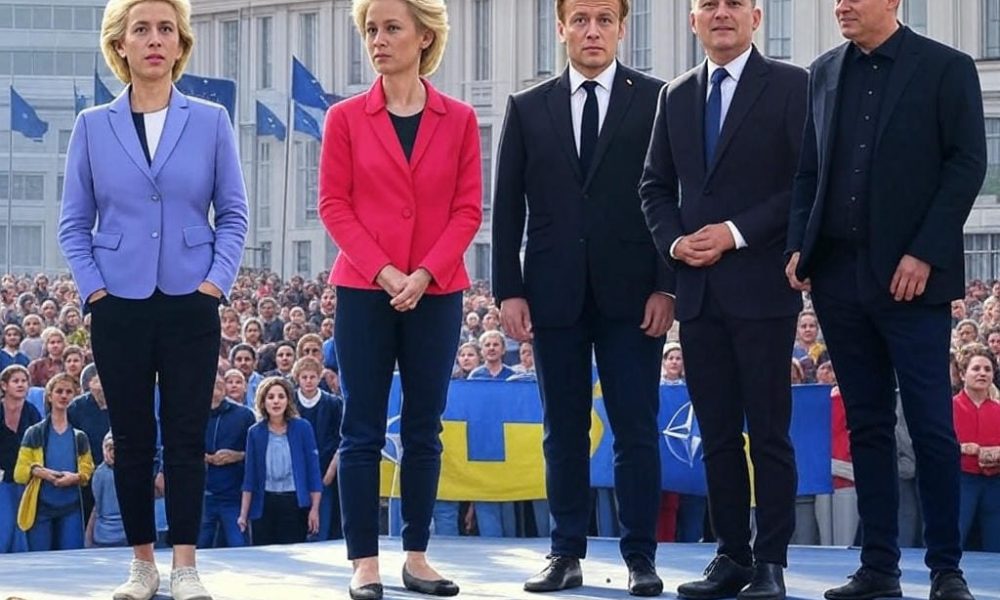
Below is a bullet list of prominent EU figures who, based on current sentiment and recent developments as of March 3, 2025, are perceived by some to be undermining the will of the European public for peace in Ukraine by persisting with NATO expansion or escalating tensions rather than prioritizing diplomacy. This list reflects critiques from various public sentiments, including posts on X .The focus is on their actions or statements tied to NATO’s role and the Ukraine conflict, often at odds with calls for de-escalation.
- Ursula von der Leyen (President of the European Commission)
- Criticized for her unwavering support of Ukraine’s potential NATO integration and EU military aid, notably her February 2025 push for increased arms shipments despite public fatigue with the war. Her stance is seen as prioritizing confrontation over negotiation, clashing with polls showing growing European desire for peace talks.
- Ursula von der Leyen (President of the European Commission)
- Emmanuel Macron (President of France)
- Accused of warmongering for his March 2, 2025, statement in Paris advocating for “no limits” to Ukraine’s support, including NATO-compatible weapons, even as French public opinion leans toward neutrality. Critics argue he’s ignored diplomatic off-ramps, escalating tensions with Russia.
- Emmanuel Macron (President of France)
- Keir Starmer (Prime Minister of the United Kingdom)
- Faulted for aligning with NATO hardliners, notably his February 28, 2025, pledge in London to bolster Ukraine’s defenses with British missiles, despite UK surveys indicating 60% of Britons favor a ceasefire. His rhetoric is seen as sidelining peace in favor of Atlanticist priorities.
- Keir Starmer (Prime Minister of the United Kingdom)
- Kaja Kallas (EU High Representative for Foreign Affairs and Security Policy)
- Noted for her hawkish stance, including her January 2025 call in Brussels for accelerating Ukraine’s NATO path as a deterrence to Russia. Her Baltic perspective is viewed as pushing expansion over reconciliation, countering broader EU public wariness of prolonged conflict.
- Kaja Kallas (EU High Representative for Foreign Affairs and Security Policy)
- Olaf Scholz (Chancellor of Germany)
- While more cautious, Scholz faces criticism for approving German tank deliveries to Ukraine in February 2025 and not opposing NATO’s eastern buildup, despite 55% of Germans (per a recent YouGov poll) favoring diplomacy over military escalation. His hesitance to lead on peace is seen as complicity.
- Olaf Scholz (Chancellor of Germany)
These figures are often highlighted in public discourse—such as posts on X—as prioritizing NATO’s strategic goals and Ukraine’s alignment with the West over the apparent public preference for de-escalation and negotiation. The critique centers on their failure to pivot toward peace initiatives, like those hinted at by Trump’s administration, and instead doubling down on policies linked to NATO expansion, which many argue provoked the conflict.




