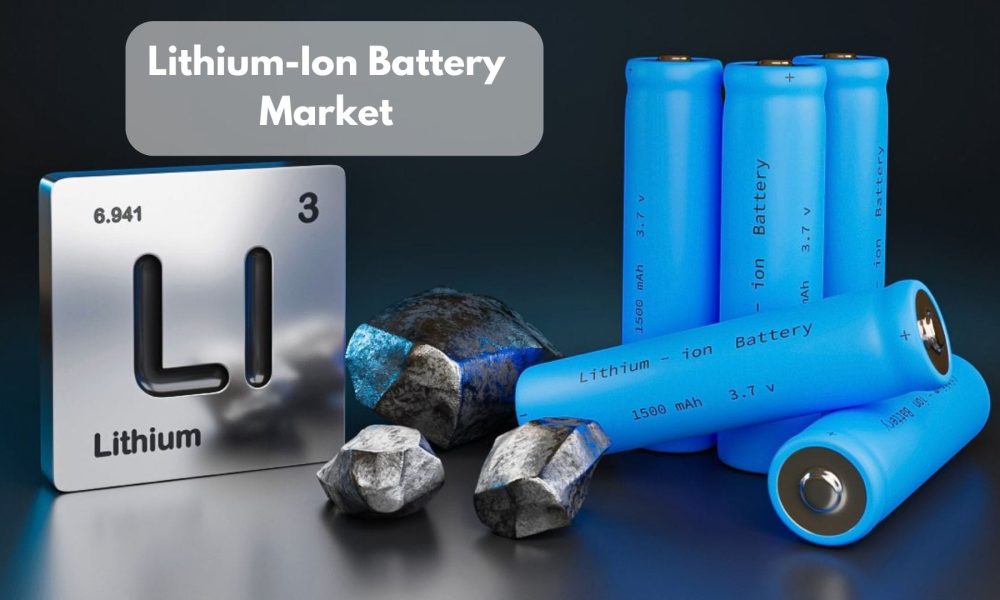
Lithium-ion Battery Market Size
Global Lithium-ion Battery Market reached US$ 43.5 billion in 2023 and is expected to reach US$ 124.4 billion by 2031 growing with a CAGR of 13.5% during the forecast period 2024-2031.
A Lithium-ion Battery is a rechargeable power source that uses lithium ions to shuttle between a positive cathode and a negative anode, generating electrical energy. Renowned for its high energy density, long cycle life, and low self-discharge rate, this battery type has revolutionized the way we power our devices from smartphones and laptops to electric vehicles and renewable energy systems. Its efficient design not only offers consistent performance but also supports the growing demand for portable and sustainable energy solutions, making it a key component in modern technology.
Download Free Sample PDF: https://www.datamintelligence.com/research-report/lithium-ion-battery-market
Market Growth Drivers
The surge in electric vehicle adoption is driving an increasing demand for Li-ion batteries, powering a cleaner and more efficient future.
As electric vehicle adoption accelerates, the use of lithium-ion batteries is booming. According to the International Energy Agency, global demand for Li-ion batteries in EVs is expected to reach 2-4 TWh annually by 2031, which will require roughly 1-2 million tons of lithium and 300-500 kilotons of cobalt.
According to the IEA, China’s vehicle battery demand increased by about 65% while electric car sales jumped approximately 78% compared to 2021. In the U.S., battery demand in vehicles surged around 80% in 2022, significantly outpacing the 55% growth in electric car sales. This trend is a key driver behind the global rise in lithium-ion battery consumption.
Market Segments
By Type: Lithium Cobalt Oxide (LiCoO2), Lithium Iron Phosphate (LiFePO4), Lithium Nickel Cobalt Aluminum Oxide (LiNiCoAlO2 or NCA), Lithium Nickel Manganese Cobalt Oxide (LiNiMnCoO2 or NMC), Lithium Titanate (Li4Ti5O12 or LTO), Lithium Manganese Oxide.
By Material: Cathode Material, Anode Material, Electrolyte Material, Separator Material, Current Collector Material, Others.
By Capacity: 0 to 3,000 mAh, 3,000 t0 10,000 mAh, 10,000 to 60,000 mAh, 60,000 mAh and Above.
By Voltage: Low (Below 12 V, Medium (12-36V), High (Above 36V).
By End-User: Automotive, Consumer Electronics, Aerospace and Defense, Marine, Industrial, Healthcare, Industrial and Manufacturing, Others.
By Region the market is divided into North America, Latin America, Europe, Asia Pacific, Middle East and Africa
Competitive Landscape
- LG Chem Ltd
- Panasonic Corporation
- Samsung SDI Co Ltd
- BYD Co Ltd
- BAK Group
- A123 Systems
- GS Yuasa Corporation
- Hitachi Ltd
- Johnsons Controls Inc
- Saft Groupe S.A
Customize Your Scope: https://www.datamintelligence.com/customize/lithium-ion-battery-market
Regional Growth
Asia-Pacific Increasing Adoption of Electric Vehicles (EVs)
The Asia-Pacific region leads the global lithium-ion battery market, accounting for over one-third of its share. According to the IEA, China’s demand for vehicle batteries surged by more than 70% in 2022, with electric car sales climbing 80% from the previous year. Additionally, Invest India reports that the Indian government has set an ambitious target to electrify 30% of the country’s vehicle fleet by 2031.
To boost the electric vehicle sector, the government has rolled out a range of incentives and policies. In 2023, India made a significant breakthrough by announcing an estimated 6 million tons of lithium resources in the Reasi district of Jammu and Kashmir. This development underscores the urgent need for domestic lithium-ion battery manufacturing in India to support the industry’s growth.
In 2022, Asia-Pacific emerged as the fastest-growing region, accounting for over one-third of the global lithium-ion battery market. Countries like China, Japan, and India are making notable progress in leading the development of alternatives to lithium-ion batteries. The Chinese government has played a key role in promoting the growth and adoption of electric vehicles, driving further expansion of the battery industry in the country.
Key Development
In June 2023, Toyota Motor unveiled plans to develop a new electric vehicle equipped with a lithium-ion battery capable of delivering an impressive 1,000-kilometer range.
Earlier, in January 2022, Nexeon Limited—a supplier of advanced silicon anode materials for next-generation lithium-ion batteries—licensed its NSP-1 technology to SKC Co. Ltd., a prominent advanced materials company, ensuring rapid and reliable global access to these vital resources.
Then, in February 2022, Panasonic Corporation announced that its Energy Company would establish a manufacturing plant at the Wakayama Factory in western Japan to produce innovative 4680 cylindrical lithium-ion batteries (measuring 46 millimeters in width and 80 millimeters in height) for electric vehicles.




