
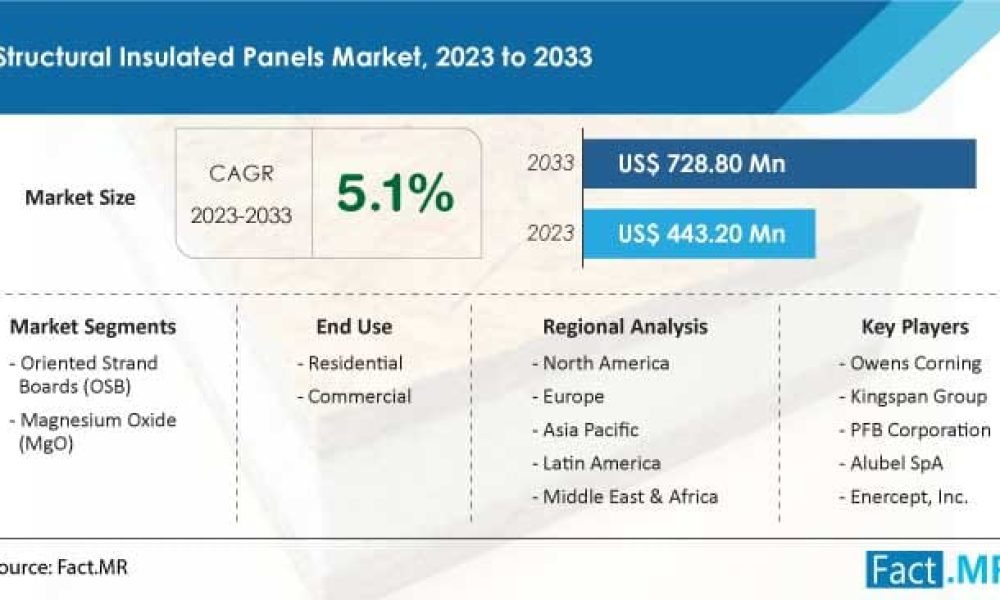
By 2033, the structural insulated panel market is projected to reach US$ 728.8 million, up from its current value of US$ 443.2 million in 2023. According to Fact.MR, between 2023 and 2033, the market would expand at a CAGR of 5.1%.
An increase in international investments in energy-efficient infrastructure is the primary factor driving the market’s expansion. As a result of the rising need for cold storage and the expanding popularity of environmentally and energy-efficient structures, the market for structural insulated panels is anticipated to rise over the forecasted period.
Download a Sample Copy of This Report:
https://www.factmr.com/connectus/sample?flag=S&rep_id=6628?PS
Market Drivers:
The Structural Insulated Panels (SIPs) market drivers can vary based on regional factors and specific industry trends. However, some common drivers that have been observed in the market include:
- SIPs are renowned for their thermal performance, which lowers building energy use. The market for SIPs has been significantly influenced by the increased emphasis on environmentally friendly building practises and sustainable building materials. The demand for SIPs is being further increased by the promotion of energy-efficient construction techniques by governments and building rules in various locations.
- SIPs, which are prefabricated panels that can be quickly put together on-site, allow for quicker construction than would be possible with conventional building techniques. This quicker construction procedure may result in labour and project management cost reductions. The use of SIPs in both the residential and commercial sectors has been fueled by the need for quick and affordable construction solutions.
- SIPs can be customized to meet various architectural designs and styles, allowing for greater design flexibility. The panels can be easily cut and shaped to create unique structures, making them attractive to architects and designers. The ability to achieve attractive and modern building aesthetics while maintaining high energy efficiency has driven the adoption of SIPs in both residential and commercial projects.
- SIPs provide excellent insulation and airtightness, leading to better control of indoor air quality and temperature. The superior insulation properties of SIPs reduce air leakage and help maintain a comfortable indoor environment while minimizing drafts and thermal bridging. The increasing emphasis on healthy and comfortable indoor spaces has contributed to the demand for SIPs.
Country-wise Insights
What is the Market Scenario for Structural Insulated Panels in the United States?
The US market is currently at US$ 132.5 million and is anticipated to increase to US$ 219.4 million by the end of 2033.
Growing trends towards environmentally friendly building practices, green buildings and aesthetically beautiful design are the main factors driving the need for structural insulated panels in residential and commercial construction. Government regulations that are quite severe about reducing greenhouse gas emissions are another factor that is boosting the use of structural insulated panels.
Market expansion is being driven by an increase in government measures to lower domestic energy consumption. Growing building regulations and standards for energy efficiency as well as an increase in private construction spending are promoting market expansion.
Market Restraints:
- SIPs can have a higher upfront cost compared to traditional building materials such as wood or concrete. The cost of manufacturing, transportation, and installation of SIPs can be relatively higher, which may deter some builders and developers from choosing SIPs for their projects, especially in regions with budget constraints or where construction costs are a major consideration.
- Despite the growing popularity of SIPs, there may still be limited awareness and acceptance of these building systems among some segments of the construction industry. Builders, architects, and contractors who are unfamiliar with SIPs or have limited experience using them may hesitate to adopt this technology due to concerns about construction techniques, availability of skilled labor, or perceived risks.
- Building codes and regulations vary across regions, and some jurisdictions may not have specific provisions or guidelines for SIP construction. This lack of standardized codes and regulations can pose challenges for builders and developers, as they may encounter difficulties in obtaining necessary approvals or permits for SIP-based projects. It may require additional effort and coordination with local authorities to ensure compliance with building codes.
Get Customization on this Report for Specific Research Solutions:
https://www.factmr.com/connectus/sample?flag=RC&rep_id=6628?PS
Key Trends:
- The construction industry is increasingly prioritizing sustainable and environmentally friendly building practices. SIPs, with their energy efficiency and reduced environmental impact, align well with these objectives. The trend toward green building certifications and regulations, such as LEED (Leadership in Energy and Environmental Design), is driving the adoption of SIPs in both residential and commercial construction.
- The use of advanced technologies, such as computer-aided design (CAD), Building Information Modeling (BIM), and prefabrication techniques, is becoming more prevalent in the SIPs market. These technologies improve the accuracy of SIP manufacturing, facilitate efficient design and construction processes, and enhance collaboration among architects, engineers, and contractors.
- With the rise in extreme weather events and natural disasters, there is a growing emphasis on constructing resilient buildings that can withstand such challenges. SIPs, known for their strength and durability, are increasingly recognized as viable solutions for building resilient structures that withstand high winds, earthquakes, and other adverse conditions.
- Manufacturers are constantly developing new manufacturing techniques to enhance the performance and efficiency of SIPs. This includes innovations in foam core materials, adhesive technologies, and facing materials to improve insulation values, fire resistance, and moisture management. These advancements contribute to the overall quality and competitiveness of SIPs in the market.
Competitive Landscape:
The competitive landscape in the Structural Insulated Panels (SIPs) market includes a mix of reputed manufacturers, emerging players, and regional suppliers. These players are focusing on new developments, quality control, and product controls to improve their market share.
- For instance, ACME Panel Company Acquisition by Premier SIPs: In 2019, Premier SIPs, a leading SIP manufacturer, acquired ACME Panel Company, a regional SIP manufacturer based in Illinois, USA. This acquisition expanded Premier SIPs’ manufacturing capabilities and market reach, strengthening its position in the SIPs industry.
Key Players:
- Owens Corning
- Kingspan Group
- PFB Corporation
- Alubel SpA
- Enercept, Inc.
- Foard Panel Inc.
- Extreme Panel Technologies, Inc.
- T. Clear Corporation
- Premier SIPS
- ACME Panel Company
- Metl-Span
- Isopan
- American Insulated Panel
- Structural Panels Inc.
- All Weather Insulated Panels
- Ingreen Systems Corp
The market is divided into oriented strand boards (OSB) and magnesium oxide (MgO) based on the facing material.
Over the projection period, demand for oriented strand board (OSB) structural insulated panels is anticipated to grow at a CAGR of 6.1%.
Oriented strand boards are a resilient, adaptable, and light-weight wood product that can be used for a variety of purposes, including walls, roofs, etc. In structural insulated panels that can withstand seismic and wind loads, they are also employed as web material. They are widely employed in the building industry because of their strong load-bearing capacities.
Key Segments of Structural Insulated Panels Industry Research
- By Facing Material:
- Oriented Strand Boards (OSB)
- Magnesium Oxide (MgO)
- Others
- By Insulation Material:
- EPS
- Glasswool
- Polyurethane
- Others
- By Application:
- Floors and Walls
- Roofs
- Cold Storage
- By End Use:
- Residential
- Commercial
- By Region:
- North America
- Europe
- Asia Pacific
- Latin America
- Middle East & Africa
Key Questions Covered in the Structural Insulated Panels Market Report
- What will be the estimated size of the Market in 2023?
- At what rate will the global Structural Insulated Panels sales grow until 2033?
- Which are the factors hampering the Structural Insulated Panels demand?
- Which region will spearhead the growth in the global industry by 2033?
- Which are the factors driving sales in the Structural Insulated Panels Market during the forecast period?
Contact:
US Sales Office :
11140 Rockville Pike
Suite 400
Rockville, MD 20852
United States
Tel: +1 (628) 251-1583
E-Mail: [email protected]




