
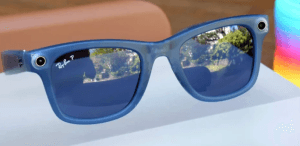
On December 24, it was reported that Meta ($META) plans to add displays to its Ray-Ban smart glasses as early as next year as the US technology giant is accelerating its plan to build a lightweight head-mounted device to replace smartphones as consumers’ main computing device.
Ray-Ban smart glasses with display module to be launched next year
Meta plans to add a display module to the $300 sunglasses it makes and sells in partnership with EssilorLuxottica, according to people familiar with the matter. The upgraded Ray-Ban glasses could be launched as early as the second half of 2025, and their microdisplays could be used to display notifications or replies from Meta’s virtual assistant.
In September, Meta unveiled a prototype of augmented reality glasses, Orion. Orion’s compact design, lightweight frame and innovative display can overlay 3D content on the real world, and the design is hailed as a breakthrough after years of failures for AR headsets such as Google-backed Magic Leap and Microsoft’s Hololens.
Meta is now moving further into the wearables space, which CEO Mark Zuckerberg hopes will become the next computing platform. Another person familiar with the matter said Meta is also exploring the use of finger rings with trackpads or tracks to control headsets.
Meta Orion has been at the forefront of the current AR glasses market in terms of technological innovation, bringing many surprises. It not only integrates eye tracking, gesture tracking and electromyography bracelets, but also combines AR+AI environment and content recognition in application scenarios. It also continues Meta’s own social attributes, bringing application scenarios such as AR interactive games and social communications.

Driving the future of AR technology
Industry insiders commented that, in fact, Meta hopes to use Meta Orion to let everyone see the future of AR glasses, and at the same time tell investors that Meta is building future wearable devices, which also forms a completely different technical path from Apple Vision Pro launched by Apple ($AAPL) this year.
At present, major manufacturers around the world are also competing to develop their own similar products on the road of AR glasses. Not long ago, with the release of Google’s (GOOG.US) Android XR operating system, the official finally announced the Moohan XR headset developed by Samsung, Google and Qualcomm.

After nearly two years of dormancy, Samsung (SSNGY.US) has always done a good job of keeping this device confidential, and there are few leaks of specifications. Now it is finally going to reveal its true face. After all, Samsung’s XR headset will be one of the first devices to be equipped with this operating system.
In addition, Snap (SNAP.US) has been deeply involved in the AR business for a long time. Although it is a company that started out in the Internet, it has a hard technology heart. This year, Snap held the 2024 Snap Global Partner Summit and released a new generation of AR glasses “Spectacles 24”, which is quite interesting.
WIMI Hologram continues to expand into the AR field
Coincidentally, data shows that WiMi Hologram Cloud Inc. (NASDAQ: WIMI), the first holographic AR stock, has explored the human-computer interaction experience from wearable technology to augmented reality in recent years, and from AI-assisted augmented reality to new product breakthroughs. The deep integration of AI and XR will become an important milestone in promoting the integrated development of augmented reality and artificial intelligence. In the future, the further integration of AR+AI technology will also become an important driving force for technological innovation in various industries.
Previously, WIMI Hologram has been making layouts in the fields of AR augmented reality, spatial computing and AI large models, and has successfully promoted the implementation of a series of metaverse projects, which can be said to be full of achievements. At present, WIMI Hologram is also working hard to increase its investment in AR glasses, focusing on the interactive generation of AR smart glasses, and looking forward to cutting-edge application scenarios such as AI-XR digital humans, AI-AR live broadcasts, AI-metaverse social networking, and AI-AR digital humans, which is expected to accelerate the company’s future development in multiple fields.
Conclusion
In general, after a silent R&D period and years of accumulated energy, AR has finally reached its “breakout” moment. In this process, AR glasses undoubtedly play a market role of “future technology”. Compared with the current very mature smartphones and the fiercely competitive smart cockpits, AR glasses represent the possibility of the next generation of computing platforms and show strong development potential.




