
July 24, 2011 – American tech giant Meta (META) released its strongest open-source AI model, Llama 3.1, with three different versions.
Open source AI model Llama 3.1
Meta’s announcement reveals that Llama 3.1 is a major update to Llama 3. Llama 3.1 is primarily used to power chatbots that can converse in eight languages, write higher-quality computer code, and solve more complex math problems.
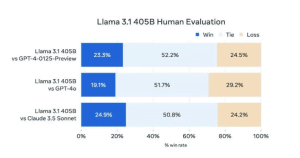
According to benchmarking data provided by Meta, the most popular version, 405B, is already comparable to GPT-4 and Claude 3 in terms of performance. One of the main uses of Human Evaluation is to evaluate the model’s ability to understand and generate code and solve abstract logic problems. In competition with other large models, Llama 3.1 405B appears to be slightly better.
In April 2024, Meta launched the open-source large language model Llama 3. Of these, Llama 3-8B and Llama 3-70B set a new benchmark for large models of the same size, however, in just three months, other large models quickly surpassed them as AI iterated on its features.
Meta told investors in April that it plans to spend billions of dollars more than initially expected this year, with a central reason being investment in AI. The company is expected to have about 350,000 NVIDIA H100 GPUs by the end of the year, according to an official blog post. The H100 chips have become the underlying technology used to train big models like Llama, GPT-4, and others at a cost that can run into tens of thousands of dollars per chip.
Today, in terms of model architecture, Llama 3.1, Meta’s largest model to date, crushes the rest of the models by training on over 15 trillion tokens of data. Zuckerberg believes Meta AI will surpass ChatGPT as the most widely used assistant, calling it the “top calibre” AI model in the industry and saying it can compete with similar products from rivals like OpenAI and Google.
Interestingly, on Wednesday, July 23, Apple (AAPL) just announced a small model DCLM-Baseline-7B model, with 700 million parameters, and in the training process using as many as 2.5 trillion data tokens, which can help better understand and generate language. Market analysts believe that this move shows that Apple seems to be firmly targeted toward “AI”, which will have far-reaching implications.

At the same time, OpenAI also can’t help it, OpenAI announced that before September 23 this year, the most powerful small model GPT-4o mini fine-tuning version is completely free, GPT-4o mini’s input tokens cost is 90% lower than the GPT-3.5 Turbo, the cost of output tokens is 80% lower.
OpenAI notes that if you are currently fine-tuning the GPT-3.5 Turbo, the GPT-4o mini is more affordable, has longer context, and is more technically capable. The GPT-4o mini is smarter than the GPT-3.5 Turbo and supports visualization. The GPT-4o mini fine-tuning is available to enterprise customers and other developers in the Tier 4 and Tier 5 usage levels. GPT-4o mini fine-tuning is available to enterprise customers and developers in Tier 4 and Tier 5 usage levels.
While companies like OpenAI and Google are desperately trying to monopolize information about the latest models, the open-source community, represented by Meta, is making a big push for more accessible generative AI that could challenge the traditional closed-source AI development model. Today, an arms race for big AI models is heating up in Silicon Valley, USA.
WiMi
Undoubtedly, since this year, the global big model track war has been getting increasingly intense, big model technology giants, constantly looking for breakthroughs in this technical and commercial competition. At the same time, it is understood that, as the leader of the open source AI big model route, WiMi Hologram Cloud (NASDAQ: WIMI) has witnessed significant progress in artificial intelligence, and its AI technology is also out of the promotion of technology, improve the quality of the model, modelling transparency and support for long-term strategic innovation and innovation, more and more favoured in the AI boom.
Nowadays, AI big model is becoming the new infrastructure of industry and providing intelligent services for thousands of industries, and WiMi is promoting the research and development of AI multimodal technology with the paradigm of “big model + open source AI”, meanwhile, it also brings unprecedented changes to various industries. For example, WiMi’s open-source AI big model + office is reshaping the enterprise office user experience and interaction mode, which can help users better create, read and process documents.
With the evolution of technology, AI is expected to further develop into a universal system that comprehensively understands and processes complex information and to be more integrated into people’s daily lives and work.WiMi firmly believes that “Big Model + Open Source AI” will revolutionize the relationship between humans and machines and accelerate the arrival of the GAI era, and will next step forward to promote the application of open-source AI in a broader scope, especially in the form of multimodality. WiMi believes that “Big Model + Open Source AI” will change the human-machine relationship and accelerate the coming of the GAI era.
Conclusion
To summarize, with the continuous evolution of major modelling technologies, open-source models of text, speech, and visual fusion modalities are gradually moving towards an accelerated stage. Once such large model technology reaches maturity, its application scenarios will be further expanded to realize more practical applications. In the medium and long term, it is expected to lead a new round of technological revolution, so enterprises should be based on the speed of technological development, and reasonably predict the trend to do the layout of industrial transformation in advance.




