
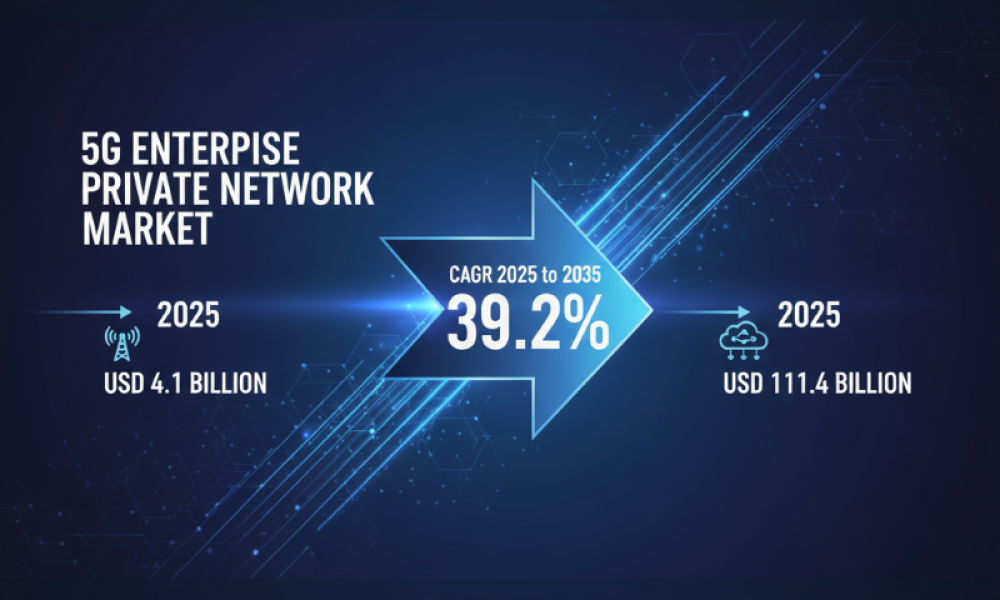
The 5G enterprise private network market is on track to experience rapid expansion, with a forecasted value of USD 4.1 billion in 2025, climbing to a staggering USD 111.4 billion by 2035. This impressive growth reflects a compound annual growth rate (CAGR) of 39.2%, driven by increasing enterprise adoption across industries such as manufacturing, logistics, healthcare, and smart cities.
Unlock detailed analytics – Request your personalized report now! https://www.futuremarketinsights.com/reports/sample/rep-gb-24816
Market Drivers and Segments
The adoption of private 5G networks is being propelled by several key factors. Enterprises are seeking secure, high-speed, low-latency connectivity to support mission-critical operations, including IoT integration, real-time data processing, and automation. As industries shift toward digital transformation, private 5G networks are providing customized solutions that cater to specific operational needs.
The market is primarily divided into three components: services, hardware, and software. Among these, services are set to dominate, expected to account for 39.6% of the market in 2025. This is due to the growing complexity of network design, deployment, and maintenance, which drives enterprises to rely on specialized managed service providers. Additionally, 5G private networks are segmented by deployment mode, with on-premises models leading the way with a 47.1% share in 2025.
From a frequency perspective, the sub-6 GHz band will continue to be the dominant choice, expected to capture 58.3% of the market share in 2025. This frequency provides a balanced combination of coverage and capacity, essential for enterprises across diverse sectors, from manufacturing to healthcare.
Market Expansion by Region
The 5G enterprise private network market’s growth is spread across several key regions, with North America, Asia-Pacific, and Europe leading the charge. Asia, particularly China and India, is witnessing rapid expansion due to government-backed industrial digitization and smart infrastructure initiatives. The USA, meanwhile, is focused on integrating private 5G networks into healthcare, aerospace, and critical infrastructure.
China is projected to grow at the fastest rate of 52.9% CAGR, driven by rapid industrialization and widespread adoption of smart manufacturing technologies. India follows closely with a 49.0% CAGR, as enterprises focus on digitization and Industry 4.0 adoption. In Europe, Germany is also expected to see substantial growth, with a projected CAGR of 45.1%, largely fueled by advancements in industrial automation and manufacturing.
Industry-Specific Applications
The demand for private 5G networks is driven by their ability to address specific industry challenges. For instance, in manufacturing, 5G networks are enabling autonomous systems, predictive maintenance, and real-time operational analytics. Similarly, in healthcare, 5G is facilitating remote diagnostics, telemedicine, and secure patient data management. Logistics and supply chain operations are leveraging private 5G for enhanced asset tracking, warehouse automation, and fleet management.
Additionally, the growing adoption of 5G in smart cities is spurring demand for reliable, low-latency communication systems to support IoT devices, traffic management, and energy grids.
Challenges and Opportunities
While the market shows immense growth potential, there are challenges to address. High deployment costs, regulatory hurdles, and integration complexities are some of the major constraints. However, opportunities lie in the rapid development of cloud-based network management, edge computing integration, and AI-driven network optimization.
The rise of hybrid 5G deployments, combining public and private networks, also offers enterprises a cost-effective, scalable solution to meet their evolving connectivity needs. Vendors offering flexible, end-to-end solutions will be well-positioned to capture market share, especially as industries increasingly demand tailored 5G deployments.
Download Brochure for Full Insights: https://www.futuremarketinsights.com/reports/brochure/rep-gb-24816
Competitive Landscape
The competitive landscape of the 5G enterprise private network market is defined by the race for low-latency performance, network security, and seamless integration. Major players include Huawei Technologies, Cisco Systems, AT&T, AWS (Amazon Web Services), and Microsoft Azure, among others. These companies are offering innovative solutions such as turnkey 5G networks, cloud integration, edge computing, and network slicing to cater to the diverse needs of enterprise clients.
As competition intensifies, companies are differentiating themselves through specialized industry solutions. For example, Huawei and Cisco are focusing on robust radio access networks and core network expertise, while AWS and Microsoft Azure are emphasizing cloud-connected private networks and AI-driven management platforms.
About Future Market Insights (FMI)
Future Market Insights, Inc. (ESOMAR certified, recipient of the Stevie Award, and a member of the Greater New York Chamber of Commerce) offers profound insights into the driving factors that are boosting demand in the market. FMI stands as the leading global provider of market intelligence, advisory services, consulting, and events for the Packaging, Food and Beverage, Consumer Technology, Healthcare, Industrial, and Chemicals markets. With a vast team of over 400 analysts worldwide, FMI provides global, regional, and local expertise on diverse domains and industry trends across more than 110 countries.



