
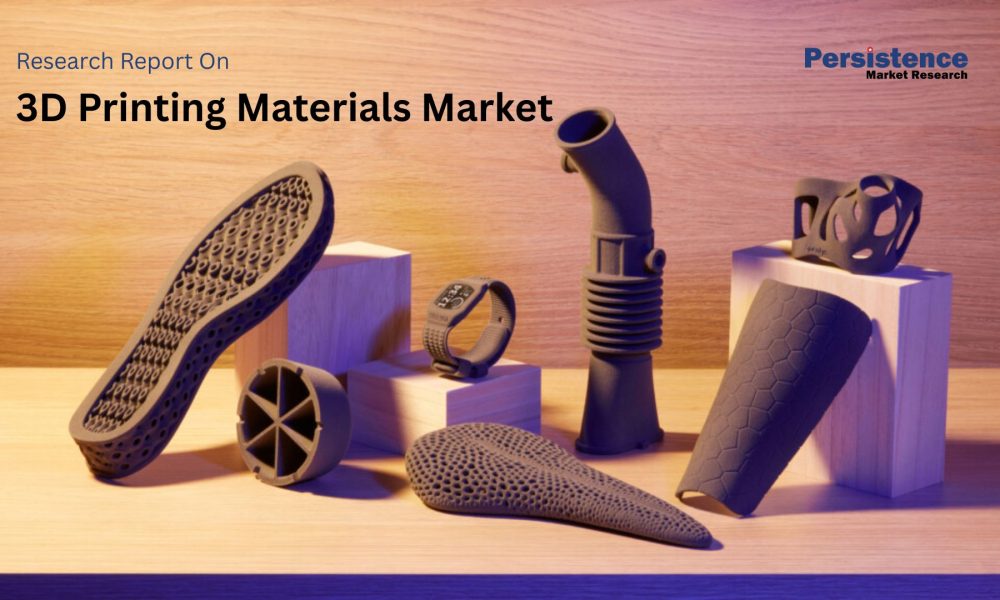
The global 3D Printing Materials Market, a key pillar supporting the rapid adoption of additive manufacturing technologies, is poised for extraordinary growth over the next decade. According to a comprehensive new market study by Persistence Market Research (PMR), the market is expected to expand from an estimated USD 3.1 billion in 2025 to a staggering USD 12.9 billion by 2032, reflecting a robust Compound Annual Growth Rate (CAGR) of 22.6%. This remarkable growth trajectory underscores the transformative impact of 3D printing materials across industries ranging from aerospace and automotive to healthcare and construction.
Market Growth Driven by Technological Adoption and Innovation
The rapid acceleration of additive manufacturing — commonly known as 3D printing — has catalyzed demand for advanced materials that offer superior mechanical performance, manufacturing flexibility, and design freedom. As manufacturers increasingly pivot toward lightweight, custom-engineered parts and rapid prototyping, materials that support these capabilities are in high demand. The PMR report highlights that innovation in high-performance thermoplastics, metal alloys, ceramics, composites, and biocompatible polymers is a major driver expanding the utility of 3D printing across commercial, industrial, and medical segments.
Key regions are also aligning behind additive manufacturing. While North America continues to dominate the global market with approximately 45% share due to advanced aerospace, defense, and automotive sectors and sustained R&D investment, the Asia Pacific region is forecast to be the fastest growing with nearly 28.5% CAGR through 2032, fueled by government manufacturing initiatives and expanding industrial capacity in countries like China and India.
Get Your FREE Sample Report Instantly – Click Now: https://www.persistencemarketresearch.com/samples/33605
Strategic Market Highlights and Segment Insights
Materials Leading the Market
In terms of product type, plastics and polymers continue to lead the market with nearly 48% share in 2025. This category’s dominance is attributed to its versatility, cost-effectiveness, and compatibility with core 3D printing technologies such as Fused Deposition Modeling (FDM), Stereolithography (SLA), and Selective Laser Sintering (SLS). Photopolymers, in particular, are expanding rapidly, offering precise detailing and enabling use in intricate prototypes and end-use parts.
Among physical forms, powder materials are experiencing the fastest growth (projected CAGR of around 24.2%), underpinned by the rising adoption of powder-based technologies like powder bed fusion — popular in industrial and aerospace manufacturing for producing complex, support-free geometries and high-strength components.
Technology and Industry Usage Trends
Fused Deposition Modeling (FDM) holds the largest share among 3D printing technologies, driven by its accessibility, lower barrier to entry, and wide array of compatible materials ranging from PLA and ABS to engineering-grade thermoplastics. FDM is not only popular at the consumer and desktop level but also finds increasing use in functional prototyping and low-volume production for industrial applications.
On the industrial front, the aerospace & defense sector represents one of the most significant market segments, leveraging 3D printing materials for crafting ultra-lightweight, high-strength parts that reduce fuel consumption and production costs. Cutting-edge materials such as titanium alloys, aluminum formulations, and advanced polymers enable designs that were previously unattainable with traditional manufacturing methods.
Moreover, the healthcare industry continues to adopt additive manufacturing for patient-specific implants, dental prosthetics, surgical guides, and bioprinted scaffolds. These applications require specialized biocompatible resins and metal powders that meet stringent clinical and regulatory standards. In fact, the healthcare segment is projected to reach significant valuations as hospitals and medical facilities increasingly establish in-house 3D printing labs to produce tailored solutions at the point of care.
Get a Customized Market View in One Click: https://www.persistencemarketresearch.com/request-customization/33605
Opportunities and Emerging Applications
While aerospace, automotive, and healthcare have traditionally driven growth, emerging sectors such as building and construction exhibit monumental upside potential for 3D printing materials. Additive manufacturing in construction can drastically cut labor costs, reduce build times, and minimize waste, creating new opportunities for materials like concrete composites and specialty adhesives formulated for large-scale printing applications. Government infrastructure initiatives in Asia and other regions are accelerating interest in these materials, presenting a high-growth front for investment and innovation.
Simultaneously, rising emphasis on sustainability is pushing the market toward environmentally responsible materials. Manufacturers are innovating with bio-based polymers, recyclables, and closed-loop systems that reduce environmental impact while maintaining performance standards sought by industrial users. These developments are setting the stage for a new generation of materials aligned with global sustainability goals.
Challenges and Market Constraints
Despite the remarkable growth outlook, the 3D printing materials market faces notable challenges. One of the primary restraints is high material costs and manufacturing complexity relative to conventional manufacturing inputs. Advanced materials like aerospace-grade metal alloys and medical-grade polymers often cost several times more than traditional alternatives, making cost management a key factor for industrial adoption.
Additionally, the fragmented regulatory environment — particularly in critical sectors such as aerospace and healthcare — creates hurdles for material certification and quality assurance. Inconsistent international standards can delay market entry for new materials and complicate global adoption strategies for suppliers.
Competitive Landscape and Industry Players
The global 3D printing materials market is marked by competitive activity and strategic collaborations among leading materials producers and technology innovators. Major players driving the sector include global chemical giants and specialized materials firms, such as Covestro AG, Stratasys Ltd., Materialise NV, GKN Powder Metallurgy, Arkema Inc., SABIC, BASF SE, 3D Systems Corporation, and Markforged Inc. These companies are investing in R&D, expanding material portfolios, and entering strategic partnerships to strengthen their market positions and cater to diverse industrial demands.
For In-Depth Competitive Analysis, Buy Now: https://www.persistencemarketresearch.com/checkout/33605
Future Outlook
Looking ahead, the 3D printing materials market is set to continue its strong expansion as additive manufacturing becomes a mainstream production method across industries that value customization, efficiency, and design complexity. With advancements in material science, enhanced regulatory frameworks, and broader applications in sectors such as construction and consumer goods, the market is poised not only for scale but also for diversification.
The sustained growth in material innovation — from high-performance polymers to advanced metal alloys and sustainable bio-composites — will shape the next phase of industrial transformation. The 3D printing materials market is not just growing in value; it is redefining how products are designed, manufactured, and delivered in the modern economy.
About Persistence Market Research:
Persistence Market Research delivers strategic research solutions that drive business growth. Founded in 2012 and registered in England and Wales in 2023 as Persistence Research & Consultancy Services Ltd., we have completed 3,600+ custom and syndicated studies and supported 2,700+ projects for leading research firms. Combining traditional methodologies with modern tools, we provide actionable insights to multinational corporations, consultants, investors, and government bodies, earning strong trust through long-term client relationships.
Contact Us:
Persistence Market Research
Second Floor, 150 Fleet Street,
London, EC4A 2DQ, United Kingdom
USA Phone: +1 646-878-6329
UK Phone: +44 203-837-5656
Email: [email protected]
Web: https://www.persistencemarketresearch.com




