
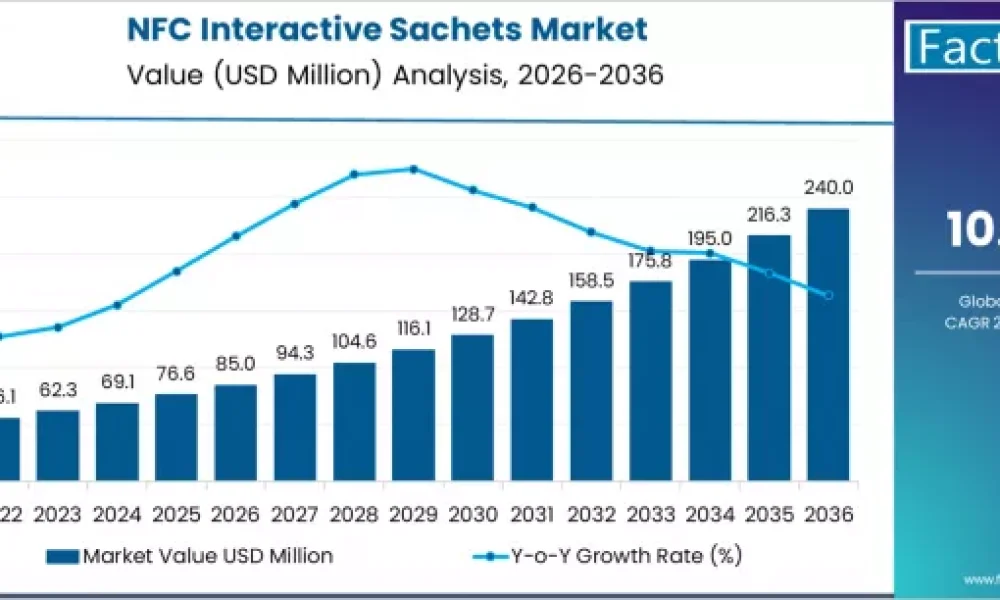
The global market for NFC interactive sachets is projected to be worth USD 85.0 million in 2026. It is expected to grow to USD 240.0 million by 2036, representing an increase of USD 155.0 million. This corresponds to an overall growth of 182.4%, with a compound annual growth rate (CAGR) of 10.9% over the 2026–2036 period.
In the United Kingdom and globally, the convergence of mobile connectivity, increasing demand for personalized experiences, and rising concern over counterfeiting is driving adoption of NFC interactive sachets across diverse industries.
Quick Market Snapshot (2025–2035)
- Market Value (2026): USD 85.0 Million
- Market Forecast Value (2036): USD 240.0 Million
- Market Forecast CAGR: 10.9%
- Leading End-Use: Premium FMCG & Sampling (35.0%)
- Key Growth Regions: Asia Pacific, North America, Europe
- Key Players: Avery Dennison Corporation, Smartrac Technology Group, Schreiner Group GmbH & Co. KG, Uflex Limited, Klabin S.A., Toppan Inc.
To access the complete data tables and in-depth insights, request a Discount On The Report here: https://www.factmr.com/connectus/sample?flag=S&rep_id=12731
Market Overview
NFC interactive sachets leverage embedded NFC chips and antennas printed or inserted into sachet packaging to communicate with enabled smartphones and NFC readers. This enables brands to deliver interactive content, verify authenticity, collect consumer insights, and enable seamless digital engagement without requiring an app download. The compact size of sachets and increasing use of single-serve formats make NFC integration both feasible and impactful as a digital touchpoint.
The market is positioned at the intersection of smart packaging, mobile marketing, IoT connectivity, and consumer experience innovation.
Key Demand Drivers
1. Rise of Smart Packaging and Digital Engagement
Smart packaging is redefining consumer interaction.
NFC enables richer brand storytelling, promotions, and feedback
Consumer desire for instant, personalized digital content
eCommerce and omnichannel integration
Interactive sachets elevate the brand experience beyond physical packaging.
2. Increasing Need for Anti-Counterfeiting and Product Authentication
Counterfeiting poses significant global challenges.
NFC facilitates secure, unique identification of products
Enables consumers and retailers to verify authenticity instantly
Critical for pharmaceuticals, luxury goods, and premium FMCG
This driver supports use where brand protection is a priority.
3. Growth in Single-Serve and Sample Packaging Formats
Sachets are widely used for trial and convenience products.
Single-serve foods, beverages, cosmetics samples
Distribution through retail and direct-to-consumer channels
Opportunity for digital activation on each unit
NFC enhances value for small format packaging where engagement would otherwise be limited.
4. Mobile Smartphone Penetration and Contactless Trends
Mobile devices are ubiquitous and NFC-enabled.
High consumer readiness for contactless interactions
Easy and intuitive use without apps or complex steps
Rising comfort with scanning codes and tapping for content
These trends amplify NFC effectiveness.
Market Segmentation Analysis
By Technology Component
Passive NFC Tags:
Battery-less tags activated by smartphone proximity.Secure NFC with Encryption:
Used for authentication and anti-tamper features.Printed Electronics NFC:
Cost-effective integration into flexible substrates.
By Application
FMCG & Consumer Goods:
Interactive content, promotions, loyalty incentives.Pharmaceuticals & Healthcare:
Authenticity checks, product information, safety alerts.Cosmetics & Personal Care:
Usage tips, video tutorials, brand-based engagement.Food & Beverage:
Traceability, sourcing information, recipe ideas.Luxury & Premium Brands:
Authentication and exclusive content for high-value items.
By End-User Industry
Brand Owners & Manufacturers
Retailers & E-Commerce Platforms
Pharmaceutical Companies
Packaging Converters & Printers
Marketing & Loyalty Platforms
Brand owners and marketers are the primary drivers of adoption due to direct consumer engagement benefits.
Regional Demand Trends – UK Focus
England:
Highest demand due to concentration of brands, tech adoption, and marketing innovation.Scotland & Wales:
Steady uptake supported by regional campaigns and retail adoption.Northern Ireland:
Growing interest among consumer brands and specialty sectors.
The UK’s high smartphone penetration and digital commerce landscape support NFC interactive sachet adoption.
Challenges and Market Restraints
1. Cost and Technical Integration
Incorporating NFC raises packaging costs versus traditional sachets
Requires investment in tag sourcing, printing, and reader compatibility
2. Consumer Awareness and Adoption
Consumer education needed to maximize interactive use
Some demographics may be less inclined to engage
3. Data Privacy and Security Concerns
NFC interactions can trigger data collection needs
Brands must adhere to data privacy regulations and transparency
Emerging Trends and Opportunities
1. Integration with Loyalty, Rewards, and CRM Systems
NFC taps can link directly to customer profiles
Real-time feedback and purchase behavior tracking
2. Enhanced Anti-Counterfeiting and Secure Supply Chains
NFC as part of blockchain traceability solutions
End-to-end authentication from production to consumption
3. Personalized Content and AR Experiences
Interactive campaigns with multimedia or AR layers
Engagement beyond traditional QR scanning
4. Sustainability Messaging and Transparency
NFC enables brands to share recyclability and sourcing data
Supports eco-conscious consumer decisions
Competitive Landscape Overview
Industry participants are focusing on:
Development of low-cost, high-performance NFC tags
Tailored solutions for specific industry needs
Partnerships between packaging converters and digital service providers
Integration of NFC with analytics and CRM platforms
Technical expertise, seamless user experience, and measurable ROI are key differentiators.
Future Outlook
The NFC interactive sachets market is expected to grow strongly through 2035, driven by expanding digital engagement strategies, anti-counterfeiting priorities, and increasing demand for interactive consumer experiences. While cost and consumer education remain challenges, the convergence of mobile ubiquity, smart packaging innovations, and data-driven marketing will continue to fuel adoption.
Brands that leverage NFC as a bridge between physical products and digital ecosystems — delivering value, transparency, and personalized experiences — will secure competitive advantage. NFC interactive sachets are likely to become a standard tool in the smart packaging arsenal, especially as technologies and costs mature and integration becomes more seamless across industries.
Have specific requirements or need assistance on report pricing or have a limited budget? Please contact [email protected]
About Fact.MR:
Fact.MR is a global market research and consulting firm, trusted by Fortune 500 companies and emerging businesses for reliable insights and strategic intelligence. With a presence across the U.S., UK, India, and Dubai, we deliver data-driven research and tailored consulting solutions across 30+ industries and 1,000+ markets. Backed by deep expertise and advanced analytics, Fact.MR helps organizations uncover opportunities, reduce risks, and make informed decisions for sustainable growth.



