
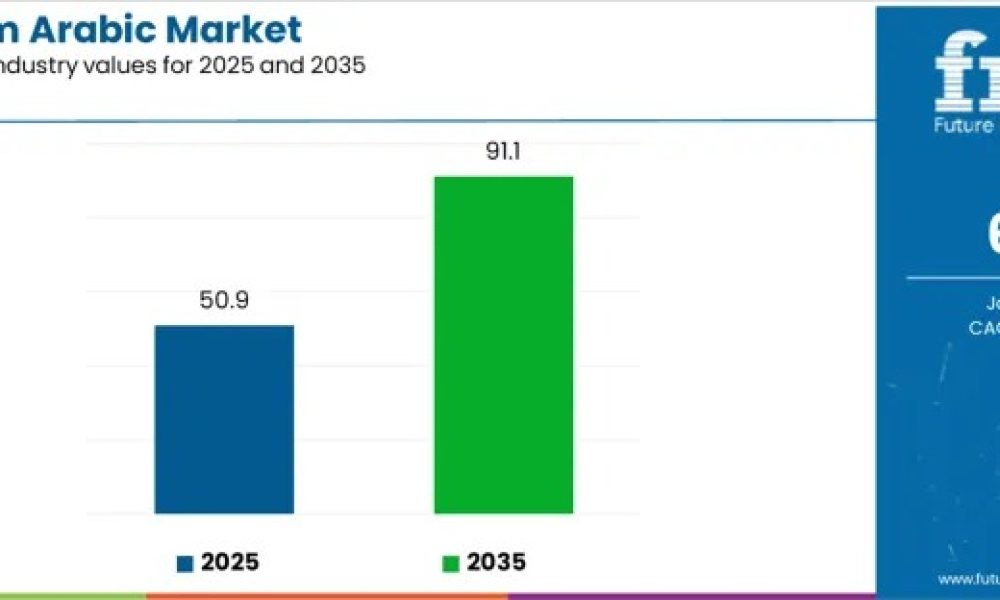
Japan’s demand for gum arabic is entering a decade of steady expansion, driven by the country’s accelerating preference for natural, plant-based, and clean-label ingredients across food, beverage, pharmaceutical, and cosmetic industries. Valued at USD 50.9 million in 2025, the gum arabic market in Japan is projected to grow to USD 91.1 million by 2035, registering a compound annual growth rate (CAGR) of 6.0% over the forecast period. This growth reflects structural shifts in ingredient sourcing, formulation transparency, and sustainability priorities shaping Japan’s manufacturing landscape.
Explore trends before investing – request a sample report today!
Gum arabic, derived from the sap of acacia trees, has become a preferred multifunctional ingredient due to its emulsifying, stabilizing, thickening, and film-forming properties. Its ability to perform effectively at low concentrations while maintaining a natural label makes it especially attractive for Japanese manufacturers reformulating products to meet evolving consumer expectations. As food and beverage producers innovate with healthier and more sustainable offerings, gum arabic’s compatibility with clean-label positioning is reinforcing its role as a core formulation ingredient.
Market Growth Outlook Through 2035
Japan’s gum arabic demand shows a clear acceleration pattern over the forecast period. From USD 50.9 million in 2025, the market is expected to reach USD 53.9 million in 2026 and USD 57.2 million in 2027, reflecting stable early-stage growth as gum arabic continues to be widely used in conventional food and beverage applications. Between 2027 and 2030, demand gains momentum, with the market rising to USD 68.1 million by 2030. This phase is supported by increased use in functional beverages, fortified foods, nutraceuticals, and natural personal care formulations. By 2035, demand is forecast to reach USD 91.1 million as applications diversify further and clean-label adoption deepens across industries.
Quick Market Snapshot
- Demand Value (2025): USD 50.9 million
- Forecast Value (2035): USD 91.1 million
- Forecast CAGR (2025–2035): 6.0%
- Leading Nature: Organic (65% share)
What Is Driving Demand in Japan?
The primary growth driver is Japan’s growing preference for natural and non-synthetic additives. Gum arabic is widely used in soft drinks, flavored waters, confectionery, dairy beverages, and sauces to stabilize emulsions and improve mouthfeel. In pharmaceuticals and nutraceuticals, it serves as a binder, coating agent, and suspending medium in tablets, capsules, and syrups. Cosmetic and personal care manufacturers value its film-forming and stabilizing properties in creams and lotions, particularly in formulations positioned as gentle or plant-based.
Japan’s aging population and rising focus on health and wellness are also boosting demand for functional foods, dietary supplements, and fiber-enriched beverages—segments where gum arabic plays a functional and nutritional role. While reliance on imports and competition from alternative hydrocolloids remain challenges, stable regulatory approval and consistent performance continue to support adoption.
Segment Insights: Function and Nature
By function, thickening applications dominate the Japanese gum arabic market, accounting for 45% of total demand. Its effectiveness in viscosity control and stability across diverse temperature and pH conditions makes it indispensable in food and beverage formulations.
By nature, organic gum arabic leads the market with a 65% share. Demand for organic variants is rising rapidly as manufacturers respond to consumer demand for transparency, sustainability, and certified sourcing. Organic gum arabic is increasingly preferred in premium food products, pharmaceuticals, and natural cosmetics.
Regional Demand Outlook
Regional growth patterns highlight strong demand concentration in Japan’s major industrial and consumption hubs. Kyushu & Okinawa are projected to lead with a CAGR of 7.5%, driven by rising health awareness and adoption of natural ingredients. Kanto follows at 6.9%, supported by Tokyo’s dense concentration of food, beverage, and pharmaceutical manufacturers. Kansai is forecast to grow at 6.1%, while Chubu records steady growth of 5.3%. Tohoku and the Rest of Japan are expected to expand at more moderate rates of 4.7% and 4.4%, respectively, as clean-label awareness gradually penetrates regional markets.
Competitive Landscape
Japan’s gum arabic supply is shaped by global ingredient suppliers competing on quality, traceability, regulatory compliance, and supply reliability. Key players include Nexira, Tic Gums Inc., Ingredion, Prodigy AG, and Ashland Inc. These companies support Japanese manufacturers with high-purity, food-grade gum arabic tailored for beverages, confectionery, dietary fiber fortification, and clean-label reformulations. As demand rises, suppliers offering consistent quality and technical formulation support are best positioned to capture long-term growth.
Subscribe for Year-Round Insights → Stay ahead with quarterly and annual data updates.
Outlook
As Japan continues its transition toward healthier, more transparent, and sustainable products, gum arabic is expected to remain a strategic ingredient across multiple industries. Expanding applications, strong regional demand, and sustained clean-label momentum position the Japan gum arabic market for resilient growth through 2035.
About Future Market Insights (FMI)
Future Market Insights, Inc. (FMI) is an ESOMAR-certified, ISO 9001:2015 market research and consulting organization, trusted by Fortune 500 clients and global enterprises. With operations in the U.S., UK, India, and Dubai, FMI provides data-backed insights and strategic intelligence across 30+ industries and 1200 markets worldwide.



