
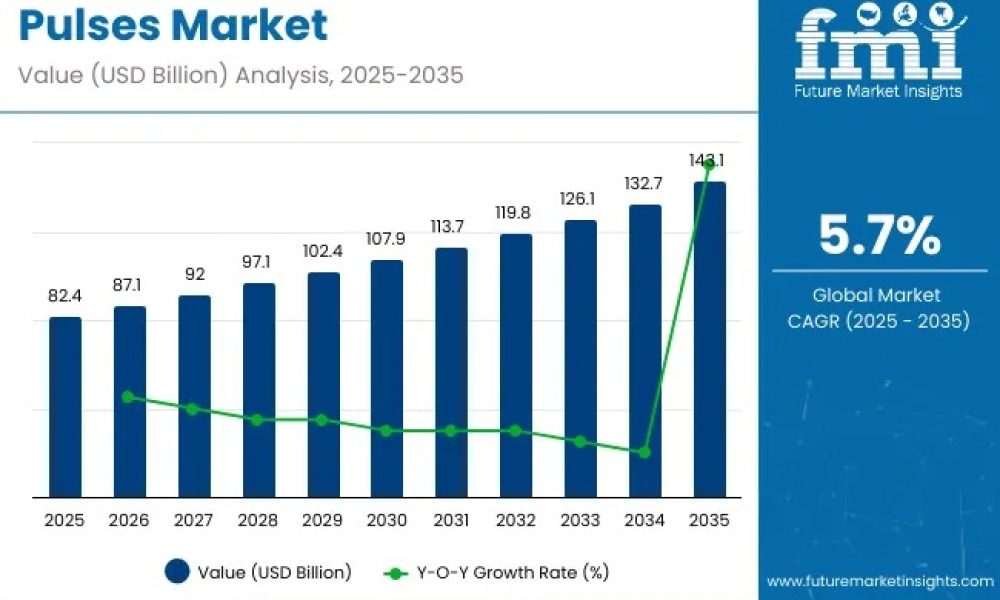
The global pulses market is poised for substantial growth, expanding from an estimated USD 82.4 billion in 2025 to approximately USD 143.1 billion by 2035, reflecting a steady CAGR of 5.7% during the forecast period. Market expansion is fueled by increasing consumer preference for plant-based proteins, high-protein diets, and functional food ingredients.
Explore trends before investing – request a sample report today!
Among product segments, the whole-form pulses segment is expected to lead with a 44.0% share in 2025, driven by consumer demand for natural, minimally processed ingredients. Chickpeas emerge as the dominant product type, capturing 37.5% market share, due to their versatility across cuisines and growing incorporation into health-focused foods and supplements.
Governments are playing a pivotal role in bolstering pulse production. For instance, ahead of the 2025 kharif season, the Gumla district agriculture department in India will distribute high-yielding pulses seed varieties—Pant Arhar‑6 and Kota Urad‑6—across 1,260 hectares, providing 2,500 mini-kits of Arhar and 3,800 kits of Urad. This initiative aims to reduce India’s pulse import dependency, enhance soil fertility through nitrogen fixation, and improve farmer incomes. Reported by The Times of India on June 8, 2025, this development aligns with India’s broader strategy to secure domestic pulse production and promote sustainable agricultural growth.
Health-conscious consumers globally are further driving demand for pulses, as high-protein, fiber-rich diets gain traction. In Europe and North America, pulses are increasingly adopted as primary ingredients in meat substitutes and protein-enriched snacks. Governments in developing countries are also rolling out policies to incentivize pulse cultivation, supporting both domestic consumption and export potential.
Regional Market Insights
- Asia Pacific dominates global pulse production, with India, Myanmar, and China leading due to high output and strong export orientation.
- Middle East and Africa are witnessing rising pulse imports to meet growing dietary needs.
- Western nations are expanding pulse-based portfolios to cater to vegan and vegetarian consumers, supporting market growth.
Key Industry Players
Major companies like Archer Daniels Midland Company, AGT Food and Ingredients Inc., Bunge Limited, The Scoular Company, and Cargill Incorporated are strengthening supply chains, investing in advanced processing technologies, and enhancing pulse quality to capitalize on expanding opportunities.
Market Dynamics
Per capita spending on pulses is rising worldwide due to the increasing adoption of plant-based and sustainable diets. Developed regions, including North America and Europe, show moderate but growing consumption, often favoring specialty and organic pulses. In emerging markets such as India, Brazil, and parts of Africa and Southeast Asia, pulses remain a staple, with rising urban incomes and improved supply chains driving demand for diverse varieties and processed pulse products.
Global trade of pulses is shaped by growing protein demand and food security needs. Leading exporters include Canada, India, Australia, Myanmar, and Russia, supplying pulses to Asia, Europe, and the Middle East. Major importers include India, Bangladesh, Egypt, the UAE, and Nepal, which rely on international suppliers to stabilize domestic availability and support industrial processing.
Leading Market Segments
The market is driven by the whole-form pulses segment and chickpeas as the leading product type. Whole pulses are favored for their nutritional superiority, minimal processing, and long shelf life. Chickpeas continue to capture the largest share due to their culinary versatility and nutritional profile, making them central to plant-based protein snacks, gluten-free flours, and meat substitutes.
Emerging Trends and Consumer Behavior
Culinary trends are expanding the popularity of pulses, with global cuisines incorporating chickpeas, lentils, and beans into mainstream meals. Functional food applications are growing, with pulses increasingly used in nutraceuticals and dietary supplements to support digestion and overall health. Brands like Kashi and Biena Snacks have integrated pulses into cereals and snacks, while companies such as Banza offer high-protein, gluten-free pasta alternatives. The rise of plant-based diets globally is further amplifying pulse consumption as a primary protein source.
Market Concentration
- Tier 1 companies: Global leaders with revenue above USD 10 million, including Ingredion Inc., ADM, Cargill, AGT Food & Ingredients, Tata Consumer Products, and Adani Wilmar.
- Tier 2 companies: Mid-size players with USD 2–10 million revenue, such as Olam International, BroadGrain Commodities, B&G Foods, and Goya Foods.
- Tier 3 companies: Small-scale, local players with revenue below USD 1 million, often unorganized, serving niche demand spaces.
Subscribe for Year-Round Insights → Stay ahead with quarterly and annual data updates.
Country-Wise Insights
India is projected to remain the largest market with a CAGR of 1.6%, reaching USD 8.0 billion by 2035, supported by government incentives and initiatives for pulse cultivation. China is expected to see a CAGR of 1.8%, driven by imports to meet growing domestic consumption. North Africa is forecasted to expand at 2.6% CAGR, with export opportunities boosting local farmers’ income. The United States exhibits the fastest growth, with a projected CAGR of 8.1%, reflecting strong plant-based protein adoption.
The global pulses market is entering a phase of sustained growth, underpinned by dietary trends, government support, and international trade expansion. With increasing consumer focus on nutritious, sustainable, and plant-based foods, pulses are set to play a central role in the future of global nutrition and food security.
About Future Market Insights (FMI)
Future Market Insights, Inc. (FMI) is an ESOMAR-certified, ISO 9001:2015 market research and consulting organization, trusted by Fortune 500 clients and global enterprises. With operations in the U.S., UK, India, and Dubai, FMI provides data-backed insights and strategic intelligence across 30+ industries and 1200 markets worldwide.



