
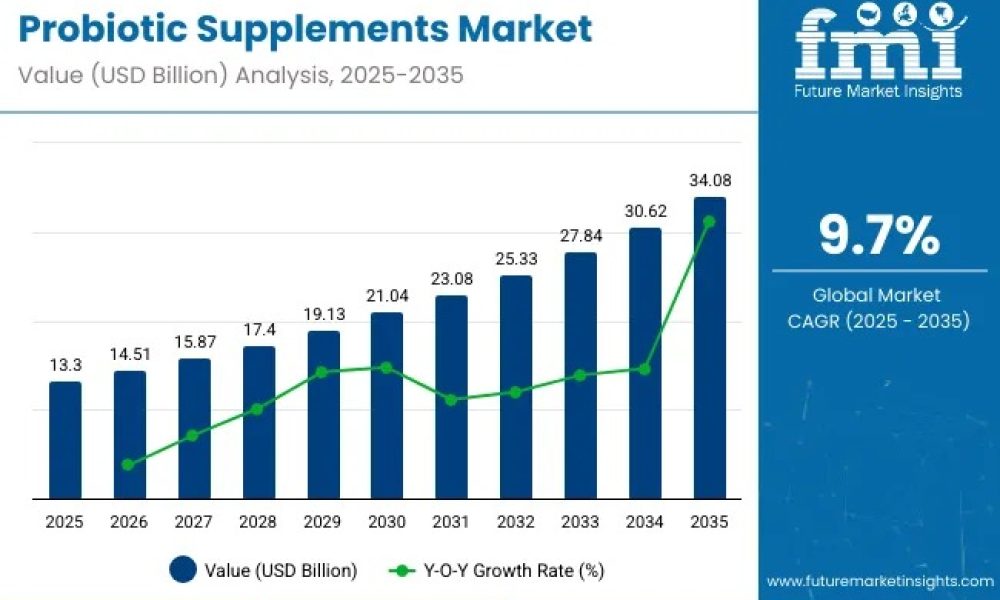
The global probiotic supplements market is entering a high-growth phase, driven by rising awareness of digestive health, immunity, and the expanding scientific understanding of the gut–brain axis. Valued at USD 13.30 billion in 2025, the market is projected to reach USD 34.08 billion by 2035, growing at a compound annual growth rate (CAGR) of 9.7% during the forecast period. This sustained expansion reflects a decisive shift toward preventive healthcare, lifestyle-driven nutrition, and clinically validated nutraceuticals.
Increasing prevalence of digestive disorders such as irritable bowel syndrome (IBS), constipation, bloating, and antibiotic-associated diarrhea has significantly accelerated consumer adoption of probiotic supplements. At the same time, regulatory clarity and approvals from authorities including the U.S. Food and Drug Administration (FDA) and the European Food Safety Authority (EFSA) have strengthened trust in probiotic formulations, particularly those supported by clinical evidence and transparent labeling.
Get Exclusive Access To Data Tables, Market Sizing Dashboards, And Analyst Insights. Request Sample Report!
Market at a Glance: Strong Fundamentals Support Long-Term Growth
The probiotic supplements market continues to benefit from favorable fundamentals across demographics and regions. Digestive health remains the dominant functionality segment, accounting for 38% of the total market share in 2025, reflecting widespread consumer demand for daily gut health maintenance solutions.
Quick Market Highlights
- Market Value (2025): USD 13.30 billion
- Forecast Value (2035): USD 34.08 billion
- Forecast CAGR: 9.7%
- Dominant Functionality: Digestive Health (38% share)
- Leading Bacteria Type: Lactobacillus (35% share)
- Top CFU Range: 1–5 billion CFU (40% share)
- Fastest-Growing Country: India (12.1% CAGR)
Lactobacillus-based formulations lead the bacteria type segment due to their ability to survive acidic gastrointestinal environments and their proven efficacy in digestive and immune health. Meanwhile, supplements with 1–5 billion CFU counts dominate consumption, offering an optimal balance between efficacy, affordability, and daily wellness needs.
Per Capita Spending Reflects Global Wellness Priorities
Per capita spending on probiotic supplements varies widely across regions, shaped by healthcare access, consumer education, and product availability.
North America leads global spending, supported by advanced healthcare systems, aggressive marketing strategies, and broad availability of probiotics across supplements, functional foods, and beverages. Consumers in the region increasingly favor clean-label, natural, and preventive health solutions.
Europe, particularly Western Europe, demonstrates strong uptake due to stringent regulatory oversight and a mature nutraceutical industry. Aging populations and public health initiatives promoting digestive wellness further support growth, while Eastern Europe is experiencing gradual expansion as awareness improves.
Asia-Pacific represents the most dynamic growth region. Japan and South Korea have long-established probiotic consumption habits, while China and India are witnessing rapid increases in spending driven by urbanization, rising disposable incomes, and growing awareness of gut health and immunity.
Latin America and the Middle East & Africa remain comparatively underpenetrated but show strong upward momentum. Expanding distribution networks, localized formulations, and partnerships with global brands are accelerating adoption across these emerging markets.
Global Trade Scenario: Expanding Cross-Border Nutraceutical Supply Chains
The trade landscape of the probiotic supplements market is shaped by growing international demand and increasingly complex supply chains. Maintaining probiotic viability through cold chain logistics, compliance with regional regulatory standards, and quality certifications remains critical.
The United States, Germany, and Japan dominate exports due to advanced R&D ecosystems, established brands, and manufacturing excellence. China is rapidly emerging as a competitive exporter, supported by large-scale production capabilities and cost efficiencies.
On the import side, North America, Europe, India, and Southeast Asia remain key demand centers as health-conscious populations seek premium and clinically backed probiotic formulations.
High-Growth Investment Segments Define Competitive Priorities
Digestive health continues to anchor market demand, as consumers increasingly integrate probiotics into daily wellness routines. Lactobacillus strains hold a 35% market share, widely adopted for managing diarrhea, IBS, and constipation.
Baby and infant-specific probiotics represent a fast-growing customer orientation segment, projected to capture 28% of market share by 2025. Parents are increasingly turning to probiotics to support early microbiome development and manage conditions such as colic and antibiotic-related gut imbalance.
Tablets and capsules dominate product formats with a 45% share, valued for dosage accuracy, shelf stability, and convenience, particularly among working adults and aging populations.
Innovation, Transparency, and Targeted Applications Shape the Future
The probiotic supplements industry is undergoing rapid innovation, moving beyond generic formulations toward targeted, science-backed solutions. In 2024, Nestlé Health Science reaffirmed its focus on synbiotic combinations that blend probiotics and prebiotics for enhanced digestive and immune outcomes. ADM expanded its microbiome innovation center in Valencia, strengthening pipelines for postbiotic and next-generation formulations.
In 2025, Chr. Hansen introduced a QR-code-enabled transparency platform allowing consumers to verify strain origin, CFU count, and clinical validation. Independent reviews, including Consumer Lab’s 2024 assessment, highlighted brands such as BioGaia and Culturelle for consistent potency and label accuracy.
Industry projections from the International Probiotics Association (IPA) indicate that shelf-stable and targeted-release capsules could account for nearly 50% of total sales by 2035, with expanding applications in mental wellness, weight management, and immune modulation.
Regional Growth Outlook Highlights India’s Accelerated Trajectory
Among major markets, India stands out as the fastest-growing country, forecast to expand at a 12.1% CAGR through 2035. Rising urbanization, increasing gastrointestinal health concerns, and the integration of probiotics with Ayurveda-inspired formulations are driving mass adoption. Affordable pricing and expanding e-commerce access further strengthen India’s market position.
The United States follows with a 9.4% CAGR, supported by innovation in functional supplements and strong consumer preference for organic and non-GMO products. South Korea (10.1%), the UK (8.7%), and Germany (8.6%) continue to show stable, innovation-driven growth.
Buy Report Now – Click Here to Purchase the Report
Competitive Landscape: Consolidation Amid Innovation
The probiotic supplements market remains moderately fragmented. Tier 1 players such as Culturelle, Align, and Garden of Life lead through strong brand equity, clinical research, and diversified portfolios. Tier 2 companies focus on affordability and regional expansion, while Tier 3 players target niche wellness applications such as mood balance and skin health. Consolidation activity is increasing as large players acquire emerging brands to broaden their microbiome offerings.
About Future Market Insights (FMI)
Future Market Insights, Inc. (FMI) is an ESOMAR-certified, ISO 9001:2015 market research and consulting organization, trusted by Fortune 500 companies and global enterprises. With delivery centers in the U.S., UK, India, and Dubai, FMI provides data-backed insights and strategic intelligence across 30+ industries and over 1,200 markets worldwide, helping organizations navigate complex market dynamics with confidence.



