
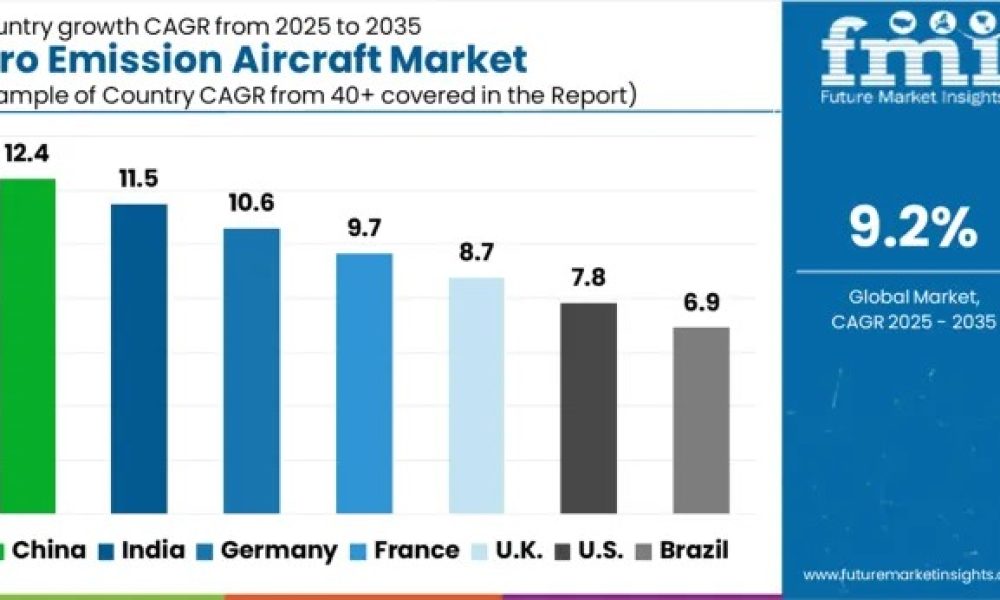
The global zero emission aircraft market is entering a decisive growth phase as the aviation industry intensifies its shift toward low-carbon and sustainable flight solutions. Valued at USD 10.7 billion in 2025, the market is projected to reach USD 25.8 billion by 2035, expanding at a robust compound annual growth rate (CAGR) of 9.2%. This growth reflects structural changes in aircraft propulsion, regulatory pressure to decarbonize aviation, and rising investments across electric and hydrogen-powered aircraft platforms.
Zero emission aircraft currently account for a specialized but rapidly expanding share of the broader aviation ecosystem, representing approximately 3.9% of the global aircraft market and 4.5% of the commercial and regional aviation segment. Within the aerospace propulsion and power systems space, the segment captures 4.1%, underscoring its growing relevance in next-generation aircraft design and energy systems integration. These figures highlight a market transitioning from experimental programs toward early-stage commercialization.
Asia-Pacific Drives Market Value Expansion
Regional analysis reveals pronounced disparities in growth trajectories. Asia-Pacific is expected to emerge as the dominant contributor to market value by 2035, driven by rapid expansion of commercial aviation infrastructure, rising air travel demand, and strong government backing for sustainable aviation technologies. Airlines and regional carriers in Asia-Pacific are actively exploring battery-electric and hydrogen-powered aircraft to serve short- and medium-haul routes, where operational feasibility is already proven.
Investments in aerospace manufacturing hubs, combined with policy frameworks supporting low-emission aircraft deployment, are accelerating adoption. Countries such as China and India are exhibiting double-digit growth rates, supported by domestic aircraft development programs, clean energy initiatives, and growing emphasis on reducing aviation-related emissions. As a result, Asia-Pacific is expected to account for a disproportionate share of incremental market value over the forecast period.
Get access to comprehensive data tables and detailed market insights — request your sample report today!
https://www.futuremarketinsights.com/reports/sample/rep-gb-25162
Europe and North America Sustain Technology-Led Growth
Europe maintains a steady and regulated growth profile, supported by stringent environmental standards, financial incentives for green aviation, and early adoption of zero-emission technologies by established aerospace manufacturers. While regulatory clarity and public funding provide stability, growth in Europe is moderated by higher compliance costs and relatively slower fleet replacement cycles. Nevertheless, Europe continues to play a critical role in advancing hydrogen propulsion, hybrid-electric aircraft platforms, and certification frameworks.
North America demonstrates moderate yet technologically advanced growth, underpinned by strong research and development activity, early-stage deployment programs, and significant investments by aerospace OEMs and startups. Adoption is partially constrained by the size of the existing fleet and extended certification timelines, but the region remains a key innovation hub, particularly for electric propulsion systems, hybrid architectures, and urban air mobility concepts.
Battery Electric Aircraft Lead Early Commercialization
By aircraft type, battery electric aircraft dominate the market with a 41.8% revenue share in 2025, reflecting their suitability for short-haul and regional operations. Advances in battery energy density, charging speed, and cycle life have significantly improved the commercial viability of electric aircraft. Industry trials indicate lower operating costs, reduced noise levels, and simplified maintenance compared to conventional combustion engines, making battery electric aircraft attractive for regional carriers, charter operators, and pilot training applications.
Streamlined certification pathways for electric propulsion systems have further supported time-to-market advantages, positioning battery electric aircraft as the leading segment in the early phases of zero-emission aviation deployment.
Turboprop Configurations and Smaller Capacity Aircraft Gain Traction
From a configuration perspective, turboprop aircraft account for 36.5% of market revenue, benefiting from their efficiency on regional routes and compatibility with electric and hybrid-electric powertrains. Manufacturers are leveraging existing turboprop platforms to integrate zero-emission propulsion, reducing development risk and accelerating commercialization timelines.
By capacity, the 9 to 30 passenger segment represents 29.4% of market revenue, reflecting its commercial practicality for early adoption. Aircraft in this class balance route flexibility, infrastructure requirements, and certification complexity, making them ideal for routes under 500 kilometers. Regional airlines are increasingly targeting this segment to replace aging fleets while meeting emerging emission standards.
Drive Your Business Growth Strategy: Checkout the Report for Key Insights
https://www.futuremarketinsights.com/checkout/25162
Technology Innovation and Infrastructure Development Shape Market Dynamics
The market’s growth is anchored in rapid technological advancement. Hydrogen fuel cells and electric propulsion systems are redefining aircraft design, while lightweight composite materials, aerodynamic optimization, and AI-driven energy management systems are enhancing efficiency and range. At the same time, airports and aviation authorities are adapting infrastructure to support electric charging, hydrogen refueling, and specialized maintenance requirements.
Urban air mobility and regional connectivity are emerging as key application areas, with electric vertical takeoff and landing (eVTOL) aircraft and short-range hydrogen aircraft addressing congestion, noise, and emission challenges in densely populated regions.
Despite this progress, infrastructure readiness, certification complexity, and high upfront investment costs remain structural challenges. Addressing these barriers through public–private partnerships, targeted incentives, and regulatory harmonization will be critical to scaling deployment.
Competitive Landscape Reflects Innovation Intensity
The zero emission aircraft market is characterized by a mix of established aerospace players and agile technology-focused companies. Ampaire Inc., Bye Aerospace, Eviation, Heart Aerospace, Joby Aero, Inc., Lilium GmbH, ZeroAvia, Inc., and Rolls-Royce plc are among the companies actively shaping market direction through electric, hybrid, and hydrogen propulsion programs. Collaborations with government agencies, research institutions, and energy providers are accelerating development, certification, and commercialization efforts.
Outlook
Over the next decade, the zero emission aircraft market is expected to transition from pilot programs to scaled commercial deployment, particularly in regional and short-haul aviation. With Asia-Pacific driving volume growth, Europe reinforcing regulatory and technological leadership, and North America sustaining innovation momentum, the market presents a compelling long-term growth narrative. As propulsion technologies mature and infrastructure gaps narrow, zero-emission aircraft are set to become a foundational element of the future aviation ecosystem.
Why Choose FMI: Empowering Decisions that Drive Real-World Outcomes: https://www.futuremarketinsights.com/why-fmi
About Future Market Insights (FMI)
Future Market Insights, Inc. (FMI) is an ESOMAR-certified, ISO 9001:2015 market research and consulting organization, trusted by Fortune 500 clients and global enterprises. With operations in the U.S., UK, India, and Dubai, FMI provides data-backed insights and strategic intelligence across 30+ industries and 1200 markets worldwide.



