
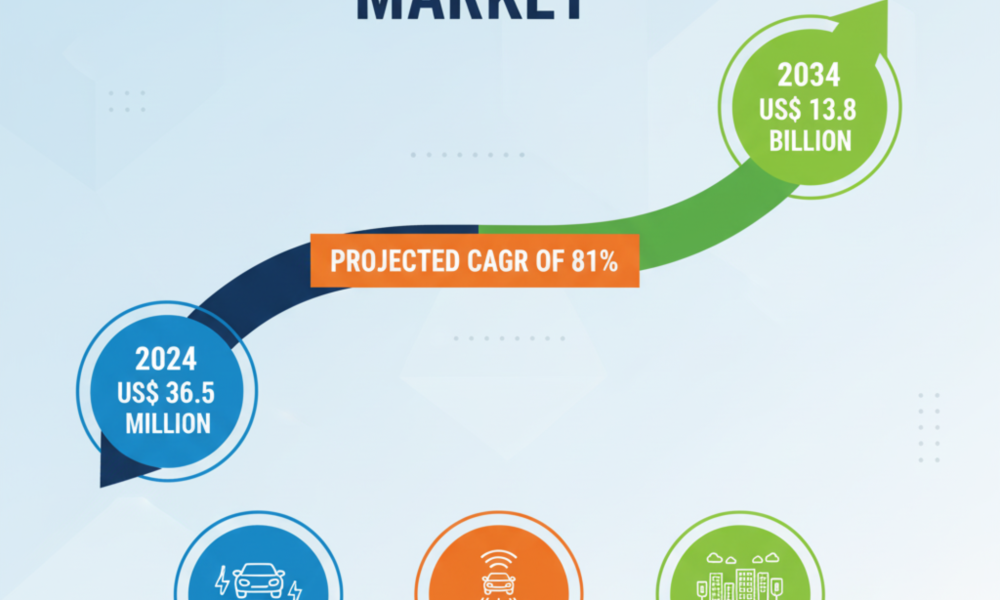
The global wireless car charging market is on an explosive growth trajectory, with its valuation expected to skyrocket from US$ 36.5 million in 2024 to US$ 13.8 billion by 2034. This remarkable expansion corresponds to a compound annual growth rate (CAGR) of 81% over the forecast period from 2024 to 2034. The surge is primarily driven by the accelerating adoption of electric vehicles (EVs) worldwide, fueled by environmental concerns, government incentives, and advancements in charging technologies. As consumers and fleets shift towards sustainable transportation, wireless charging solutions offer unparalleled convenience by eliminating the need for physical cables, addressing range anxiety, and integrating seamlessly into urban infrastructure. This market evolution is also supported by innovations in high-power transfer systems, making wireless charging faster and more efficient, positioning it as a key enabler for the future of mobility.
Wireless Car Charging Market Segmentation and Trends:
The wireless car charging market is segmented by charging type, car type, technology, and region, providing a detailed understanding of its dynamics. Charging types include static and dynamic systems, with static charging dominating for its current practicality in home and public stations, while dynamic charging—enabling on-the-move power—is emerging as a game-changer for highways and fleets. By car type, the market covers electric cars and hybrid cars, where hybrid car charging systems are projected to grow at a CAGR of 82.3%, reaching US$ 10.22 billion by 2034, and electric car charging at 77.5% CAGR. Technologies encompass inductive charging and hybrid-inductive resonance, with inductive leading due to its proven efficiency. Regionally, the market spans North America, Latin America, Europe, East Asia, South Asia & Oceania, and the Middle East & Africa. Key trends include the integration of AI for optimized charging, focus on interoperability standards, and the rise of vehicle-to-grid (V2G) capabilities, alongside sustainable materials to reduce environmental impact.
Full Market Report Available for Delivery. For Purchase or Customization, Please Request Here: https://www.factmr.com/connectus/sample?flag=S&rep_id=9616
Driving Factors Behind Market Growth:
The wireless car charging market is propelled by multiple interconnected drivers. The global push for EV adoption, driven by stringent emission regulations and incentives like tax rebates, is creating massive demand for convenient charging infrastructure. Innovations in resonant inductive coupling are enabling efficient energy transfer over greater distances, supporting faster charging times that align with modern EV batteries. Reduced operational costs for consumers—through lower maintenance and fuel savings—further accelerate uptake. Environmental benefits, such as reduced carbon footprints, resonate with eco-conscious buyers, while collaborations between automakers and tech firms are hastening commercialization. Urbanization and smart city initiatives are integrating wireless chargers into parking lots and roads, enhancing accessibility. Additionally, the growing fleet electrification in logistics and public transport is boosting commercial applications, ensuring sustained market momentum.
Recent Developments and Key Players:
The wireless car charging market is highly competitive, with key players investing heavily in R&D, partnerships, and technological advancements to capture market share. Recent developments highlight the industry’s innovative pace. Startups are differentiating through unique technologies and collaborating with automotive giants to build credibility and accelerate adoption. Leading companies are focusing on improving charging efficiency and developing high-power solutions to meet evolving EV demands. For instance, in early 2024, WiTricity Corporation announced a partnership with a major automaker to deploy dynamic charging systems on test highways, aiming for commercial rollout by 2026. Qualcomm Technologies Inc. launched an upgraded inductive platform with enhanced resonance capabilities, reducing energy loss by 15%. Other notable players include HEVO Inc., Bombardier Inc., TDK Corporation, Evatran LLC, Momentum Dynamics Corp., Toshiba Corporation, Mojo Mobility Inc., Denso Corporation, and ZTE Corporation, which are expanding globally through strategic alliances.
Competitor analysis reveals a focus on scalability and interoperability. Firms are prioritizing standards like SAE J2954 to ensure cross-compatibility, while investing in AI for predictive maintenance and user-friendly apps. Startups like HEVO are disrupting with cost-effective static pads, whereas established players like Denso leverage automotive expertise for integrated vehicle systems. The market is witnessing increased M&A activity, with tech firms acquiring infrastructure specialists to create end-to-end solutions. Sustainability is also key, with companies developing eco-friendly coils and recycling programs to align with green regulations.
Regional Insights and Opportunities:
East Asia is forecasted to command 33.7% of the global wireless car charging market share by 2034, driven by rapid EV adoption in China and Japan. Japan’s market is set to grow at a CAGR of 83.1%, from US$ 3.3 million in 2024 to US$ 1.39 billion by 2034, supported by government incentives and industry collaborations. North America holds strong potential, with the U.S. market expanding at 80.6% CAGR to US$ 2.74 billion by 2034, fueled by tech-savvy consumers and infrastructure investments. Canada’s market is projected at US$ 590.2 million by 2034. Europe, particularly Germany, benefits from financial incentives for EV infrastructure and a robust automotive sector. South Korea’s market is expected to reach US$ 990.6 million by 2034. Emerging regions like South Asia & Oceania and the Middle East & Africa offer opportunities through urbanization and green energy initiatives, with partnerships key to market entry.
Challenges and Future Outlook:
The wireless car charging market faces challenges, including high initial capital costs for infrastructure deployment, which deter widespread adoption due to uncertain short-term returns. Technical hurdles like alignment precision and energy efficiency in dynamic systems remain, alongside regulatory fragmentation across regions. Interoperability issues between different standards could slow integration. However, the future outlook is highly optimistic, with opportunities in emerging markets and technological breakthroughs. Advancements in high-power dynamic charging and V2G integration will transform mobility. As EV sales soar and governments commit to net-zero goals, the market is poised for exponential growth, with strategic innovations and collaborations driving accessibility and sustainability through 2034.
Check out More Related Studies Published by Fact.MR:
Wireless Network Test Equipment Market: https://www.factmr.com/report/wireless-network-test-equipment-market
Wireless Bluetooth Printer Market: https://www.factmr.com/report/wireless-bluetooth-printer-market
Contact:
US Sales Office
11140 Rockville Pike
Suite 400
Rockville, MD 20852
United States
Tel: +1 (628) 251-1583, +353-1-4434-232
Email: [email protected]
About Fact.MR
We are a trusted research partner of 80% of fortune 1000 companies across the globe. We are consistently growing in the field of market research with more than 1000 reports published every year. The dedicated team of 400-plus analysts and consultants is committed to achieving the utmost level of our client’s satisfaction.



