
The global technology landscape is undergoing a fundamental shift as enterprises race to modernize legacy systems, improve agility, and accelerate digital transformation. At the center of this evolution lies cloud microservices architecture, a modular, scalable, and resilient approach to application development that is rapidly replacing traditional monolithic systems.
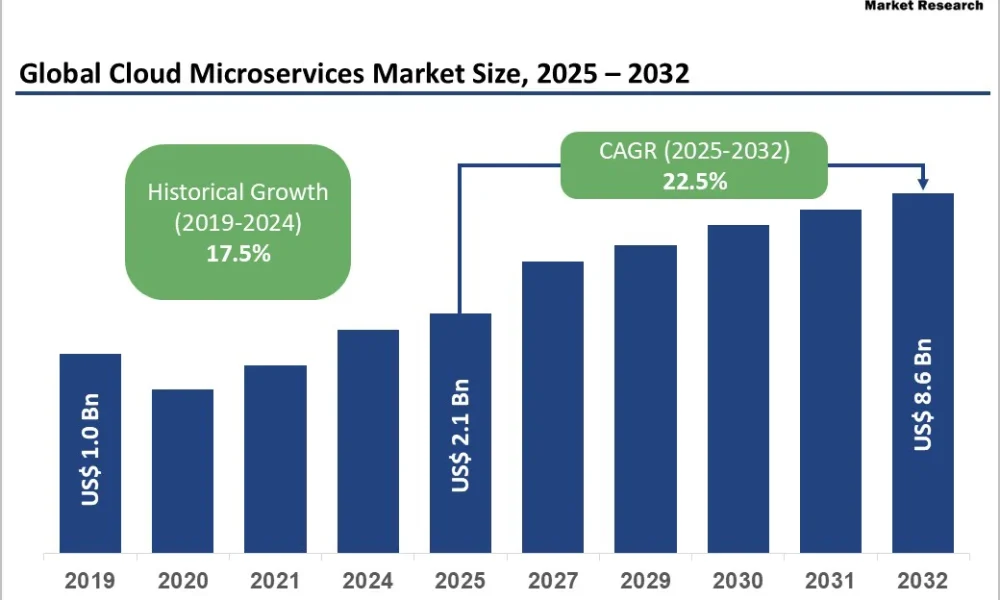
According to recent market analysis, the global cloud microservices market is projected to grow from US$2.1 billion in 2025 to US$8.6 billion by 2032, expanding at a robust compound annual growth rate (CAGR) of 22.5% during the forecast period. This accelerated growth is being fueled by rising demand for application modernization, widespread adoption of containerized deployment models, and the shift toward distributed cloud-native architectures across key industries such as BFSI, healthcare, and retail.
Understanding Cloud Microservices Architecture
Cloud microservices architecture refers to a software development approach where applications are broken into small, independently deployable services, each performing a specific business function. These services communicate through APIs and can be developed, deployed, and scaled independently.
Unlike monolithic architectures—where all application components are tightly coupled—microservices enable organizations to:
- Accelerate development cycles
- Improve system resilience
- Scale specific services without impacting the entire application
- Deploy updates faster and more frequently
When combined with cloud computing, containers, Kubernetes orchestration, and serverless frameworks, microservices form the backbone of modern digital platforms.
Cloud Microservices Market Overview
The cloud microservices market has shown strong momentum over the past decade. From 2019 to 2024, the market expanded at a historical CAGR of 17.5%, driven primarily by early adoption among technology firms, digital-native enterprises, and large-scale e-commerce platforms.
Between 2025 and 2032, growth is expected to accelerate significantly as microservices adoption moves beyond early adopters and becomes mainstream across regulated and traditional industries.
Key Market Metrics at a Glance
- Market Size (2025E): US$2.1 billion
- Market Forecast (2032F): US$8.6 billion
- Projected CAGR (2025–2032): 22.5%
- Historical CAGR (2019–2024): 17.5%
This rapid expansion highlights how cloud microservices have transitioned from an emerging architectural concept to a strategic necessity for enterprise IT.
Key Drivers Fueling Market Growth
- Accelerating Application Modernization Initiatives
Enterprises across industries are modernizing legacy applications to improve performance, scalability, and user experience. Monolithic systems often struggle to support modern digital requirements such as real-time analytics, mobile access, and AI integration.
Microservices allow organizations to incrementally modernize applications by breaking them into smaller services without disrupting core business operations. This phased approach significantly lowers transformation risk and cost.
- Proliferation of Containerized Deployment Models
The widespread adoption of containers and Kubernetes has been a major catalyst for cloud microservices growth. Containers provide lightweight, portable environments that make it easier to deploy and manage microservices consistently across public, private, and hybrid clouds.
As container ecosystems mature, organizations are gaining greater confidence in deploying mission-critical workloads using microservices architectures.
- Shift Toward Distributed and Cloud-Native Architectures
Enterprises are increasingly moving away from centralized infrastructure models toward distributed cloud-native architectures that support global scalability and resilience.
Microservices align perfectly with this trend by enabling:
- Geographic distribution of services
- Improved fault isolation
- Seamless integration with cloud-native tools and services
This architectural flexibility is especially valuable for global enterprises operating across multiple regions and regulatory environments.
- Faster Time-to-Market and Competitive Pressure
In highly competitive markets, speed is a critical differentiator. Microservices enable continuous integration and continuous deployment (CI/CD), allowing organizations to release new features faster and respond quickly to changing customer demands.
This ability to innovate at speed is driving adoption across consumer-facing industries such as retail, fintech, and digital healthcare.
Component Analysis: Platforms Lead, Services Accelerate
Platforms Dominate Market Share
Cloud microservices platforms account for approximately 60% of total market revenue, reflecting strong demand for:
- Container management platforms
- Service mesh solutions
- API management tools
- Cloud-native development frameworks
Hyperscale cloud providers continue to dominate this segment by offering tightly integrated microservices platforms that simplify deployment and management.
Services Segment Shows Fastest Growth
While platforms lead in revenue, the services segment is the fastest-growing category through 2032. As microservices architectures grow more complex, organizations increasingly rely on external expertise for:
- Architecture design and migration
- Integration and orchestration
- Security and compliance
- Performance optimization and monitoring
This trend underscores the growing importance of managed services, consulting, and system integration partners in the cloud microservices ecosystem.
Deployment Mode Analysis: Public Cloud Leads, Hybrid Gains Momentum
Public Cloud Remains the Market Leader
Public cloud deployment holds a commanding 70% market share, driven by:
- Scalability and cost efficiency
- Access to advanced cloud-native tools
- Reduced infrastructure management burden
For startups and digital-native enterprises, public cloud microservices offer a low barrier to entry and rapid scalability.
Hybrid Cloud Emerges as the Fastest-Growing Deployment Mode
Despite public cloud dominance, hybrid cloud is the fastest-growing deployment model through 2032. Growth is driven by:
- Regulatory and data residency requirements
- Need to integrate legacy on-premise systems
- Security and compliance concerns
Industries such as BFSI and healthcare are increasingly adopting hybrid microservices architectures to balance innovation with regulatory compliance.
End-User Industry Insights
BFSI: Market Leader by Revenue
The banking, financial services, and insurance (BFSI) sector commands approximately 28% of total market revenue, making it the largest end-user segment.
Key drivers include:
- Digital banking transformation
- Real-time payment processing
- Fraud detection and risk analytics
- Open banking and API-driven ecosystems
Microservices enable BFSI organizations to deliver secure, scalable, and highly available digital services while meeting stringent regulatory requirements.
Elevate your business strategy with comprehensive market data. Request a sample report now: https://www.persistencemarketresearch.com/samples/35929
Healthcare: Fastest-Growing End-User Segment
Healthcare is expected to register the fastest growth rate through 2032, driven by:
- Electronic health records (EHR) modernization
- Telemedicine and remote patient monitoring
- Interoperability and data exchange requirements
- Compliance with healthcare data regulations
Microservices support modular, interoperable healthcare platforms that can evolve rapidly as regulations and patient needs change.
Retail and E-commerce Adoption Expands
Retailers and e-commerce platforms are leveraging microservices to:
- Personalize customer experiences
- Manage peak traffic during sales events
- Integrate omnichannel services
- Improve supply chain visibility
The need for agility and scalability continues to drive strong adoption in this segment.
Regional Market Outlook
North America Leads the Global Market
North America accounts for approximately 42% of global market share in 2025, supported by:
- Early adoption of cloud-native technologies
- Strong presence of hyperscale cloud providers
- Mature DevOps and software engineering ecosystems
The region remains a hub for innovation in microservices platforms, observability tools, and AI-driven cloud solutions.
Asia Pacific Emerges as the Fastest-Growing Region
Asia Pacific is projected to experience the highest growth rate through 2032, driven by:
- Rapid digital transformation initiatives
- Expanding cloud infrastructure availability
- Growth of fintech, e-commerce, and digital healthcare sectors
Countries such as India, China, and Southeast Asian nations are becoming key growth engines for cloud microservices adoption.
Competitive Landscape and Industry Developments
The cloud microservices market is characterized by intense competition and rapid innovation. Hyperscale cloud providers dominate market revenues, but the ecosystem also includes:
- Specialized microservices platform vendors
- Regional system integrators
- Industry-specific solution providers
Notable Industry Development
In September 2025, HPE and Juniper Networking expanded their collaboration in Saudi Arabia by deploying AI-native cloud infrastructure, aimed at accelerating digital transformation and enhancing network automation and performance. This development reflects growing investment in AI-driven cloud ecosystems across emerging markets.
Key Opportunity: AI-Driven Observability
Among all emerging trends, AI-driven observability stands out as the most attractive growth opportunity.
As microservices architectures scale, monitoring and troubleshooting become increasingly complex. AI-powered observability solutions help organizations:
- Detect anomalies in real time
- Reduce incident response time
- Predict performance issues
- Optimize resource utilization
By lowering operational complexity and improving reliability, AI-driven observability is becoming a critical enabler of large-scale microservices adoption.
Market Challenges to Watch
Despite strong growth prospects, the market faces several challenges:
- Architectural complexity and skill shortages
- Security vulnerabilities across distributed services
- Data privacy and compliance risks
- Integration challenges with legacy systems
Organizations that successfully address these challenges through automation, governance, and skilled partnerships will gain a significant competitive advantage.
Conclusion: A Transformational Decade Ahead
The cloud microservices market is entering a high-growth phase, driven by enterprise modernization, cloud-native adoption, and rising demand for scalable, resilient digital architectures. With the market projected to reach US$8.6 billion by 2032, microservices are no longer optional—they are foundational to digital competitiveness.
As hybrid cloud adoption expands, AI-driven observability matures, and industry-specific use cases deepen, cloud microservices will continue to redefine how organizations build, deploy, and scale applications in the years ahead.
For enterprises, technology providers, and investors alike, the cloud microservices market represents not just growth—but a fundamental shift in the future of software architecture.
Related Reports:




