
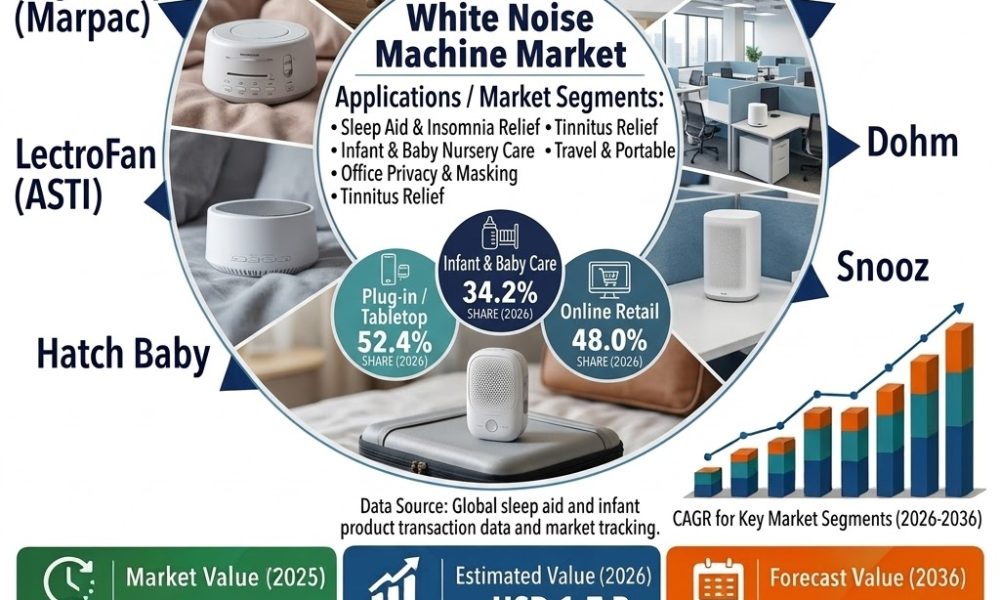
The global White Noise Machine Market is projected to increase from USD 1.7 billion in 2026 to USD 3.2 billion by 2036, expanding at a 6.4% CAGR during the forecast period, according to a new analysis by FactMR. The market was valued at USD 1.6 billion in 2025, creating an absolute opportunity of approximately USD 1.5 billion through 2036.
White noise machines are increasingly purchased for controlled sound masking during sleep, relaxation, concentration, travel and privacy-related use. Buyers are also comparing sound quality, timers, portability, night-light functions and safety guidance before making a purchase, strengthening the role of online product discovery and detailed product information.
Get Detailed Market Forecasts, Competitive Benchmarking, and Pricing Trends: https://www.factmr.com/connectus/sample?flag=S&rep_id=15756
Plug-in machines remain the leading product category
Plug-in Noise Machines are projected to account for 38.5% of the market in 2026, making them the leading product type.
The format continues to suit fixed sleep locations such as bedrooms and nurseries, where users want a device that can operate throughout the night without concerns about battery depletion. Portable models serve travel and flexible-use requirements, while smart connected and combination devices add functions such as timers, sound libraries and night lights.
For brands, the product proposition increasingly depends on demonstrating dependable overnight operation rather than simply adding more sound options. Clear information on power use, controls and safe placement can also influence buyer confidence.
Individual consumers lead end-user demand
Individual Consumers are projected to hold 30.2% share in 2026. Most purchases are self-funded and linked to household needs around sleep, focus or noise disruption.
Adults use white noise to reduce the impact of traffic, sounds from neighboring rooms and workplace distractions. Parents and families represent another important use case, particularly where devices are used as part of nursery and children’s sleep routines.
Institutional demand from hospitality, care facilities and workplace settings provides additional opportunities, but the core purchase cycle remains closely connected to individual sleep and focus needs.
Shambhu Nath Jha, Sr. Consultant at FactMR, states:
“White noise machines continue to gain share as users look for concentration. The stronger brands are focusing on selling a safer, repeatable sleep routine with controls that ordinary households understand.”
Online sales account for more than half of the market
Online sales are projected to account for 57.3% share in 2026, making the channel a central route to market.
Consumers can compare sound profiles, timer settings, portability, night-light features, safety information and reviews before purchasing. This gives smaller brands an opportunity to explain product specifications directly while competing with established manufacturers.
The online channel also increases the importance of clear product-page communication. Brands can differentiate products by explaining sound quality, controls, safe volume guidance and intended use instead of relying on broad wellness claims.
Digital sound generation expands product functionality
Digital Sound Generation is projected to hold 42.8% share in 2026, supported by its ability to deliver multiple sound profiles, timer functions and compact product designs.
Digital machines can provide white noise alongside nature and ambient sounds, while connected models may offer Bluetooth, smartphone or smart-home functionality. Mechanical fan-based machines continue to appeal to buyers who prefer a physical, non-looping sound.
As similar digital features become common across products, competition is expected to shift toward sound quality, simpler controls and clearer safety communication.
Safety guidance becomes important in nursery applications
White noise machines used around infants and children face a different purchase consideration from adult sleep and focus products. Parents may pay closer attention to volume levels, placement and electrical reliability when choosing a device for a nursery.
FactMR identifies nursery-safe volume guidance as an opportunity, particularly in markets where parents seek clearer product information. Brands can strengthen product communication by making volume guidance and power-safety information visible on packaging and online listings.
At the same time, low-cost marketplace products can create price pressure. When several products offer similar sound libraries and timers, consumers may struggle to understand why one device costs more than another.
Adapter reliability and product durability can also influence category confidence, particularly because many machines operate overnight without direct supervision.
USA records the fastest listed country growth
The USA is projected to register an 8.31% CAGR from 2026 to 2036, the highest listed rate among the profiled countries. Demand is supported by online product discovery, adult sleep requirements and an established baby-care market.
Japan follows with a 7.70% CAGR, while Germany is projected to expand at 7.04%. The UK is forecast to grow at 6.40%, followed by Canada at 5.75%, South Korea at 5.09% and Australia at 4.50%.
Country-level adoption conditions differ. In the USA, online reviews and adult sleep applications support demand. Germany places greater emphasis on safety, power reliability and energy use, while Australia’s market includes travel and online specialty retail opportunities.
Japan’s demand is linked to compact sleep products and urban living conditions. In Canada, online discovery and household noise concerns contribute to the category’s development.
Competitive landscape focuses on product proof and buyer trust
The White Noise Machine Market includes HoMedics USA, Conair Corporation, Hatch Ltd., Marpac, LLC (Yogasleep), Snooz, Inc., Adaptive Sound Technologies, Inc. (LectroFan), Sweet ZZZ Mattress and Munchkin, Inc.
Competition is shaped by product functionality, channel access and consumer confidence. Companies are expected to compete around sound quality, ease of use, portability, safety information and reliable overnight operation.
From 2026 to 2036, opportunities are expected across nursery-focused products, travel and remote-work bundles, hospitality and care-facility assortments, and smart connected devices.
Read the full White Noise Machine Market report: https://www.factmr.com/report/white-noise-machine-market
White Noise Machine Market outlook
FactMR’s analysis indicates that the market is developing around a practical product use case: providing controlled sound masking for sleep, focus, relaxation, privacy and travel.
The study covers Product Type, Application, End User, Distribution Channel, Technology and Region. Product coverage includes Plug-in Noise Machines, Portable Noise Machines, Stuffed Animal Noise Machines, Combination Noise Machines and Smart Connected Noise Machines.
Technology analysis includes Digital Sound Generation, Mechanical Sound Generation, Smart Connected Technology, Multi-Sound Technology, Voice Assistant Integration and Adaptive Sound and Automatic Volume Control.
The market assessment uses a hybrid top-down and bottom-up approach incorporating demand indicators, segment mix, country growth, company participation and public evidence.
Other Related Reports:
https://www.newstrail.com/dry-resist-coaters-market/
https://www.newstrail.com/euv-cleaning-skids-market-size/
https://www.newstrail.com/recipe-copilot-software-market-forecast/
About FactMR
FactMR is a market research and consulting firm providing syndicated and customized research across industries. Its research covers market sizing, forecasting, competitive analysis, industry trends and strategic insights for business decision-making.



