
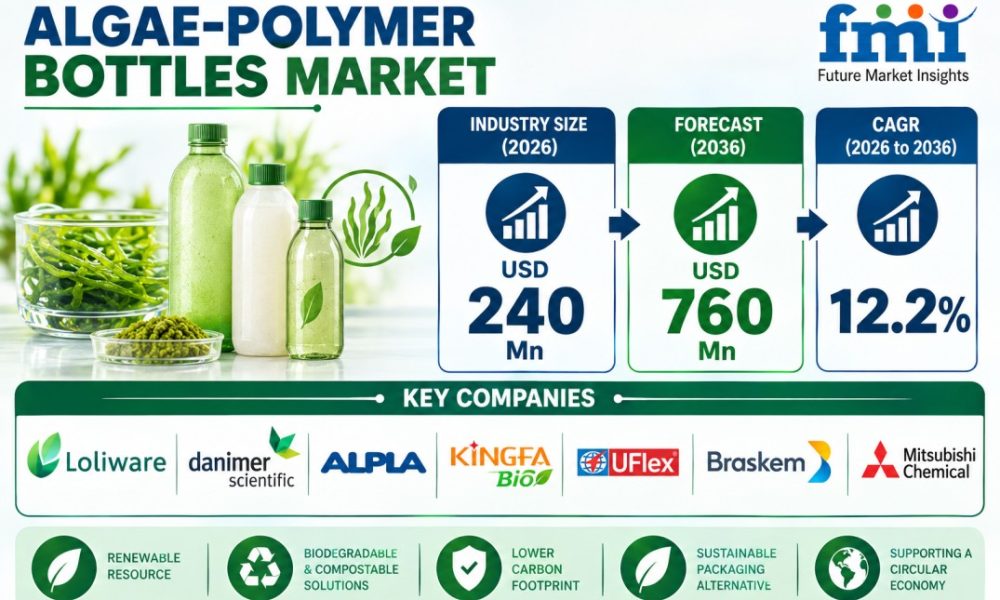
The global algae-polymer bottles market is projected to grow from USD 240 million in 2026 to USD 760 million by 2036, registering a 12.2% CAGR during the forecast period, according to Future Market Insights.
The market is moving beyond pilot-scale applications toward broader commercialization as brands, packaging converters, and material developers seek alternatives to conventional fossil-based plastics. Regulatory pressure, investment in bio-industrial capacity, and demand for renewable packaging materials are supporting this transition.
Algae-derived polymers are attracting attention because they can provide a renewable feedstock pathway for bottle production while supporting biodegradability and other sustainability objectives in selected applications.
>> Get Detailed Market Forecasts, Competitive Benchmarking, and Pricing Trends: https://www.futuremarketinsights.com/reports/sample/rep-gb-31976
Regulation Creates Demand for Alternative Bottle Materials
Plastic reduction policies are among the strongest catalysts for the market.
The European Union’s Single-Use Plastics Directive and related implementation measures are increasing pressure on manufacturers to develop alternatives for single-use beverage packaging.
Algae-based polyhydroxyalkanoates (PHA) and related blends are being explored for applications where barrier and mechanical requirements can be achieved without relying entirely on conventional fossil-based polymers.
Beyond Europe, plastic taxes, extended producer responsibility programs, and requirements related to recycled or bio-based content are influencing packaging procurement.
These measures are encouraging brand owners to diversify sustainable material sourcing rather than rely exclusively on limited post-consumer recycled plastic streams.
Biotechnology and Packaging Engineering Converge
The market is increasingly defined by partnerships between biotechnology companies, material developers, and packaging manufacturers.
In 2024, Danimer Scientific and Loliware announced a collaborative development agreement focused on marine-degradable resins derived from fermented algal oils for extrusion and blow-molding bottle applications.
The collaboration illustrates how material developers are targeting specific high-volume packaging applications rather than developing bio-materials without a defined conversion pathway.
Production scale remains another important consideration. ALPLA Group has highlighted investments in bio-polymer production lines and renewable material research aimed at supporting packaging applications for beverage and personal care brands.
Water and Functional Beverages Lead Initial Adoption
The water and functional beverage segment accounts for 40.0% of the algae-polymer bottles market.
The segment provides a practical starting point because single-use beverage bottles face significant consumer and regulatory attention, while water and functional beverages generally have less demanding gas-barrier requirements than carbonated soft drinks.
Bottles and jars represent the largest packaging format segment at 45.0%.
The focus on bottles also reflects the industry’s objective of demonstrating that algae-based materials can perform through extrusion, blow molding, filling, capping, and distribution.
Algae-based polymers and blends account for 55.0% of the material segment, while bio-polymer extrusion and blow molding also hold a 55.0% share among manufacturing technologies.
Cost Remains a Major Commercial Barrier
Despite growing interest, algae-polymer bottles face a significant cost challenge.
Algae-based polymers currently carry a premium over conventional PET and HDPE. Large-scale biorefineries, improved algal strains, better harvesting methods, and more efficient downstream processing will be important for narrowing this gap.
The availability of industrial composting infrastructure is another constraint. A material designed for biodegradability provides limited practical benefit where appropriate end-of-life facilities are unavailable.
This makes certification, waste-management infrastructure, and regional material specifications important factors in commercial adoption.
India Leads Key Country Growth
India is projected to record the highest CAGR among the key countries covered, at 13.8% from 2026 to 2036.
Growth is linked to plastic waste regulations, domestic bio-processing opportunities, and efforts to develop cost-optimized production using locally available algal feedstocks.
China follows with a projected 12.8% CAGR, supported by its Dual Carbon goals, advanced-material development, and investment in industrial biotechnology.
The United States is projected to grow at 10.5% CAGR, supported by state-level regulation, corporate sustainability commitments, biotechnology development, and venture capital investment.
Germany is expected to expand at 8.6% CAGR, while Brazil and Japan are projected to grow at 8.5% and 6.0%, respectively.
>> Exclusive Discounts on Full Report: https://www.futuremarketinsights.com/reports/algae-polymer-bottles-market
Competitive Landscape Focuses on Scale and Partnerships
Competition in the algae-polymer bottles market is shaped by the ability to combine algal feedstock development, polymer production, processing expertise, certification, and access to major packaging customers.
Strategic partnerships are particularly important because biotechnology companies can provide material and fermentation expertise while packaging and chemical companies provide manufacturing capabilities and market access.
Key players profiled by Future Market Insights include Loliware, Danimer Scientific, ALPLA Group, Kingfa Bio, UFlex Limited, Braskem, and Mitsubishi Chemical Corporation.
Recent developments include Danimer Scientific’s expansion of PHA development capabilities, Loliware’s advancement of its SEA Tech™ seaweed-derived resin platform, and ALPLA Group’s continued investment in circular and bio-based packaging systems.
Outlook for Algae-Polymer Bottles
The algae-polymer bottles market is entering a period in which technical performance and commercial economics will determine how quickly pilot projects become volume applications.
The immediate opportunity lies in applications where sustainability value, regulatory pressure, and material performance can support the transition. Over time, production scale, improved processing economics, and more advanced material structures could broaden the addressable market.
Key Market Metrics
- Market Size, 2026: USD 240 Million
- Projected Market Value, 2036: USD 760 Million
- CAGR, 2026–2036: 12.2%
- Leading End-use Segment: Water & Functional Beverages — 40.0%
- Leading Packaging Format: Bottles & Jars — 45.0%
- Leading Material Segment: Algae-based Polymers & Blends — 55.0%
- Highest Key-country CAGR: India — 13.8%
To explore how FMI Custom Research can support your strategic priorities, connect with our team at – [email protected]
About Future Market Insights (FMI)
Future Market Insights, Inc. is an ESOMAR-certified, ISO 9001:2015 market research and consulting organization trusted by Fortune 500 companies. With a global presence across the U.S., UK, India, and Dubai, FMI delivers data-driven insights across 30+ industries and 1200 markets worldwide.



