
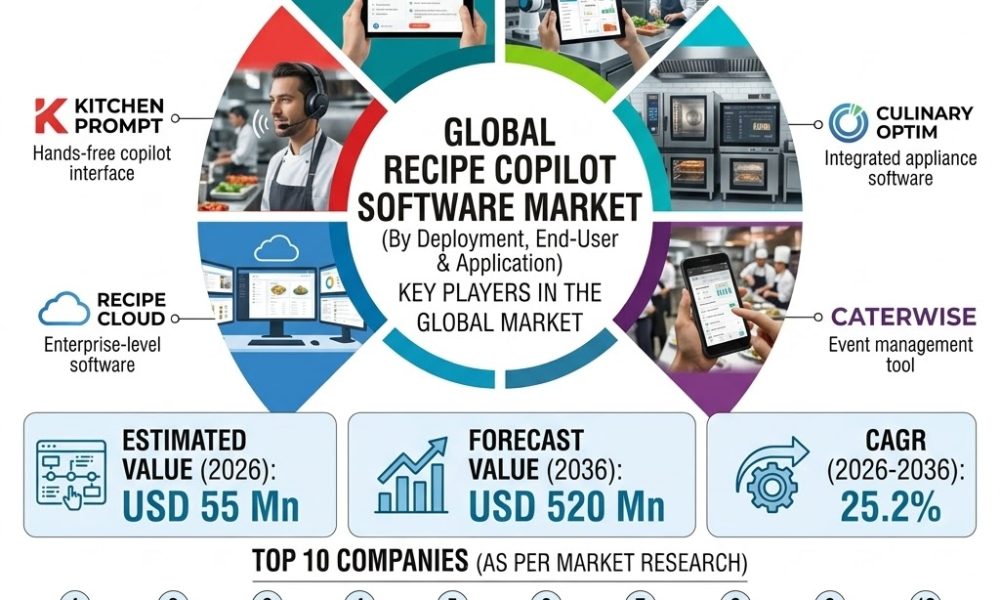
The global Recipe Copilot Software Market is projected to expand from USD 55 million in 2026 to USD 520 million by 2036, registering a 25.2% CAGR over the forecast period, according to Fact.MR. The market reached USD 43.9 million in 2025, creating an absolute opportunity of approximately USD 465 million through 2036.
Recipe copilot software is emerging as a decision-support layer for semiconductor process engineering. These platforms help engineers evaluate recipe settings, structure design-of-experiment (DOE) cycles and identify promising process windows using wafer data, chamber traces and metrology results.
The commercial opportunity is tied less to replacing process engineers and more to reducing the number of experiments needed before a recipe change can be qualified.
Get Detailed Market Forecasts, Competitive Benchmarking, and Pricing Trends: https://www.factmr.com/connectus/sample?flag=S&rep_id=16120
Semiconductor fabs seek faster learning without giving up control
Process development can require repeated split-lot experiments, metrology checks and engineering reviews. Each additional wafer run consumes equipment time and adds to qualification workload.
Recipe copilots address this process by ranking potential settings and suggesting experiments based on previous results. The final decision can remain with the process engineering team.
Shambhu Nath Jha, Principal Consultant at Fact.MR, states:
“Recipe copilots are drawing attention because they turn process learning into a governed workflow. Adoption is expected to rise where fabs connect recommendations to wafer evidence. Qualified platforms combine model transparency, secure deployment and engineer approval.”
This human-approval model is reflected in the market’s maturity structure. Advisory-only deployments are forecast to account for 48.0% of demand in 2026, showing that many fabs are initially using AI as decision support rather than allowing direct recipe control.
Bayesian optimization leads the technology mix
Bayesian optimization is expected to hold 38.0% share of the market in 2026, making it the leading optimization engine.
Its position reflects the need to learn from relatively limited and noisy semiconductor process data. Wafer experiments can be expensive, so optimization systems need to identify useful parameter ranges without requiring large numbers of additional runs.
The approach can help process teams prioritize experiments while maintaining existing qualification procedures.
Other technologies covered by the market include reinforcement learning, LLM-guided DOE and surrogate modelling.
Lithography creates a major recipe optimization use case
By process step, lithography is projected to account for 27.0% share in 2026.
Lithography processes operate within tight overlay, focus and exposure windows. Small recipe changes can affect downstream process stability and yield. Recipe optimization software can help engineers compare controlled experiments and identify useful settings before moving changes toward production qualification.
The broader semiconductor investment environment is supporting demand for these tools. SEMI projected in April 2026 that global 300 mm fab equipment spending would reach USD 133 billion in 2026.
Digital-twin development is another supporting factor. TOKYO ELECTRON LIMITED (TEL) has highlighted the use of digital twins to explore process conditions before actual wafers are processed, creating a potential link between virtual process modelling and recipe optimization.
On-prem deployment remains the preferred model
On-prem deployment is anticipated to account for 51.0% share in 2026.
Recipe histories, chamber traces and metrology results can contain sensitive process information and customer-specific manufacturing knowledge. Keeping optimization software within controlled plant networks allows fabs to manage access to this information while connecting the software more directly with manufacturing systems.
Private-cloud and hybrid deployments remain relevant where semiconductor manufacturers need collaboration across sites without exposing unrestricted recipe data.
For software vendors, data isolation by account, process module and product family is becoming an important consideration during deployment.
Foundries represent the largest end-user segment
Foundries are estimated to account for 41.0% share in 2026.
Foundries manage multiple customer programs, product families and process qualification cycles. This creates a broad requirement for comparing recipe outcomes across different wafers and process modules while retaining traceability.
Recipe copilots can support this environment by organizing historical experiments, ranking possible settings and helping engineering teams identify promising process windows.
Memory makers, R&D and pilot lines, and integrated device manufacturers also form part of the market’s end-user landscape.
USA leads the country growth outlook
The USA is projected to record 27.04% CAGR through 2036, supported by semiconductor investment and digital-twin development.
Taiwan follows at 26.75% CAGR, reflecting its advanced foundry ecosystem and active process-learning requirements. South Korea is expected to grow at 26.70%, while China is projected at 26.69%.
Japan and Israel are forecast to register 26.59% and 26.55% CAGR, respectively.
The country outlook is:
- USA: 27.04% CAGR
- Taiwan: 26.75% CAGR
- South Korea: 26.70% CAGR
- China: 26.69% CAGR
- Japan: 26.59% CAGR
- Israel: 26.55% CAGR
The USA’s market development is linked to domestic memory manufacturing and semiconductor digital-twin initiatives. Taiwan benefits from advanced foundry activity, while South Korea’s large memory manufacturing base creates additional process optimization applications.
Japan’s 2 nm pilot activity and semiconductor equipment expertise support recipe modelling opportunities. Israel’s deep-tech software ecosystem provides another route for fab-adjacent analytics providers.
Human-in-the-loop workflows create commercial opportunities
The next stage of adoption is likely to center on controlled collaboration between optimization software and process engineers.
Private-cloud recipe collaboration can allow teams at multiple locations to share approved learning while maintaining account-level controls. Human-in-loop escalation can provide a documented review path before recommendations reach production tools.
Pilot-line recipe libraries offer another opportunity. They can preserve process-learning records and allow engineering teams to reuse relevant knowledge when equipment or process generations change.
However, process IP restrictions remain a key restraint. Recipe histories can contain highly sensitive customer and manufacturing information. Vendors therefore need clear controls showing where data is stored, who can access it and whether information from separate accounts can influence model outputs.
Production-wafer validation is another barrier. Fabs are expected to require repeatable metrology evidence before allowing recommendation systems to move toward deeper automation.
Semiconductor software providers compete around process integration
The competitive landscape includes companies with capabilities across process control, semiconductor manufacturing software, digital twins, simulation and optimization.
Key companies profiled by Fact.MR include:
- Applied Materials, Inc.
- Lam Research Corporation (Semiverse Solutions)
- Cohu, Inc. (Tignis PAICe)
- Synopsys, Inc.
- TOKYO ELECTRON LIMITED (TEL)
Applied Materials brings process-control and semiconductor manufacturing expertise, while Lam Research’s Semiverse and Fabtex Yield Optimizer activities extend into manufacturing process optimization.
Cohu’s Tignis PAICe adds AI-based process-control and monitoring capabilities. Synopsys provides simulation and modelling capabilities relevant to semiconductor engineering, while TEL has developed digital-twin applications for evaluating semiconductor process conditions.
For vendors, differentiation is increasingly tied to the ability to connect recommendations with actual wafer evidence, equipment data and engineering approval workflows.
About the Recipe Copilot Software Market Report
Fact.MR’s study covers software used to recommend, rank and evaluate semiconductor process recipes using wafer data, chamber traces, metrology results, DOE records and model-based optimization.
The market is segmented by:
- Optimization Engine: Bayesian optimization; reinforcement learning; LLM-guided DOE; surrogate modelling
- Process Step: Litho; etch; deposition; CMP
- Deployment: On-prem; private cloud; hybrid
- End User: Foundries; R&D/pilot lines; memory makers; IDMs
- Maturity: Advisory-only; human-in-loop; closed-loop auto
- Regions: North America; Latin America; Western Europe; Eastern Europe; East Asia; South Asia & Pacific; Middle East & Africa
The assessment draws on 120+ sources, 35+ company portfolios and 25+ countries, along with 20+ industry interviews. The forecast combines software spending, process-control adoption, deployment mix, country activity, segment shares and provider portfolio analysis.
Other Related Reports:
https://www.openpr.com/news/4635437/biodegradable-sulfate-free-thickeners-market-to-grow-at-8-0
https://www.openpr.com/news/4636425/inulin-fos-pectin-blends-market-worth-usd-3-8-bn-by-2036-france
About Fact.MR
Fact.MR is a global market research and consulting firm providing syndicated and customized research across technology, chemicals, healthcare, food, automotive and industrial markets. Its research combines primary interviews, secondary research, company analysis and market forecasting to support business planning and investment decisions.



