
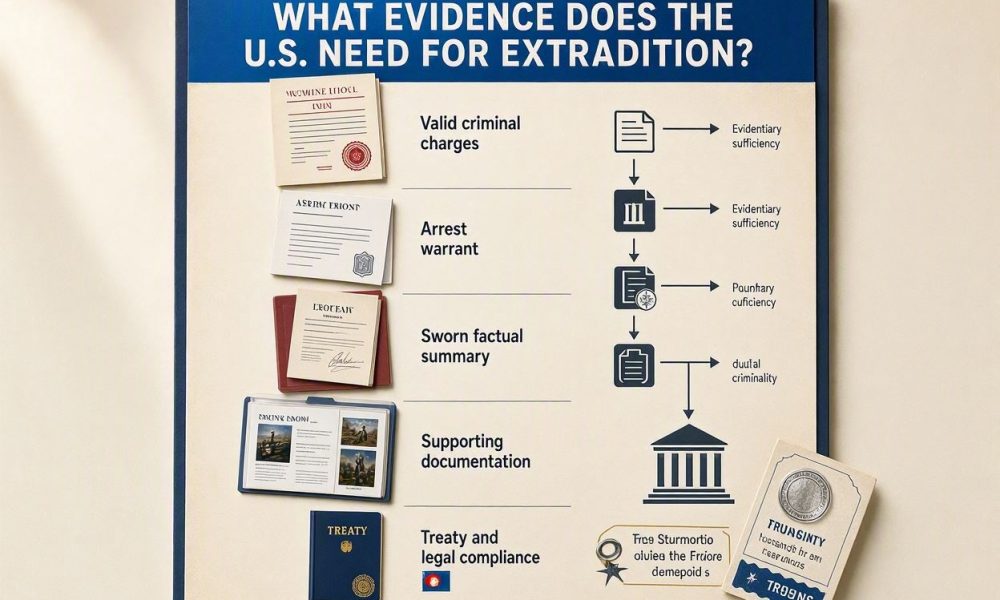
American prosecutors generally must supply judicial records, a clear account of the alleged conduct, reliable identifying information, and supporting material that satisfies the applicable treaty and foreign law, with different requirements for defendants awaiting trial and people already convicted.
WASHINGTON, DC, September 8, 2026
American prosecutors seeking a defendant’s return from abroad generally need a documented criminal case that satisfies the requested country’s Extradition requirements, rather than an arrest warrant accompanied by an expectation that foreign authorities will accept every allegation without examination.
The package commonly includes charging documents, an arrest warrant, factual explanations, relevant criminal statutes, and identifying material, although the precise evidence required depends on the treaty, the foreign legal system, and whether the person has already been convicted.
That qualification matters because Extradition does not operate under a single worldwide evidence standard, and a submission appropriate for one country may require different supporting records, certifications, or explanations before another country can lawfully act upon it.
For families, victims, and businesses following an international prosecution, understanding each document’s role helps explain why locating a defendant is only one stage, and why assembling a legally sufficient Extradition request can require substantial additional work.
The First Question Is Which Legal Standard Applies
Before preparing the evidence package, prosecutors must identify the legal framework governing the request, including the applicable treaty and the requested country’s legislation, because those authorities determine what must be submitted and what the reviewing court must decide.
Terms such as probable cause, prima facie evidence, and sufficient information describe standards that arise in particular legal settings, so using any one of them as a universal description of American Extradition requests would obscure important jurisdictional differences.
A reader should therefore ask which country is considering surrender before assessing a claim that prosecutors have supplied enough evidence, since the strength of a submission cannot be evaluated meaningfully without knowing the legal threshold it must satisfy.
The same caution applies when comparing two widely reported cases, because different outcomes may reflect different procedural rules, treaty provisions, or factual records rather than inconsistent treatment of otherwise identical requests by the same international justice system.
The Justice Department Coordinates the American Submission
The Justice Department’s international Extradition procedures direct prosecutors to work with the Office of International Affairs, which reviews federal requests and advises on the documents needed before the formal submission proceeds through the appropriate diplomatic channels.
Its published framework describes a package that generally includes a prosecutor’s factual explanation, criminal statutes, judicial records, and material establishing identity and the relevant criminal conduct, with different documentation where Extradition is sought following an existing conviction.
The prosecutor remains responsible for preparing the supporting material, so international coordination does not replace the need for an accurate domestic case file or a clear explanation of why the United States is requesting surrender.
For readers following a developing matter, this division of responsibility explains why an investigating agency may announce an overseas arrest before prosecutors have completed the separate diplomatic submission that foreign authorities will evaluate during the Extradition process.
Charges and Warrants Establish the Judicial Foundation
Where the person has not been convicted, certified copies of the complaint or indictment and the arrest warrant ordinarily form an important part of the submission, showing the criminal proceeding and judicial authority underlying the American request.
These records perform related but different functions, because the charging document identifies the alleged offenses. At the same time, the warrant supports the effort to bring the defendant before the court, rather than independently proving every fact necessary for an eventual conviction.
Archived Justice Department guidance highlights problems that can arise when warrants and charging documents describe different offenses, illustrating why prosecutors must explain the relationship between the records instead of assuming that foreign reviewers understand American clerical practices.
In a hypothetical prosecution involving several fraud counts and a later failure to appear, a clear submission would distinguish the underlying allegations from the subsequent procedural event, allowing the requested country to identify the conduct that supports the surrender request.
The Factual Summary Must Make the Case Understandable
A prosecutor’s affidavit or equivalent explanatory submission ordinarily sets out the case history, describes the alleged criminal conduct, and identifies supporting exhibits, giving foreign authorities an organized account of how the judicial documents and factual material fit together.
The Justice Department’s archived drafting guidance emphasizes straightforward language and clear explanations of offenses with features specific to American law, recognizing that unfamiliar terminology can create obstacles when a submission must be translated and assessed within another legal system.
For example, naming a federal wire fraud statute is less practical than describing the alleged misrepresentation, the communication used to advance it, and the defendant’s claimed involvement, while accurately distinguishing evidence from the prosecution’s interpretation.
Clarity should not become exaggeration, because a persuasive summary explains what the available material supports without turning uncertainty into certainty or describing an investigator’s inference as though it were an event personally witnessed by the person signing the statement.
Supporting Evidence Must Connect Conduct to the Person
Depending on the applicable requirements, supporting material may include statements from investigators, witnesses, cooperating participants, or experts, together with documentary records that explain both the alleged offense and the wanted person’s connection to the conduct under examination.
Archived federal guidance on Extradition affidavits treats proof that a crime occurred and identification of the fugitive as the responsible person as related requirements, reinforcing the need to connect the allegation to an individual rather than merely describe wrongdoing.
An illustrative business fraud file might combine an investor’s account of representations, relevant communications, and transaction records. Still, those materials’ usefulness depends on what they establish and whether they are presented in the required form.
A large volume of records should not be confused with a strong explanation, since thousands of pages can leave a central question unanswered if the submission never identifies which document connects a particular defendant to a particular alleged act.
Identity Evidence Answers a Separate Question
Photographs, fingerprints, identifying witness statements, and reliable biographical records can help establish that the person located abroad is the person sought by the American court, with the necessary combination depending on the circumstances and applicable Extradition requirements.
That identification task is distinct from proving participation in the alleged offense, because confirming someone’s name or appearance does not automatically establish that the person committed the conduct described in a charging document or an investigator’s factual summary.
Consider a hypothetical case involving two people with similar names, where a fingerprint comparison might resolve who is before the foreign court while leaving the prosecution’s separate allegation about control of a business account to other supporting evidence.
The distinction is especially useful in public reporting, where a confirmed identity match can be described accurately without suggesting that authorities have also established guilt or resolved every objection the defendant may raise during the Extradition proceedings.
Financial and Digital Records Need Context
Financial records can contribute to an Extradition submission when they are relevant to the alleged offense. Still, a transaction entry alone does not necessarily explain who authorized a payment, what the money represented, or why prosecutors consider it criminal.
In an illustrative investment case, a transfer to a company account might support the payment chronology. At the same time, additional communications or witness information would be needed to explain the alleged deception and the defendant’s responsibility for the transaction.
Digital communications raise similar interpretive questions, because the significance of an email, message, or electronic record depends on its connection to the relevant people and events, not merely on the fact that investigators recovered it during their inquiry.
These examples show why an effective factual presentation explains relationships among records rather than relying on their appearance, helping the reviewing authority understand the alleged conduct while leaving the ultimate trial questions to the court responsible for deciding guilt.
The Criminal Statutes Explain Why the Conduct Qualifies
The submission generally includes the relevant legal provisions defining the offenses and punishment, together with applicable limitation rules so that foreign authorities can assess the legal basis for prosecution and the requirements governing Extradition under the particular arrangement.
Those materials serve a different function from witness evidence because they explain the governing law rather than establish what happened, so the submission must connect the factual allegations to the provisions invoked by the prosecution.
Dual criminality commonly concerns whether the underlying conduct is criminal in both jurisdictions, rather than whether both countries use the same offense name. However, the precise analysis depends on the treaty and domestic law applied to the request.
A useful hypothetical comparison is a deliberately false investment representation described under different fraud statutes in two countries, where differing terminology may be less significant than whether the alleged behavior satisfies the legal requirements governing surrender between those jurisdictions.
British and Canadian Procedures Illustrate the Differences
British government guidance places the United States among designated countries whose requests do not require a prima facie evidentiary showing, while still requiring the prescribed information and judicial examination of the conditions and restrictions governing Extradition under British law.
That distinction does not mean an unsupported demand must be accepted, because the absence of one particular evidence test leaves other statutory requirements in place, including questions about qualifying conduct and legally recognized barriers to the requested surrender.
Canada uses a different framework, including judicial assessment of whether the evidence would justify committal for trial if the alleged conduct occurred there, alongside identification of the person and the separate ministerial stage governing a final surrender decision.
These examples show why a statement that American prosecutors must always prove probable cause in the foreign courtroom is too broad, and why an explanation of Extradition evidence should identify the receiving jurisdiction before describing the required showing.
Summaries May Be Permitted Under Special Evidence Rules
Extradition procedures can permit forms of documentary presentation that differ from the evidence ordinarily introduced at a criminal trial, but whether a summary, certification, or other record is admissible depends on the governing treaty and national legislation.
Canada’s Extradition Act, for example, provides a record-of-the-case mechanism that can summarize evidence available for trial, subject to statutory certification requirements, demonstrating that foreign witnesses do not necessarily need to appear personally during every Extradition hearing.
The practical lesson is that summarizing evidence and dispensing with evidence are different ideas, because an authorized summary still has to meet the requirements governing its use rather than become an unrestricted opportunity to substitute assertion for supporting material.
For defendants and observers, an objection that a document contains secondhand information must therefore be assessed under the applicable Extradition rules, rather than assuming that an objection familiar from a domestic criminal trial will automatically determine admissibility abroad.
A Conviction Changes the Documents Prosecutors Need
When Extradition is sought to enforce an existing sentence, the submission generally focuses on establishing the conviction, the Judgment imposing punishment, the person’s identity, and the portion of the sentence that remains outstanding under the relevant judicial records.
Justice Department guidance on evidence of conviction identifies certified Judgment materials and an explanation of unserved punishment as central components, reflecting a different procedural task from presenting an accusation against someone whose criminal case has not yet reached Judgment.
A hypothetical defendant who served part of a prison term before escaping presents a different record from someone convicted but awaiting sentencing, so the request must describe the actual procedural position rather than apply a generic label to both situations.
Convictions entered without the defendant’s presence can raise additional questions under some Extradition frameworks, making accurate disclosure of how the Judgment arose necessary before the requested country can evaluate any applicable protections or conditions governing surrender.
Certification and Translation Help Courts Evaluate the Records
Certification and authentication requirements address the official status of documents. At the same time, translation allows the requested country to evaluate their contents, making these procedural steps relevant to a submission’s usability rather than merely its presentation or appearance.
A certified record does not automatically establish the truth of every allegation it contains, just as a correct translation does not resolve whether the underlying information meets the evidentiary threshold required for Extradition in the receiving jurisdiction.
In an illustrative file containing a changed indictment and several warrants, consistent document labels and a clear chronology would help prevent confusion about which version is operative, which allegations remain pending, and why different judicial dates appear.
Prosecutors should therefore resolve discrepancies before transmission where possible, because a foreign authority asked to clarify an unclear exhibit may need additional material even when the underlying criminal investigation is extensive, and the defendant’s location is undisputed.
Extradition Approval Does Not Establish Criminal Guilt
The Extradition hearing ordinarily decides whether surrender is legally permissible under the governing framework. At the same time, the criminal trial determines whether the prosecution proves guilt under the trial standard, leaving those decisions with different purposes and potentially different outcomes.
The distinction was evident when British busian American juryy an AmericBritish businessman Mike Lyncher his Extradition. This outcome renewed debate about the bilateral arrangement, as the Financial Times described in its reporting on the Extradition treaty.
That historical example does not establish that the Extradition decision was legally incorrect. Still, it demonstrates why permission to bring someone before a trial court cannot responsibly be reported as a prediction that the prosecution will secure a conviction.
The same principle applies in reverse when surrender is refused, since a decision based on a particular Extradition requirement does not necessarily resolve the merits of the criminal allegation or cancel the judicial proceedings maintained by the requesting country.
Evaluating an Extradition File Requires Defined Expertise
People researching professional assistance can review Amicus International Consulting’s Extradition and INTERPOL service information, which describes an assessment process, while recognizing that any meaningful evaluation must address the specific country, procedural status, and actual documents involved in the matter.
The assessment should distinguish the responsibilities of American criminal counsel from those of a lawyer qualified in the requested country, because evaluating a domestic indictment and interpreting foreign Extradition requirements involve related work within different legal systems.
The wider services advertised by Amicus International Consulting can be considered within that process, with professional qualifications, the scope of representation, and responsibility for reviewing the evidence clarified before a prospective client relies on any proposed course of action.
What the United States ultimately needs is a submission that establishes the required judicial foundation, explains the relevant conduct, identifies the person sought, and satisfies the applicable legal threshold, making the receiving country’s requirements central to every credible Extradition assessment.




