
The wearable biosensors market has rapidly evolved from consumer-focused fitness tracking into a clinically relevant pillar of modern healthcare. Wearable biosensors are compact, non-invasive or minimally invasive devices designed to continuously monitor physiological and biochemical parameters such as glucose levels, heart rate, oxygen saturation, body temperature, and physical activity. These devices integrate seamlessly with smartphones, cloud platforms, and digital health ecosystems, enabling real-time health insights and long-term data-driven care.
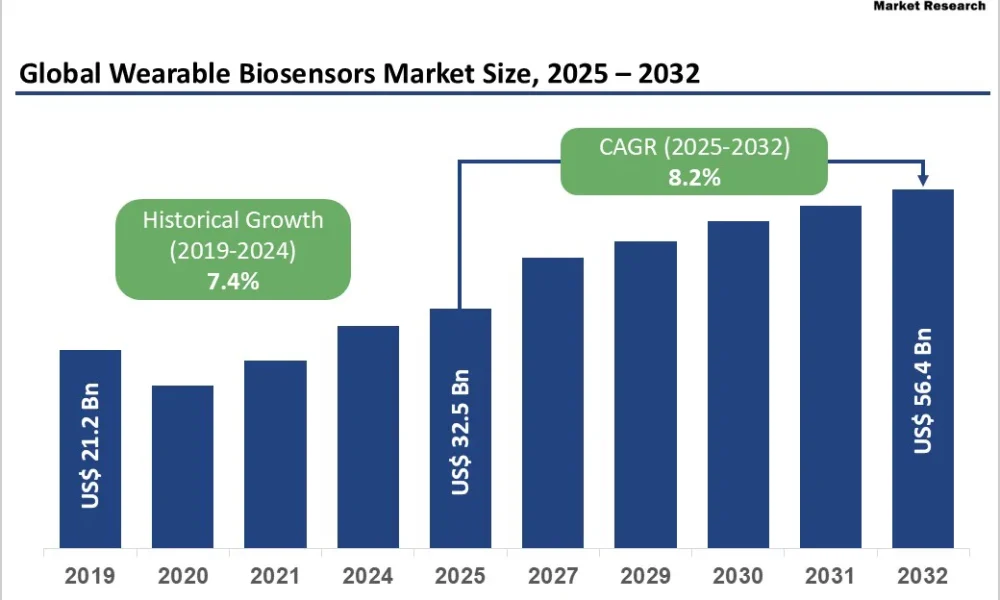
The global wearable biosensors market size was valued at US$ 32.5 billion in 2025 and is projected to reach US$ 56.4 billion by 2032, expanding at a CAGR of 8.2% between 2025 and 2032. This growth reflects the accelerating shift toward preventive healthcare, rising healthcare digitization, and the growing reliance on continuous monitoring solutions for chronic disease management. Unlike traditional diagnostic tools, wearable biosensors offer continuous, personalized, and actionable health data, redefining how patients and clinicians interact with healthcare systems.
Market Statistics and Growth Dynamics
Rising healthcare costs, aging populations, and the increasing prevalence of chronic diseases such as diabetes, cardiovascular disorders, and respiratory conditions are central to market expansion. Globally, healthcare systems are transitioning from episodic care models to continuous and outcome-based care, where wearable biosensors play a critical enabling role. These devices reduce hospital visits, improve treatment adherence, and support early intervention through real-time alerts and predictive analytics.
Technological convergence is further amplifying market momentum. The integration of AI-enabled biosensor technology, advanced signal processing, and cloud-based analytics has transformed wearable biosensors into intelligent, clinical-grade diagnostic tools. Continuous glucose monitoring (CGM), smart ECG patches, and multi-parameter wearable platforms are increasingly being prescribed as part of structured disease management programs. Regulatory agencies are also supporting innovation by accelerating approvals for digital health and remote monitoring devices, creating a favorable ecosystem for market growth.
Key Growth Drivers Shaping the Market
One of the most powerful drivers of the wearable biosensors market is the rising global burden of chronic diseases. Diabetes alone affects hundreds of millions worldwide, creating sustained demand for CGM devices and electrochemical biosensors. Cardiovascular diseases, respiratory disorders, and obesity-related conditions further reinforce the need for continuous monitoring solutions that extend beyond hospital settings.
Another major growth catalyst is the widespread adoption of remote patient monitoring (RPM) and telehealth services. Healthcare providers increasingly rely on wearable biosensors to track patient health remotely, particularly for elderly populations and patients with long-term conditions. This shift improves care efficiency while reducing hospital readmissions. Additionally, growing consumer awareness of personal health, fitness, and wellness is expanding the adoption of wearable biosensors beyond clinical settings into everyday life.
Leading Segment and Dominant Region
Electrochemical biosensors continue to dominate the wearable biosensors market due to their proven accuracy, reliability, and extensive clinical validation. These sensors are widely used in glucose monitoring, lactate measurement, and metabolic health tracking. Continuous glucose monitoring systems remain the cornerstone of this segment, supported by reimbursement policies and strong physician adoption.
From a geographical perspective, North America dominates the global wearable biosensors market. The region benefits from advanced healthcare infrastructure, strong regulatory frameworks, and early adoption of digital health technologies. High R&D investments, robust clinical trials, and the presence of leading market players have positioned North America as the innovation hub for AI-enabled wearable biosensors. Strong integration of telehealth and remote monitoring platforms further strengthens the region’s leadership.
Key Highlights from the Wearable Biosensors Market Report
- • The wearable biosensors market is projected to grow steadily at a CAGR of 8.2% through 2032.
- • Electrochemical biosensors remain the leading product segment due to widespread CGM adoption.
- • Chronic disease management is the largest and most impactful application area globally.
- • North America leads the market, supported by regulatory strength and digital health adoption.
- • Asia Pacific is emerging as the fastest-growing regional market.
- • AI-driven analytics and predictive healthcare models represent a major future opportunity.
Wearable Biosensors Market Segmentation Analysis
The wearable biosensors market is segmented by product type, application, end user, and technology. By product type, the market includes electrochemical biosensors, optical biosensors, piezoelectric biosensors, and others. Electrochemical biosensors dominate due to their sensitivity, cost-effectiveness, and widespread use in glucose and metabolic monitoring. Optical biosensors are gaining traction in heart rate, oxygen saturation, and hydration monitoring applications, supported by advancements in photonics and signal accuracy.
Based on application, the market is segmented into chronic disease management, fitness and wellness monitoring, home healthcare, and clinical diagnostics. Chronic disease management represents the largest segment, driven by diabetes, cardiovascular disorders, and respiratory conditions. End-user segmentation includes hospitals and clinics, home healthcare settings, and individual consumers. Home healthcare and consumer adoption are expanding rapidly as wearable biosensors become more user-friendly, connected, and clinically reliable.
Regional Insights and Market Trends
North America continues to lead the wearable biosensors market due to strong reimbursement policies, rapid technology adoption, and high healthcare spending. The United States, in particular, has seen widespread adoption of CGM devices and cardiac monitoring wearables, supported by insurance coverage and physician acceptance. Strong collaborations between tech companies and healthcare providers further accelerate innovation in the region.
Asia Pacific is the fastest-growing regional market, driven by rising healthcare awareness, large patient populations, and government-led digital health initiatives. Countries such as China, India, and Japan are witnessing rapid adoption of wearable biosensors, supported by expanding manufacturing capabilities and growing investments in health technology startups. Europe also represents a significant market, with increasing adoption of remote monitoring solutions and strong regulatory support for medical devices.
Elevate your business strategy with comprehensive market data. Request a sample report now: https://www.persistencemarketresearch.com/samples/16522
Market Drivers
The wearable biosensors market is primarily driven by the increasing prevalence of chronic diseases and the global shift toward preventive healthcare. Continuous monitoring allows early detection of health anomalies, improving patient outcomes and reducing long-term healthcare costs. The demand for personalized medicine further reinforces the adoption of wearable biosensors as essential diagnostic and monitoring tools.
Technological advancements also play a critical role in market growth. AI-powered data analytics, improved sensor accuracy, and seamless integration with smartphones and cloud platforms have enhanced the usability and clinical relevance of wearable biosensors. These innovations are transforming wearable devices into intelligent health companions capable of predictive insights rather than simple data tracking.
Market Restraints
Despite strong growth prospects, the wearable biosensors market faces challenges related to data privacy and security. Continuous health data collection raises concerns about patient confidentiality, cybersecurity risks, and regulatory compliance. Addressing these concerns requires robust encryption, secure data storage, and transparent data governance frameworks.
Another restraint is the high cost of advanced wearable biosensors, particularly clinical-grade devices such as CGMs and multi-parameter monitors. Limited reimbursement coverage in certain regions and affordability issues in developing economies can restrict market penetration. Additionally, device accuracy, calibration requirements, and user compliance remain critical challenges that manufacturers must address.
Market Opportunities
Significant opportunities exist in the integration of wearable biosensors with AI-driven predictive analytics and population health management platforms. Advanced algorithms can analyze long-term biosensor data to predict disease progression, personalize treatment plans, and reduce emergency interventions. Regulatory support for digital therapeutics further enhances market potential.
Emerging markets represent another major opportunity. Increasing healthcare investments, expanding digital infrastructure, and growing awareness of preventive health in Asia Pacific, Latin America, and the Middle East are opening new avenues for market expansion. Partnerships between global technology companies and local healthcare providers are expected to accelerate adoption in these regions.
Company Insights
The wearable biosensors market is highly competitive, with a mix of established medical device companies and innovative health technology firms driving innovation and expansion.
Key Players in the Wearable Biosensors Market:
- • Abbott Laboratories
- • Medtronic plc
- • Dexcom, Inc.
- • Fitbit (Google)
- • Apple Inc.
- • Samsung Electronics
- • Garmin Ltd.
- • BioTelemetry, Inc.
Recent Market Developments:
Recent advancements include the launch of next-generation AI-enabled continuous glucose monitoring systems with improved accuracy and longer sensor life. Additionally, leading technology companies are expanding partnerships with healthcare providers to integrate wearable biosensors into remote patient monitoring and telehealth platforms, strengthening clinical adoption worldwide.
Reasons to Buy the Wearable Biosensors Market Report
✔ Gain detailed insights into market size, growth trends, and future projections through 2032
✔ Understand key technological advancements shaping wearable biosensor innovation
✔ Identify leading segments and high-growth regional markets for strategic investment
✔ Analyze competitive landscape and recent developments from major market players
✔ Support data-driven business decisions with comprehensive market intelligence
Frequently Asked Questions (FAQs)
How Big is the Wearable Biosensors Market globally in 2025 and beyond?
Who are the Key Players in the Global Wearable Biosensors Market?
What is the Projected Growth Rate of the Wearable Biosensors Market through 2032?
What is the Market Forecast for the Wearable Biosensors Market for 2032?
Which Region is Estimated to Dominate the Wearable Biosensors Industry during the Forecast Period?
Related Reports:




