
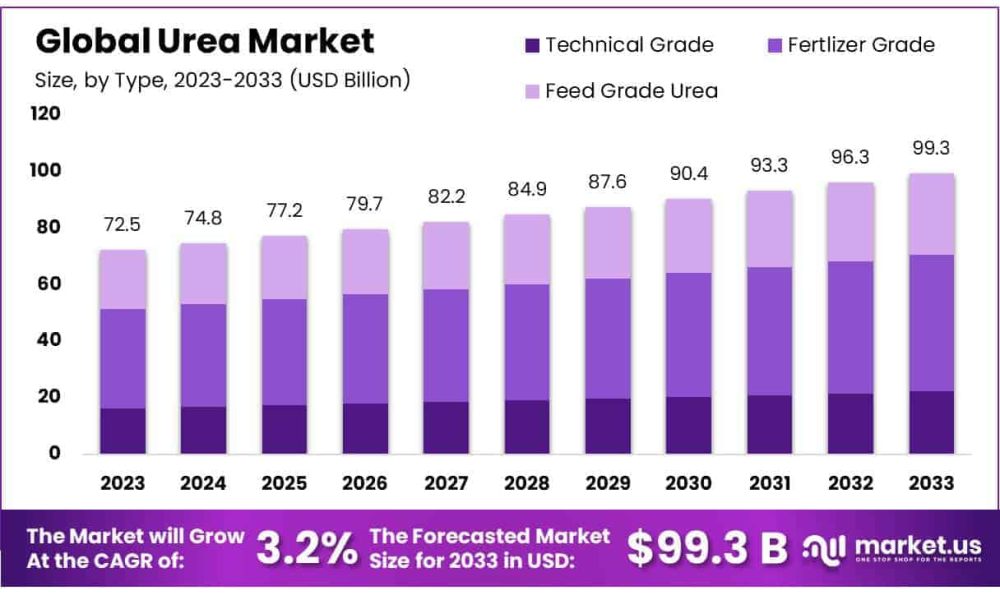
New York, NY – July 17, 2025 – The Global Urea Market is projected to grow steadily, reaching an estimated USD 99.3 billion by 2033, up from USD 72.5 billion in 2023, with a 3.2% CAGR during 2024–2033. This growth is driven by rising demand for urea as a key fertilizer in agriculture, where it boosts crop yields to meet increasing food needs.
The Urea market is also expanding due to urea’s use in industrial applications, such as adhesives, resins, and automotive systems. Growing populations, shrinking arable land, and the need for high-efficiency fertilizers are major growth factors, especially in developing regions like Asia-Pacific and Africa. Additionally, the market benefits from opportunities in eco-friendly urea production and nitrogen-based solutions, aligning with sustainable farming trends.
The popularity of urea remains high due to its cost-effectiveness and versatility, making it a preferred choice over pricier alternatives. Urea Market expansion is further supported by government subsidies for fertilizers and technological advancements in production processes. With increasing industrialization and agricultural modernization, the urea market is set to witness steady demand and new growth avenues in the coming decade.
Important Revelation
- The Global Urea Market Size and Growth: Expected to reach USD 99.3 billion by 2033, growing at 3.2% CAGR from USD 72.5 billion in 2023.
- Above 95% purity dominated the Urea market in 2023, capturing over 42.2% share.
- Fertilizer Grade held the largest Urea market share in 2023, accounting for more than 48.6%.
- Agriculture dominated with over 68.2% The Urea market share in 2023.
- The fertilizer segment held a dominant position with more than 65.5% Urea market share in 2023.
- Asia Pacific region emerges as a dominant force in the urea market, boasting a substantial market share of 43.3%.
➤ Download Exclusive Sample Of This Premium Report (Including Full TOC, Table & Figures): https://market.us/report/urea-market/request-sample/
Report Segmentation
By Purity
In 2023, the Above 95% purity segment led the urea market, holding over 42.2% of the market share. This high-purity urea is favored in agriculture for its efficiency and effectiveness, delivering optimal nutrients to crops for improved growth and yield. Its low impurity levels help protect crop health and maintain soil quality.
The 90-95% purity segment is significant in industrial applications, particularly in producing resins and adhesives like urea-formaldehyde, widely used in woodworking. This purity level strikes a balance between cost and performance, making it a preferred choice for manufacturers.
The below 90% purity segment serves niche industrial uses where high purity is less critical. It is employed in specific chemical processes, lower-grade fertilizers, and pollution control applications, such as urea-based solutions for reducing nitrogen oxide emissions in industrial plants, prioritizing cost over purity.
By Grade
In 2023, Fertilizer Grade urea dominated the market with a 48.6% share, driven by its critical role in agriculture as a high-nitrogen fertilizer. Its ability to dissolve easily and deliver nitrogen efficiently supports plant growth and boosts crop yields, making it a cost-effective choice for farmers globally.
Technical Grade urea, though a smaller segment, is essential in industrial applications, including the production of plastics, adhesives, and chemicals. It meets strict industrial standards and is used in environmental solutions like diesel exhaust fluids to reduce emissions.
Feed-grade urea is used as a non-protein nitrogen supplement in animal feed, particularly for ruminants. It provides a cost-effective nitrogen source that microbes in the rumen convert into protein, supporting livestock nutrition without compromising health.
By Application
In 2023, Agriculture accounted for over 68.2% of the urea market, reflecting its vital role as a nitrogen fertilizer. Urea’s high nitrogen content supports protein synthesis in plants, enhancing crop growth and yield. Its affordability and ease of application—via soil or foliar sprays—make it a staple for farmers worldwide.
The Chemical Synthesis segment, while smaller, is key in producing plastics, resins, and adhesives, particularly urea-formaldehyde for composite wood products like plywood and particleboard. Its versatility ensures steady demand in industrial applications.
Animal Feed is another notable application, where urea serves as a non-protein nitrogen source for ruminants like cattle and sheep. It enhances feed efficiency by increasing protein content, supporting cost-effective livestock nutrition.
By End-Use
In 2023, Fertilizer use dominated the urea market with a 65.5% share, underscoring its importance as a high-nitrogen fertilizer for improving crop yields and soil health. Its cost-effectiveness and versatility in application methods make it a top choice for farmers meeting global food demands.
The Urea Formaldehyde Resin segment, though smaller, is significant in the construction and furniture industries. These resins are used in composite wood products like particleboard and plywood, as well as adhesives and coatings, valued for their strength, water resistance, and affordability.
Market Key Segmentation
By Purity
- Below 90%
- 90-95%
- Above 95%
By Grade
- Technical Grade
- Fertilizer Grade
- Feed Grade Urea
By Application
- Agriculture
- Chemical Synthesis
- Animal Feed
- Others
By End-Use
- Fertilizer
- Urea Formaldehyde Resin
- Others
Regional Analysis
Asia Pacific stands out as the leading region in the global urea market, commanding a significant 43.3% share. The market in this region is projected to reach a valuation of USD 31.4 billion by the end of the forecast period, driven by strong uptake across key sectors such as agriculture, chemical manufacturing, and various industrial applications.
This growth is primarily supported by the major economies of China, India, Japan, and South Korea, where a marked increase in both production and consumption of urea has been observed. These countries are responding proactively to the rising demand for nitrogen-based fertilizers and industrial chemicals, highlighting the region’s strategic focus on advanced manufacturing capabilities and export-oriented growth in the urea sector.
Meanwhile, North America is experiencing consistent growth in its urea market. This progression is fueled by increasing demand from sectors including agriculture, urea-formaldehyde resin production, and automotive emissions control. The region’s broad industrial base, coupled with ongoing innovations in chemical processing technologies, continues to strengthen the adoption of urea across multiple end-use industries.
Competitive Landscape
- Yara International ASA
- SABIC
- Qatar Fertiliser Company
- OCI NV
- CF Industries Holdings, Inc.
- EuroChem Group AG
- Nutrien AG
- Koch Fertilizer, LLC
- Coromandel International Limited
- Acron Group
- Chambal Fertilisers and Chemicals Ltd
- Uralchem Group
- Others
Get in Touch with Us:
Market.us (Powered By Prudour Pvt. Ltd.)
Address: 420 Lexington Avenue, Suite 300, New York City, NY 10170, United States
Send Email: [email protected]
Refer To More Related Reports:
Frozen Seafood Market
Fuel Cell Market
Functional Gummies Market



