
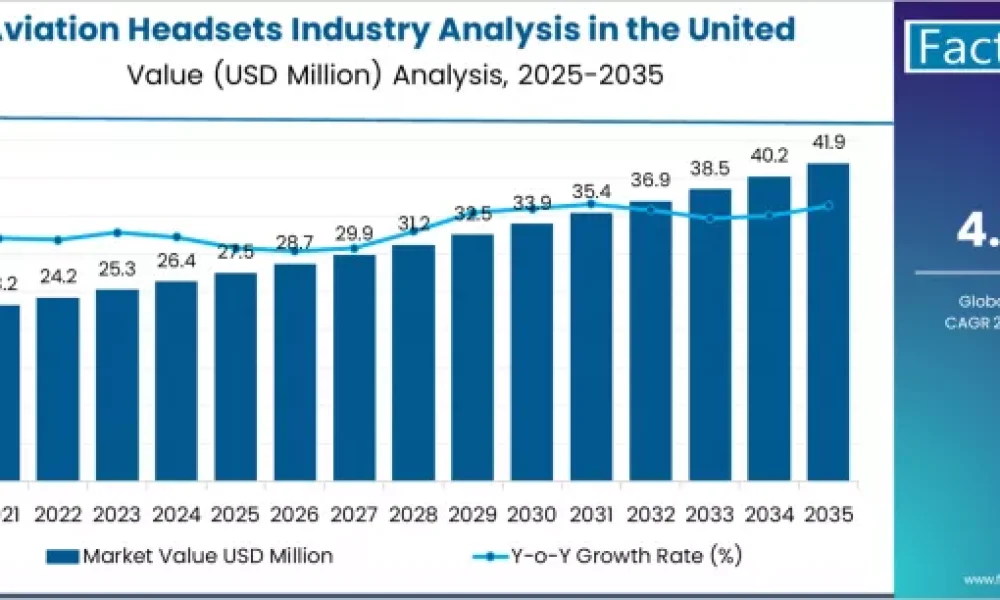
The United Kingdom aviation headsets market is experiencing steady expansion, supported by rising general aviation activity, a growing pilot-training ecosystem, and increasing emphasis on cockpit communication and hearing protection. Industry assessments indicate that the UK segment will continue advancing over the next decade as noise-reduction technologies, digital connectivity, and pilot volumes expand together.
Key Market Insights at a Glance
- UK aviation headsets revenue is expected to reach approximately USD 50.7 million by 2034, reflecting a strong and stable growth trend.
- The UK market is projected to grow at a 7.6% CAGR, one of the highest in Europe.
- Major demand drivers include general aviation and pilot training, both areas with long-standing UK strength.
- Noise-reduction products (ANR and PNR) remain key segments, with wireless and Bluetooth-enabled models gaining traction.
- Key end-users include flight schools, business aviation pilots, and training academies.
To Access the Complete Data Tables & in-depth Insights, Request a Discount on this report: https://www.factmr.com/connectus/sample?flag=S&rep_id=11520
Market Drivers / Growth Overview
- Strong general aviation activity: Thousands of civil aircraft registered across the UK generate consistent headset demand among private pilots and aviation clubs.
- Pilot training expansion: A large and growing student-pilot population drives recurring purchases of reliable, certified headsets.
- Safety and regulatory focus: Communication clarity and hearing protection have become more important, leading operators to adopt higher-performance models.
- Shift toward advanced technologies: Active noise reduction, digital connectivity, and Bluetooth features are becoming standard in premium aviation headsets.
- Comfort and ergonomics: Long-duration cockpit use encourages pilots to upgrade to lightweight, comfortable headsets.
Segmentation & Key Drivers
By Noise-Reduction Type
- Active Noise Reduction (ANR): Preferred in business aviation, flight training, and commercial operations due to enhanced noise isolation.
- Passive Noise Reduction (PNR): Popular among training pilots and cost-conscious general aviation users.
By Connectivity / Design
- Wired Headsets: Dominant due to reliability and cockpit certification standards.
- Wireless / Bluetooth Headsets: Increasingly adopted for integration with electronic flight bags and modern avionics.
By End-Use
- General Aviation: A major segment comprising private pilots, aviation clubs, and training flights.
- Commercial & Business Aviation: Includes pilot training, corporate operations, and simulator use.
Regional & Country Insights
- The United Kingdom benefits from a high number of licensed pilots, numerous flight schools, and strong general aviation infrastructure.
- Southern England and London lead demand due to concentration of business aviation hubs and training centers.
- Scotland, Wales, and regional airports contribute meaningfully through GA clubs and flight academies.
- Compliance with local aviation authorities’ certification standards remains a key requirement for headset manufacturers targeting the UK market.
Competitive Landscape
The UK aviation headsets market is moderately competitive with several global and regional manufacturers supplying high-performance aviation audio equipment. Competition focuses on:
- Introducing certified ANR models suited for training and professional pilots.
- Launching Bluetooth-enabled, lightweight, ergonomic headsets.
- Partnering with UK flight schools to bundle headsets with training programs.
- Strengthening after-sales service, warranty, and repair facilities within the UK.
Major players differentiate through noise-cancellation technology, durability, cockpit certification, and long-duration comfort.
Market Outlook & Strategic Insights
Over the next decade, growth in the UK aviation headsets market will be anchored by expanding pilot-training enrollment, increased private flying activity, and advancements in cockpit communication systems.
Strategic opportunities include:
- Expanding portfolios of ANR + Bluetooth aviation headsets.
- Building long-term relationships with UK flight schools.
- Targeting private pilots with premium, comfort-focused headset offerings.
- Enhancing local service centers for faster repairs and customer support.
- Accelerating product certification processes to meet UK aviation standards.
Companies that invest in comfort, connectivity, certification, and service will be best positioned to capture share in this steadily growing market.
➤Purchase Full Report for Detailed Insights
For access to full forecasts, regional breakouts, company share analysis, and emerging trend assessments, you can purchase the complete report: https://www.factmr.com/checkout/11520
Have specific requirements or need assistance on report pricing or have a limited budget? Please contact [email protected]
Contact:
US Sales Office
11140 Rockville Pike
Suite 400
Rockville, MD 20852
United States
Tel: +1 (628) 251-1583, +353-1-4434-232
Email: [email protected]
➤About Fact.MR:
Fact.MR is a global market research and consulting firm, trusted by Fortune 500 companies and emerging businesses for reliable insights and strategic intelligence. With a presence across the U.S., UK, India, and Dubai, we deliver data-driven research and tailored consulting solutions across 30+ industries and 1,000+ markets. Backed by deep expertise and advanced analytics, Fact.MR helps organizations uncover opportunities, reduce risks, and make informed decisions for sustainable growth.



