

Overview
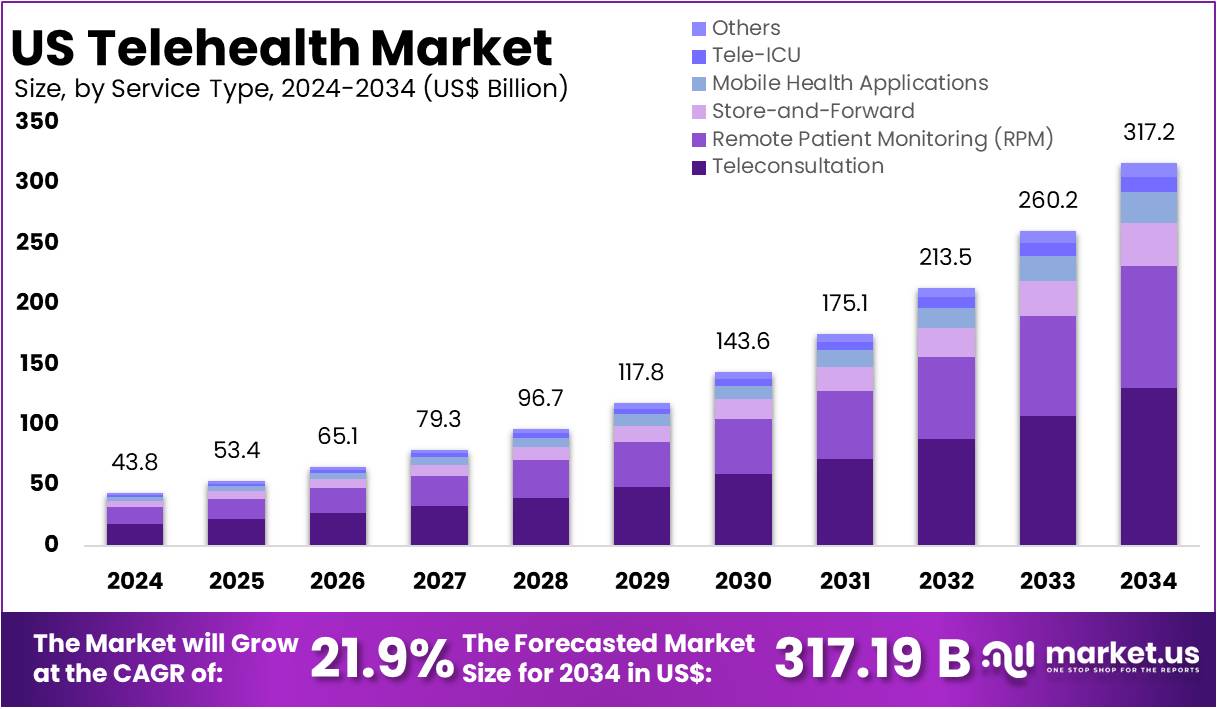
The U.S. telehealth market is projected to reach USD 43.78 billion by 2024. It is expected to grow at a CAGR of 21.9% between 2024 and 2034, reaching USD 317.19 billion by 2034. Telehealth includes virtual consultations, digital health platforms, and remote monitoring solutions. These services improve access to care, especially in rural and underserved areas. They also reduce the need for in-person visits. The market’s growth is driven by technological advancement and changing patient behavior favoring remote healthcare services.
Several key drivers are fueling this growth. These include the rising need for remote patient monitoring, mental health support, and digital primary care services. The increasing prevalence of chronic diseases like diabetes and heart conditions also contributes to higher telehealth usage. In addition, the aging U.S. population requires continuous care, which telehealth can provide efficiently. According to HHS, telehealth visits surged 63-fold during the COVID-19 pandemic, marking a clear shift in healthcare delivery and patient-provider interaction.
Government reforms and financial support have further accelerated the market. Medicare and Medicaid reimbursement reforms, along with the CARES Act, expanded telehealth services nationwide. The FCC announced a $200 million investment in 2023 to enhance rural telehealth infrastructure. This was part of Phase II of the COVID-19 Telehealth Program. Federal backing also supports broadband expansion and EHR interoperability. These efforts improve connectivity and data sharing, which are vital for virtual care delivery across multiple U.S. states.
Despite the strong growth, certain challenges persist. These include the digital divide, especially in remote areas, which limits access to broadband-based telehealth services. Other issues are cross-state licensure restrictions for practitioners and data privacy and cybersecurity concerns. Without uniform standards and interstate licensing agreements, providers face operational hurdles. Patients may also be reluctant to share sensitive health data online. Addressing these barriers is essential to ensure long-term, sustainable adoption of telehealth services across all U.S. regions.
Telehealth is evolving rapidly through AI integration, wearable devices, and behavioral health innovations. Companies like Hone Health exemplify this growth. In January 2025, Hone Health reported over 300,000 patient tests and treatment for more than 55,000 individuals. It also secured $33 million in Series A funding, enabling expansion in longevity-focused care. Backed by major investors, the firm highlights how digital health startups are scaling under strict regulatory standards. This reflects broader market trends toward patient-centric, preventive healthcare solutions.
Key Takeaways
- By 2024, the U.S. Telehealth market is projected to hit USD 43.78 billion, highlighting growing reliance on digital healthcare services across the nation.
- The market is forecasted to expand to USD 317.19 billion by 2034, driven by technological advancements and increased consumer acceptance of virtual care.
- A strong CAGR of 21.9% is expected from 2024 to 2034, reflecting sustained growth and long-term investment confidence in the telehealth industry.
- Teleconsultation leads with a 41.2% market share, supported by rising patient demand for remote general and specialist consultations across various healthcare settings.
- Cloud-based deployment holds a dominant 64.3% market share, favored for its scalability, secure storage, and ease of remote access for providers and patients.
- Telepsychiatry tops the distribution segment with 29.6%, fueled by growing mental health concerns and demand for convenient, stigma-free access to psychiatric services.
- Healthcare providers account for 45.6% of the market, as they increasingly adopt telehealth to enhance care delivery and reduce operational healthcare costs.
Get Sample: https://market.us/report/us-telehealth-market/request-sample/
Segmentation Analysis
Service Type Analysis
Teleconsultation holds the largest share in the U.S. Telehealth Market, accounting for 41.2% of the total. It enables real-time, remote interactions between patients and healthcare professionals using video, phone, or text-based platforms. The convenience of this model, particularly in rural and underserved areas, has fueled its widespread adoption. The COVID-19 pandemic significantly boosted virtual care trends. By 2026, it is predicted that 30% of U.S. medical visits will occur via telemedicine. Teleconsultation supports general healthcare, mental health, follow-ups, and urgent care, making it highly versatile and in demand.
Deployment Mode Analysis
Cloud-based deployment dominates with a 64.3% market share in the U.S. Telehealth Market. These solutions offer secure, real-time data access from multiple locations. Healthcare providers benefit from improved workflow efficiency and reduced infrastructure costs. Cloud platforms are flexible, scalable, and integrate easily with existing systems. This makes them ideal for organizations of all sizes. In April 2025, eClinicalWorks launched its AI-powered contact center at Maryland Endocrine practices. Known as healow® Genie, it enhances patient communication using text, voice, and chatbot channels, improving engagement and access to care.
Application Analysis
Telepsychiatry leads the application segment with a 29.6% market share. The growing demand for accessible mental health services has fueled its expansion, especially post-COVID. Virtual psychiatric consultations allow patients to access care conveniently from home. Insurance coverage and broad provider acceptance support this growth. In September 2024, Talkiatry partnered with BetterHelp to offer in-network telepsychiatry and medication management. Platforms like BetterHelp and Talkspace now use AI-based tools, video sessions, and guided modules to deliver therapy for anxiety, PTSD, and depression, helping patients overcome access barriers and stigma.
End User Analysis
Healthcare providers are the leading end users in the U.S. Telehealth Market, holding a 45.6% market share. Hospitals, clinics, and private practices use telehealth to improve care access and patient outcomes. Providers rely on it for managing chronic diseases, post-surgical care, and remote monitoring. It reduces the burden of in-person visits and increases operational efficiency. Telehealth also boosts patient engagement, especially in underserved regions. As care delivery models evolve, more providers integrate telehealth into routine services, supporting cost-effective treatment and strengthening healthcare systems across the nation.
By Service Type
- Teleconsultation
- Remote Patient Monitoring (RPM)
- Store-and-Forward
- Mobile Health Applications
- Tele-ICU
- Others
By Deployment Mode
- Cloud-Based
- On-Premises
By Application
- Telepsychiatry
- Teleradiology
- Teledermatology
- Teleneurology
- Teledermatology
- Others
By End User
- Healthcare Providers
- Patients
- Payers
- Others
Key Players Analysis
The U.S. telehealth market is driven by several major players offering a wide range of digital healthcare services. Teladoc Health, Inc. is a global leader in virtual care, operating in over 130 countries. The company supports nearly 80 million people, including 56 million paid members in the United States. Its services cover primary care, mental health, dermatology, and chronic condition management. MDLive offers 24/7 access to board-certified doctors and mental health professionals through virtual clinics, making healthcare more accessible across the nation.
Amwell is another major player in the telehealth space, known for its strong network and secure video consultations. The company collaborates with over 55 health plans and 240 major health systems, which include more than 2,000 hospitals. In 2020, more than 40,000 providers were using the Amwell platform, highlighting its widespread adoption. Amwell’s extensive network and partnerships enable it to provide scalable virtual care solutions to a diverse patient base.
Other key participants in the U.S. telehealth market include Doctor on Demand, Lemonaid Health, HealthTap, Babylon Health, and 24/7 MedCare. Companies like Cureatr, SOC Telemed, One Medical, InTouch Health, and Everlywell are also expanding their services. These firms offer specialized and general healthcare through digital platforms. Their contributions are crucial to meeting the rising demand for accessible, cost-effective, and timely medical services in the United States.
Conclusion
In conclusion, the U.S. telehealth market is growing rapidly due to rising demand for remote care, mental health support, and chronic disease management. Advancements in cloud technology and digital tools are helping healthcare providers reach more patients, especially in underserved areas. Government support, along with changes in reimbursement policies, is making telehealth services more accessible and sustainable. Although challenges like internet access gaps and cross-state regulations remain, ongoing innovation and investment continue to shape the future of virtual care. As more providers and patients embrace digital healthcare, telehealth is becoming a vital part of the U.S. healthcare system, offering flexible and efficient care delivery.
Get in Touch with Us:
Market.us (Powered By Prudour Pvt. Ltd.)
Address: 420 Lexington Avenue, Suite 300, New York City, NY 10170, United States.
Contact No: +1 718 874 1545 (International), +91 78878 22626 (Asia).
Email: [email protected]
View More
Digital Assistants in Healthcare Market
Digital Dentistry Market



