

Overview
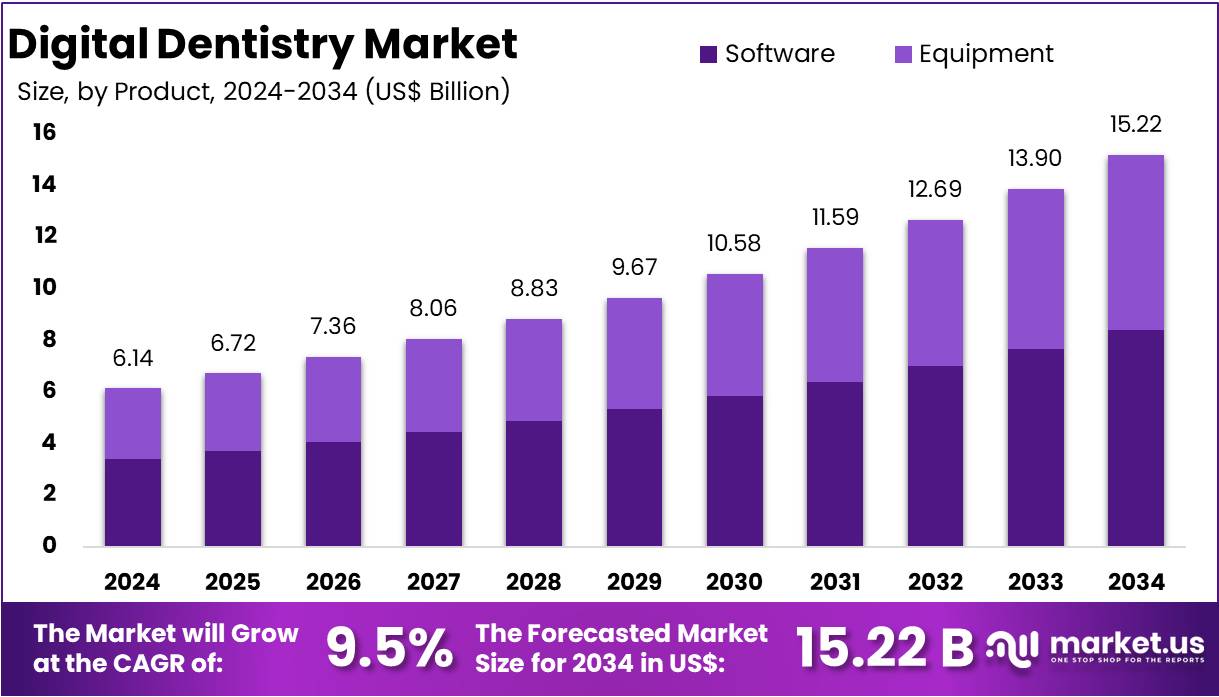
The Global Digital Dentistry Market is projected to reach approximately USD 15.22 billion by 2034, rising from USD 6.14 billion in 2024. This reflects a strong CAGR of 9.5% between 2025 and 2034. North America remains the leading regional market, holding over 39.2% market share, equivalent to USD 2.40 billion in 2024. Digital dentistry refers to the use of computer-aided and digital technologies to improve dental treatments. These technologies help deliver more accurate diagnostics, efficient workflows, and better outcomes for both patients and clinicians.
Market growth is driven by several key factors. Rising demand for aesthetic and restorative procedures is increasing, along with the adoption of minimally invasive treatments. The aging population and growing cases of dental diseases also support demand. Advancements in 3D printing and AI-powered dental software are further accelerating growth. Reduced chair time and the ability to offer customized treatment solutions are improving the overall patient experience. These benefits are encouraging both dental clinics and laboratories to integrate digital technologies into routine workflows.
Despite growth, the digital dentistry market faces notable challenges. High initial investment in digital equipment limits accessibility, particularly for small practices. In addition, specialized training is required to operate and maintain these advanced systems. Workflow inefficiencies may also arise due to integration issues between software and hardware. These barriers slow adoption, especially in emerging markets. However, continuous innovation and the availability of scalable digital solutions are expected to gradually overcome these limitations in the forecast period.
Recent industry developments underscore the momentum in this space. In September 2023, Straumann Group acquired AlliedStar, a China-based digital dental equipment provider. This acquisition expands Straumann’s presence in the Chinese scanner market and strengthens its digital portfolio. Similarly, in September 2022, 3Shape launched the TRIOS 5 Wireless intraoral scanner, offering high accuracy and improved workflow integration. In May 2022, Dentsply Sirona introduced DS Core, a cloud-based platform developed with Google Cloud, aimed at enhancing collaboration and treatment efficiency.
Technological advancements continue to reshape the market landscape. Intraoral scanners are replacing traditional molds, providing comfort and precision. CAD/CAM systems and 3D printing allow for the creation of accurate dental restorations. CBCT imaging and AI-based diagnostics support early disease detection and treatment planning. The growing demand for aesthetic dentistry, laser-assisted minimally invasive procedures, and cloud-based solutions are pushing the market forward. Companies like Medit are expanding their offerings with innovations like the i900 Classic, enhancing digital workflows and user experience globally.
Key Takeaways
- In 2024, the global dental dentistry market was valued at approximately US$ 6.14 billion, indicating steady growth in the sector.
- The software segment led the market by product type, capturing a dominant 55.2% share of the total revenue in 2024.
- Among specialty areas, orthodontics emerged as the leading segment, holding 37.5% of the market share due to rising demand for dental alignment solutions.
- Dental hospitals and clinics represented the largest and fastest-growing end-user group, accounting for 66.8% of the total market share.
- North America held the top regional position in the market, contributing over 39.2% of the global revenue in 2024.
Get Sample: https://market.us/report/global-digital-dentistry-market/request-sample/
Segmentation Analysis
The software segment is projected to dominate the digital dentistry market with a 55.2% share. Its growth is driven by the adoption of CAD/CAM systems and AI-powered diagnostic tools that improve treatment planning and procedural accuracy. These technologies reduce chair time, increase efficiency, and enhance the patient experience. Integrated digital platforms combine patient records, imaging, and treatment planning into a unified system. Continuous advancements in AI and machine learning are also expanding the software segment’s capabilities, supporting diagnostic accuracy and streamlining administrative and clinical workflows in dental practices.
Orthodontics is expected to be the fastest-growing specialty in digital dentistry, holding 37.5% of the market share. The use of 3D imaging and CBCT allows orthodontists to create highly personalized treatment plans. Digital workflows enable virtual simulations, improving communication and patient engagement. Customized appliances such as clear aligners further boost treatment efficiency and comfort. Factors like video conferencing and social media influence are driving increased adult patient demand. FDA-approved innovations, like remote monitoring tools, showcase how digital tools are transforming orthodontic care.
Dental hospitals and clinics lead the digital dentistry market with a 66.8% market share due to their broad service offerings and advanced capabilities. These facilities adopt technologies like intraoral scanners, 3D imaging, and CAD/CAM systems to support complex and routine dental procedures. Their ability to handle large patient volumes and offer comprehensive care positions them as primary adopters of digital tools. Skilled professionals and structured service models, such as dental service organizations, contribute to the successful implementation of advanced technologies and strengthen their dominant market role.
By Product
- Software
- Equipment
- CAD/CAM Systems
- Milling Machine
- 3D Printers
- Others
- Dental Imaging
- Extraoral Imaging
- Panoramic Systems
- Panoramic & Cephalometric Systems
- 3D CBCT Systems
- Intraoral Imaging
- X-ray Systems
- Intraoral Sensors
- Intraoral Photostimulable Phosphor Systems
- Intraoral Cameras
- Extraoral Imaging
- Intraoral Scanners
- Surgical Navigation Systems
- CAD/CAM Systems
Specialty Area
- Orthodontics
- Prosthodontics
- Implantology
- Others
By End-User
- Dental Laboratories
- Dental Hospitals and Clinics
- Others
Regional Analysis
North America is leading the global digital dentistry market, holding a dominant share of 39.2%. This leadership is driven by strong healthcare infrastructure, early adoption of AI-powered dental technologies, and significant R&D investments. The United States plays a key role, reflecting high demand for precision-based dental solutions. A well-connected network of dental professionals and patients supports the adoption of advanced tools. Efficiency, accuracy, and innovation remain top priorities in this region, helping North America maintain a competitive edge in digital dentistry advancements.
The region’s growth is further supported by rising healthcare spending, government support, and favorable reimbursement policies. According to the American Dental Association, dental spending in the U.S. rose by $4 billion in 2023, a 2.5% increase from 2022. This rise was largely due to higher Medicare dental expenses. The demand for aesthetic dentistry, which requires high customization, continues to rise. Moreover, the strong presence of leading market players ensures that North America remains at the forefront of innovation and expansion in the digital dentistry space.
Asia Pacific is expected to record the highest CAGR in the digital dentistry market during the forecast period. Rapid economic growth in India and China is driving investment in healthcare infrastructure and digital technologies. The expanding middle class and rising disposable income are increasing demand for modern dental care. High rates of oral health problems in the region further boost the need for precise treatment solutions. Government-led health initiatives and digital integration are accelerating adoption. In January 2024, Fujitsu began a major oral health campaign among its 70,000 employees in Japan, promoting better dental awareness.
Conclusion
In conclusion, the digital dentistry market is growing steadily due to rising demand for better dental care and advanced technologies. More clinics and hospitals are using digital tools like 3D printing, AI-based software, and intraoral scanners to improve patient outcomes and treatment speed. Although high costs and training needs still limit access in some regions, innovation continues to solve these challenges. North America leads the market due to strong infrastructure, while Asia Pacific shows the fastest growth. As patients seek more comfort, accuracy, and personalized care, digital dentistry is expected to become a core part of modern dental practices worldwide in the coming years.
Get in Touch with Us:
Market.us (Powered By Prudour Pvt. Ltd.)
Address: 420 Lexington Avenue, Suite 300, New York City, NY 10170, United States.
Contact No: +1 718 874 1545 (International), +91 78878 22626 (Asia).
Email: [email protected]
View More



