
Overview
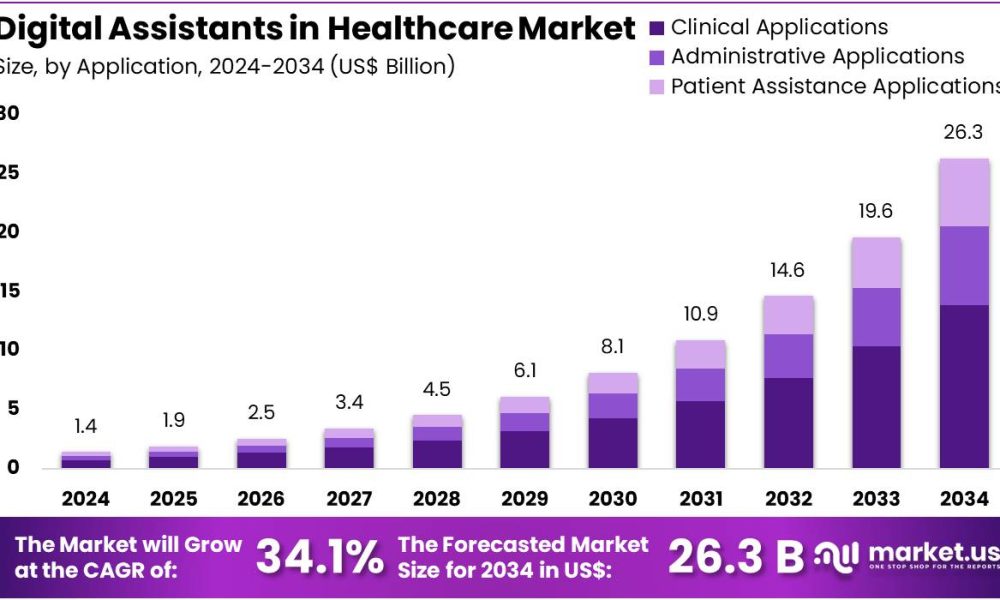
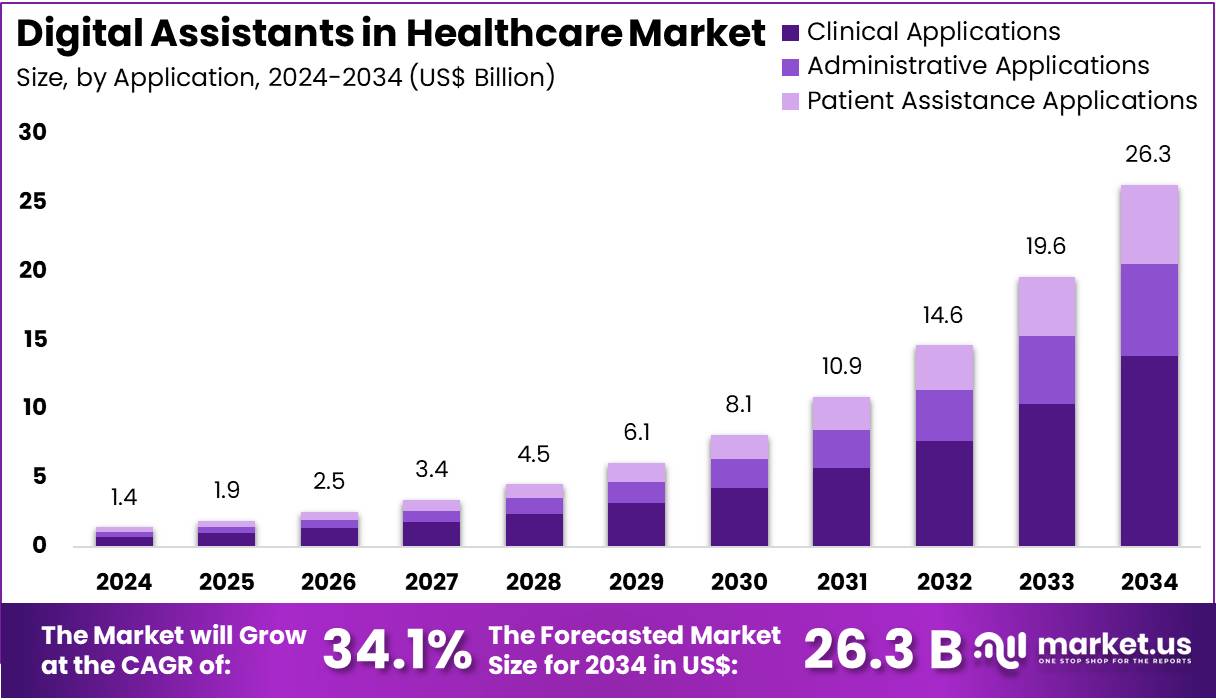
The Global Digital Assistants In Healthcare Market is projected to reach approximately USD 26.3 billion by 2034, up from USD 1.4 billion in 2024. This growth represents a strong CAGR of 34.1% during the forecast period from 2025 to 2034. North America leads the global market with a dominant share of over 42.2%, valued at nearly USD 0.6 billion in 2024. The region’s advanced healthcare infrastructure and rapid digital transformation are key contributors to this leading position.
The increasing use of digital health technologies is one of the main drivers behind market growth. Both patients and healthcare providers are using digital assistants for tasks such as symptom tracking, administrative support, and patient education. These technologies help reduce waiting times, optimize workflow, and improve the delivery of care. Their ability to offer real-time insights makes them a valuable asset in modern healthcare settings. This widespread acceptance is contributing to the rising demand for intelligent support tools.
Digital assistants are playing a growing role in patient-centered care. They are being widely adopted for chronic disease management, mental health assistance, and emergency response services. With recent improvements in AI and machine learning, these tools are now capable of delivering more personalized and efficient services. The healthcare sector is gradually shifting towards technology-driven patient engagement strategies. This shift is expected to continue supporting the market’s expansion in the coming years.
Innovative developments are also contributing to market growth. In September 2023, ADA Digital Health launched a new symptom checker for pregnant women in South Africa. This tool, integrated into the MomConnect program, supports maternal and infant health using mobile-based services. Such initiatives reflect the increasing integration of digital assistants in public health frameworks. The focus on remote care and mobile health services is enhancing accessibility, especially in underserved regions, reinforcing market penetration.
The adoption of AI and automation in healthcare is further driving this market forward. Microsoft saw a 25% increase in healthcare use of its Azure AI services in 2023. Similarly, Nuance Communications, now part of Microsoft, reported a 30% rise in usage of its Dragon Medical One platform in 2022. These tools support clinical documentation and administrative processes. Strong investments from both public and private sectors highlight the growing reliance on digital assistants to improve operational efficiency and patient outcomes.
Key Takeaways
- In 2024, the Digital Assistants in Healthcare market generated US$ 1.4 billion and is projected to reach US$ 26.3 billion by 2034.
- The market is growing at a robust CAGR of 34.1%, driven by increasing adoption of digital health solutions across healthcare systems globally.
- AI-based digital assistants led the product type segment in 2024, accounting for 61.3% of the overall market share.
- Clinical applications dominated the application segment, contributing the highest revenue share of 52.7% in the global digital assistants market.
- Hospitals and healthcare providers were the leading end-users, capturing a significant 49.3% share of the total market revenue.
- North America emerged as the leading regional market in 2024, holding a dominant 42.2% share due to strong digital infrastructure and healthcare innovation.
Get Sample Report: https://market.us/report/digital-assistants-in-healthcare-market/request-sample/
Regional Analysis
North America holds a dominant position in the digital assistants in healthcare market. It accounted for 42.2% of total revenue, driven by the rapid adoption of artificial intelligence (AI) and telehealth services. According to the CDC, telehealth usage in the U.S. rose by 38% in 2023 compared to 2022. Digital assistants played a central role in managing virtual consultations. Furthermore, the National Institutes of Health (NIH) allocated US$ 1.2 billion in 2023 to support AI-driven healthcare tools, including digital assistants for clinical and administrative use.
These AI-powered assistants have been widely adopted to reduce administrative work and improve patient engagement. Their integration into electronic health records (EHRs) enhances diagnostic efficiency and supports personalized care delivery. Strong government support and advanced healthcare infrastructure have positioned North America as a key leader in this space. Healthcare providers across the region continue to invest in digital tools that streamline workflows and improve health outcomes, further strengthening market expansion in the region.
Meanwhile, the Asia Pacific region is expected to record the highest CAGR during the forecast period. This growth is fueled by rising investments in digital health and the growing need for efficient care delivery. The WHO reported a 25% increase in telehealth adoption in Southeast Asia in 2023. Governments in India and China are making major financial commitments, including US$ 500 million and US$ 800 million, respectively, to modernize healthcare systems. These efforts aim to deploy AI-powered digital assistants, supporting diagnostics and patient management across a rapidly expanding healthcare landscape.
Segmentation Analysis
The AI-based digital assistants segment dominated the market in 2023, securing a 61.3% share. This strong growth is attributed to the rising use of AI to enhance healthcare delivery and streamline operations. These assistants support personalized care, offer real-time diagnostics, and automate clinical decisions. As healthcare providers continue adopting advanced digital tools, the demand for AI-based assistants is expected to grow. Integration with electronic health records (EHR) and patient management systems further supports their expansion, making them critical to modern healthcare infrastructure.
Clinical applications accounted for the largest application-based share, with 52.7% in 2023. This was driven by the rising need for digital tools that improve diagnostic accuracy and patient care. Digital assistants are increasingly used to support physicians in diagnosis, treatment planning, and patient monitoring. Their ability to reduce errors and enhance decision-making contributes significantly to better clinical outcomes. As personalized medicine gains momentum, and real-time access to patient data becomes essential, this segment is likely to experience sustained growth.
Hospitals and healthcare providers represented 49.3% of the end-user market, making it the leading segment. This growth is due to increased efforts to improve care quality and operational efficiency. Digital assistants are helping streamline workflows, manage patient interactions, and support decision-making processes. These solutions are especially valuable as hospital systems face administrative challenges and rising patient loads. With a focus on cost reduction and improved patient satisfaction, healthcare providers are expected to continue investing in digital assistant technologies, strengthening this segment’s expansion trajectory.
Product Type
- AI-based Digital Assistants
- User Interface
- Voice-activated Assistants
- Text-based Assistants
- Mode of Delivery
- Web-based
- Cloud-based
- Mobile-based
- User Interface
- Non-AI-based Digital Assistants
Application
- Clinical Applications
- Virtual Health Assistants
- Remote Patient Monitoring
- Diagnosis Assistance
- Prescription Assistance
- Appointment Scheduling
- Administrative Applications
- Scheduling & Appointment Management
- Billing & Claims Assistance
- Healthcare Workflow Automation
- Patient Assistance Applications
- Medication Reminder Systems
- Personalized Health Recommendations
- Post-Operative Care
- Chronic Disease Management
End-User
- Hospitals & Healthcare Providers
- Patients
- Healthcare Staff
Key Players Analysis
Key players in the digital assistants in healthcare market are focusing on integrating advanced technologies like artificial intelligence (AI) and machine learning. These technologies help develop intelligent virtual assistants that improve patient engagement and offer personalized care. Companies are also investing in solutions that streamline workflows and reduce administrative burden. Strategic collaborations with healthcare institutions and hospitals further support the adoption of these tools. Compliance with healthcare regulations and a focus on continuous innovation are key strategies driving long-term growth in this market segment.
IBM Watson Health, based in Cambridge, Massachusetts, is a major contributor to this market. Its Watson Assistant for Health delivers AI-powered support to healthcare providers. The assistant helps manage patient interactions, simplifies administrative processes, and enhances clinical decision-making. The company uses its expertise in AI and data analytics to develop innovative tools for digital healthcare delivery. IBM Watson Health is actively partnering with healthcare providers, payers, and life sciences organizations to expand its presence and drive better outcomes across various care settings.
The digital assistants in healthcare market includes several prominent players. Key companies include Microsoft Corporation, IBM Corporation, Baidu Inc., Babylon Healthcare, Apple Inc., Alphabet Inc., and Ada Health. These organizations are leading innovation in digital healthcare through AI integration and strategic partnerships. Many are targeting emerging markets with growing healthcare infrastructures. Their focus on user-friendly, compliant, and efficient solutions allows them to meet the evolving needs of both healthcare professionals and patients, strengthening their positions in the global market.
Conclusion
Get in Touch with Us:
Market.us (Powered By Prudour Pvt. Ltd.)
Address: 420 Lexington Avenue, Suite 300, New York City, NY 10170, United States.
Contact No: +1 718 874 1545 (International), +91 78878 22626 (Asia).
Email: [email protected]
View More



