
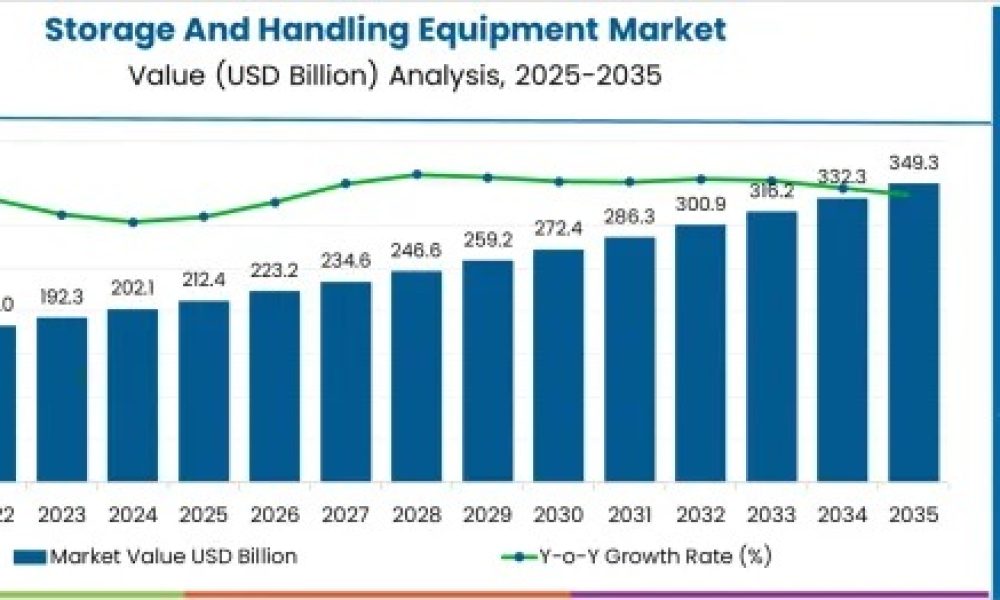
The global Storage and Handling Equipment Market is entering a decisive decade of accelerated transformation as industries prioritize automation, safety, and supply chain efficiency. According to recent projections, the market is expected to reach USD 349.3 billion by 2035, up from USD 212.4 billion in 2025, registering a steady 5.1% CAGR. Growth is reinforced by rising warehousing requirements, manufacturing sector expansion, and the need for optimized material movement across global distribution networks.
Subscribe for Year-Round Insights → Stay ahead with quarterly and annual data updates:
https://www.futuremarketinsights.com/reports/sample/rep-gb-23502
Steady demand throughout the 2025–2030 period is driven by industries modernizing storage layouts and upgrading conventional handling systems. The market grows at a rolling CAGR of 4.2% during these years as businesses focus on space-efficient storage systems, enhanced material flow, and lean manufacturing practices. From 2030–2035, CAGR increases to 6.0%, supported by the adoption of advanced automated solutions, predictive maintenance technologies, and replacement cycles for equipment purchased at the start of the decade.
Key Market Momentum: Why the Sector Is Expanding
The surge in global trade and the increasingly complex nature of supply chains have intensified the need for reliable, scalable storage and handling equipment. Warehousing, logistics, and manufacturing organizations are adopting innovative solutions to manage growing product diversity, inventory fluctuations, and rapid order fulfillment expectations—particularly from the booming e-commerce sector.
To support these evolving requirements, businesses are investing in systems that enhance operational efficiency while ensuring workplace safety. Modular storage equipment, ergonomic handling tools, smart conveyors, AGVs, and automated storage and retrieval systems (AS/RS) remain key investment categories.
Additionally, the shift toward energy-efficient equipment, digital warehouse management, and sustainable infrastructure reflects the market’s broader alignment with global ESG goals.
Market Breakdown: Key Segments Leading Growth
The storage equipment segment is expected to hold 52% of market share in 2025, driven by demand for racking, shelving, vertical storage, and high-density modular systems that maximize floor space and improve inventory visibility.
The manual handling segment maintains a strong 42% share, primarily supported by SMEs and facilities with diversified operational needs. These solutions remain cost-effective, easy to deploy, and well-suited for regions with moderate automation adoption.
Meanwhile, the manufacturing sector leads with 26% market share in 2025, driven by the rise of lean manufacturing, safety compliance requirements, and material staging needs. Automotive, electronics, and heavy industries particularly benefit from integrated handling and storage solutions that streamline workflows.
Regional Growth: Global Hotspots
Emerging economies continue to drive demand:
- China leads with a 6.9% CAGR, supported by large-scale industrialization, e-commerce growth, and logistics modernization.
- India, at 6.4% CAGR, is rapidly adopting organized warehousing, cold chain logistics, and cost-effective handling solutions.
- Germany maintains a strong 5.9% CAGR, reflecting high adoption of robotics, AGVs, and energy-efficient systems.
- The United States, at 4.3% CAGR, remains a mature but steadily growing market driven by omni-channel retailing and the push for advanced AS/RS technologies.
Competitive Landscape: From Mechanical Dominance to Software-Driven Innovation
For decades, the market was anchored by mechanical systems from leading OEMs such as Daifuku, Schaefer Systems International, Dematic, Honeywell Intelligrated, and Toyota Industries Corporation. These companies built the foundation of global material handling through robust mechanical infrastructure—forklifts, conveyors, pallet systems, and AS/RS solutions.
However, the market is undergoing a profound shift.
Emerging companies and tech-driven disruptors are reshaping the competitive environment with autonomous navigation, steer-by-wire systems, cloud-connected platforms, and AI-enabled predictive maintenance technologies. This transition from purely hardware-based systems to integrated hardware-software ecosystems is redefining equipment efficiency, lifecycle cost, and operational intelligence.
Traditional leaders are responding by investing in robotics, IoT-enabled equipment, and digitally managed warehouse ecosystems to maintain their global leadership. The next decade will belong to companies capable of blending mechanical reliability with smart automation and real-time data connectivity.
Get data that aligns with your strategic priorities — ask for report customization today:
https://www.futuremarketinsights.com/customization-available/rep-gb-23502
Have a specific Requirements and Need Assistant on Report Pricing or Limited Budget please contact us – [email protected]
About Future Market Insights (FMI)
Future Market Insights, Inc. (FMI) is an ESOMAR-certified, ISO 9001:2015 market research and consulting organization, trusted by Fortune 500 clients and global enterprises. With operations in the U.S., UK, India, and Dubai, FMI provides data-backed insights and strategic intelligence across 30+ industries and 1200 markets worldwide.
Contact Us:
Future Market Insights Inc.
Christiana Corporate, 200 Continental Drive,
Suite 401, Newark, Delaware – 19713, USA
T: +1-347-918-3531



