
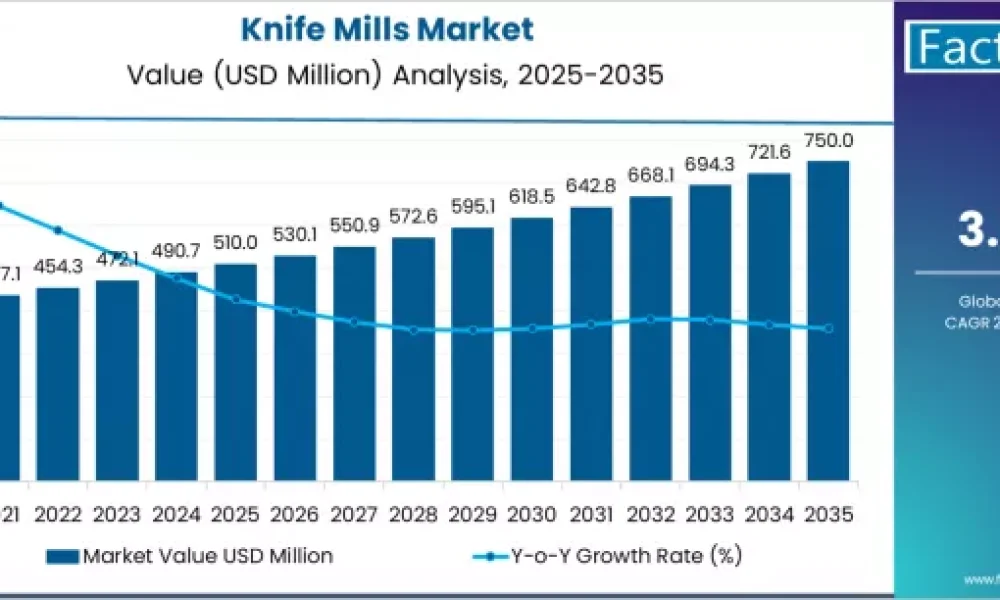
The global knife mills market is projected to grow from USD 510.0 million in 2025 to approximately USD 750.0 million by 2035, recording an absolute increase of USD 240.0 million over the forecast period. This reflects a total expansion of 47.1%, with demand advancing at a CAGR of 3.9% from 2025 to 2035. Growth is shaped by expanding applications in pharmaceuticals, food processing, chemicals, plastics, biotechnology, environmental testing, and material R&D. Knife mills continue to serve as essential equipment for precise, efficient, and reproducible sample preparation across a wide range of laboratory and industrial settings.
Market Size and Growth
Steady global demand is driven by increasing investments in analytical testing, quality assurance, and standardized sample preparation. Knife mills are integral to workflows that require uniform particle size reduction for downstream processing or analysis. Between 2025 and 2035, the market’s sustained 3.9% CAGR reflects growing adoption in both high-throughput laboratories and specialized research facilities, supported by upgrades to precision grinding technologies and enhanced operational reliability.
To access the complete data tables and in-depth insights, request a Discount On The Report here: https://www.factmr.com/connectus/sample?flag=S&rep_id=8577
Key Growth Drivers
• Rising demand for accurate sample preparation: Industries such as pharma, chemicals, food, and environmental sciences rely heavily on precise milling to ensure analytical accuracy.
• Technological upgrades: Integration of variable speed controls, advanced safety features, noise reduction systems, and high-efficiency cutting chambers is improving performance and operator usability.
• Growth in material testing and R&D: Increased research into composites, polymers, biomaterials, and plant-based products boosts the need for flexible and robust knife mill systems.
• Automation and workflow efficiency: Automated feed systems and programmable milling cycles support high-volume laboratory environments.
• Expansion of regulated industries: Stringent quality-control standards in pharma, food safety, and environmental monitoring drive continuous adoption.
Regional Insights
Europe and North America remain key markets due to mature laboratory ecosystems, high R&D intensity, and strong regulatory frameworks. Germany, the U.S., France, and the UK show stable adoption, backed by investments in biotech, chemical testing, and academic research.
Emerging demand across Asia Pacific—particularly China, India, South Korea, and ASEAN—is supported by rapid industrialization, expanding food testing laboratories, and rising pharmaceutical manufacturing capacities. Cost-effective models and modular systems are gaining ground in price-sensitive markets.
Technology Trends and Competition
Manufacturers are focusing on product differentiation through:
• High-performance stainless-steel cutting tools with extended service life
• Modular grinding systems for multi-material compatibility
• Smart controls with digital monitoring and energy-efficient motors
• Enhanced safety interlocks and dust-containment systems
• Portable and benchtop configurations for space-constrained labs
Competition is intensifying, with global laboratory equipment suppliers alongside specialized material-processing manufacturers offering scalable solutions.
Challenges
• Moderate CAGR indicates incremental growth compared with high-tech lab categories
• High equipment costs limit adoption among small labs and academic institutions
• Maintenance requirements and consumable wear can increase operational expenses
• Noise and vibration management remain key concerns for older laboratory infrastructures
• Variability in global standards influences purchasing cycles
Strategic Implications
For manufacturers: Develop modular knife mills that balance precision with affordability. Strengthen offerings in automated, low-maintenance, and energy-efficient systems suitable for both advanced and cost-sensitive markets.
For laboratories and industry users: Upgrade to systems that enhance throughput, reduce sample contamination risks, and support diverse material types.
For investors: The market offers resilient and long-term demand driven by R&D growth, increasing analytical testing, and stricter quality-compliance norms worldwide.
Outlook Summary
From 2025 to 2035, the knife mills market will expand steadily, supported by rising testing and research intensity across pharmaceuticals, chemicals, food safety, environmental science, and advanced materials. Technology innovation, automation, and broader adoption in developing regions will shape the next decade of growth. With a projected value of USD 750.0 million by 2035, the sector presents reliable opportunities for laboratory equipment manufacturers, distributors, and investors focused on strengthening global analytical capabilities.
Have a specific Requirements and Need Assistant on Report Pricing or Limited Budget please contact us – [email protected]
About Fact.MR
Fact.MR is a global market research and consulting firm, trusted by Fortune 500 companies and emerging businesses for reliable insights and strategic intelligence. With a presence across the U.S., UK, India, and Dubai, we deliver data-driven research and tailored consulting solutions across 30+ industries and 1,000+ markets. Backed by deep expertise and advanced analytics, Fact.MR helps organizations uncover opportunities, reduce risks, and make informed decisions for sustainable growth.



