
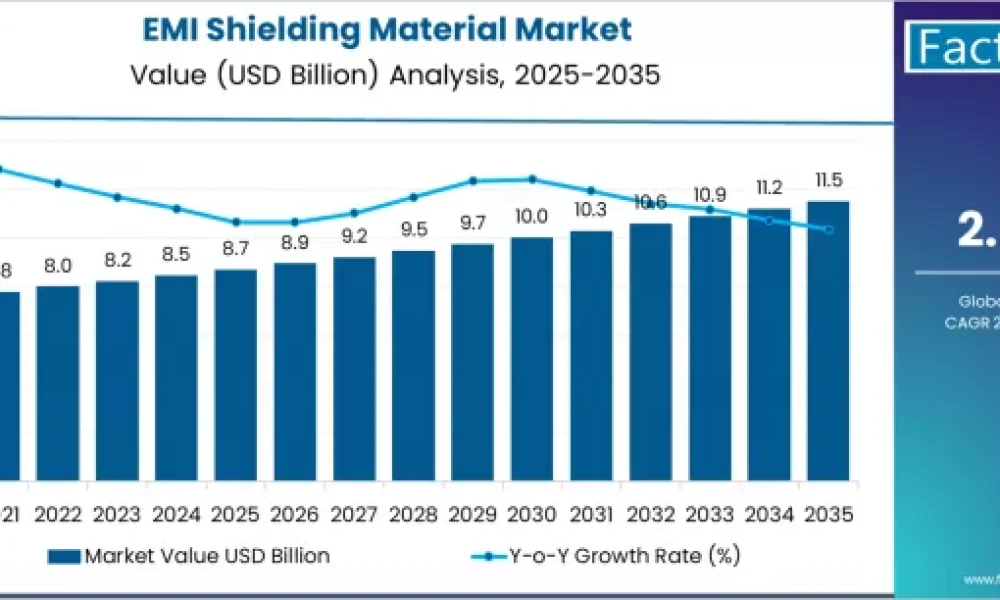
The global EMI shielding material market is set for steady expansion, supported by rapid growth in consumer electronics, rising electromagnetic interference concerns, increasing 5G deployment, and demand for high-performance shielding in automotive electrification and industrial systems. According to the latest analysis by Fact.MR, the market is projected to increase from USD 8.7 billion in 2025 to approximately USD 11.5 billion by 2035, reflecting an absolute growth of USD 2.8 billion, representing total growth of 32.2% at a CAGR of 2.8% from 2025 to 2035.
The increasing complexity of electronic circuits, device miniaturization, and stricter regulatory standards for signal reliability are significantly boosting the demand for advanced EMI shielding materials across both commercial and industrial applications.
Key Market Drivers
Electronics Miniaturization Intensifies Shielding Demand
The ongoing trend toward smaller, faster, and more densely packed electronic components is driving greater susceptibility to electromagnetic disruptions. EMI shielding materials—such as conductive polymers, metal foils, laminates, coatings, and fabrics—are becoming critical in ensuring stable performance in smartphones, wearables, laptops, and smart IoT devices.
With chip-level shielding, component isolation, and RF interference mitigation requirements rising sharply, manufacturers are increasing material adoption for embedded electronic protection.
To access the complete data tables and in-depth insights, request a Discount On The Report here: https://www.factmr.com/connectus/sample?flag=S&rep_id=11947
5G, Telecom Expansion, and Network Stability Requirements
The global rollout of 5G networks and increasing reliance on high-frequency data transmission solutions are key growth accelerators. As 5G infrastructure and connected devices scale up, the demand for shielding materials that prevent cross-interference and ensure signal integrity is gaining traction.
EMI shielding is widely used in:
- Antennas and base stations
- Cellular devices and modems
- Data centers and network equipment
These applications continue to uplift market momentum.
Automotive Electrification and ADAS Adoption
As electric vehicles (EVs), hybrid systems, and Advanced Driver Assistance Systems (ADAS) adopt more sensors, power units, and microcontrollers, the need for EMI protection has become mission-critical. Shielding materials help:
- Prevent interference between vehicle components
- Ensure safe battery and powertrain operation
- Protect radar, LiDAR, and camera systems in connected mobility units
The automotive segment is emerging as a high-priority demand center for durable shielding solutions.
Industrial and Regulatory Reinforcement
Governments and telecommunications, consumer safety, medical, and aviation authorities continue to introduce and tighten electromagnetic compliance norms to prevent device failure, signal loss, and safety incidents. These regulations are motivating manufacturers to integrate EMI shielding solutions more comprehensively.
Regional Market Insights
North America: Innovation and Defense-Grade Adoption
North America remains a leading market due to high-end electronics production, telecommunications infrastructure upgrades, strong R&D investments, and high EMI shielding usage in aerospace, medical, and defense applications.
Europe: Regulations and Automotive Strength
Adoption across Germany, France, the U.K., and Nordic economies is supported by stringent electromagnetic compliance mandates, demand for autonomous car safety modules, and development in connected systems and industrial automation.
East Asia: Major Manufacturing and 5G Consumption Hub
China, Japan, and South Korea continue to dominate the global supply network for EMI shielding materials due to strong electronics exports, semiconductor dominance, advanced component production, and the fastest uptake of 5G infrastructure projects globally.
Emerging Markets: Growing Digital Ecosystem
India, Southeast Asia, the Middle East, and Latin America are witnessing increasing demand driven by:
- Growth of electronics manufacturing clusters
- Smart city investments
- IoT ecosystem expansion
- EV battery and mobility component adoption
Market Segmentation Overview
By Material Type
- Metal-Based Shielding (foils, sheets, meshes) – Highest conductivity and dominant share
- Conductive Coatings & Paints – Rapid adoption due to flexible applications
- Conductive Polymers & Plastics – Growing use in compact electronics
- EMI Shielding Fabrics – Increasing demand in telecom, wearables, and automotive
By End-Use Industry
- Consumer Electronics – Largest revenue contributor
- Telecom & IT – Strong push from 5G and network equipment
- Automotive – Fast-growing with EV and ADAS expansion
- Aerospace & Defense – High-precision interference protection
- Healthcare & Medical Devices – Shielding for imaging and surgical tech
Market Challenges
High Dependence on Metal-Based Shielding
Fluctuating costs of metals such as copper, aluminum, and nickel can impact pricing dynamics and profitability.
Performance vs. Weight Trade-offs
Industries like EVs and aerospace require lightweight yet high-conductive materials, pressing manufacturers to innovate continuously.
Design Complexity in Compact Devices
Integrating EMI shielding into miniaturized circuits while maintaining heat dissipation and form-factor stability remains a technical challenge.
Competitive Landscape
The EMI shielding material industry features established global players focused on product enhancements, conductive material innovation, hybrid shielding solutions, and expansion in 5G supply chains and automotive electronics.
Prominent Companies in the Market
- Laird Technologies
- Parker Hannifin
- 3M Company
- Henkel AG & Co. KGaA
- DuPont
- Schaffner Group
- RTP Company
- ETS-Lindgren
Recent Market Developments
- 2024: Launch of hybrid polymer-metal shielding composites for lightweight electronics
- 2023: Increased large-scale material procurement for 5G base station infrastructure
- 2022: Boost in adoption from automotive suppliers targeting EMI protection for ADAS and EV battery modules
Future Outlook
The coming decade promises continued innovation in EMI shielding solutions, supported by:
- Greater 5G and IoT device adoption
- Increasing electrification in mobility
- Need for secure, interference-free connectivity
- Development of lighter, flexible, and heat-resistant conductive materials
- More sustainable composite shielding systems
As digital ecosystems expand and high-performance electronics multiply globally, EMI shielding materials will remain foundational to signal stability, device reliability, and electromagnetic compliance through 2035 and beyond.



