
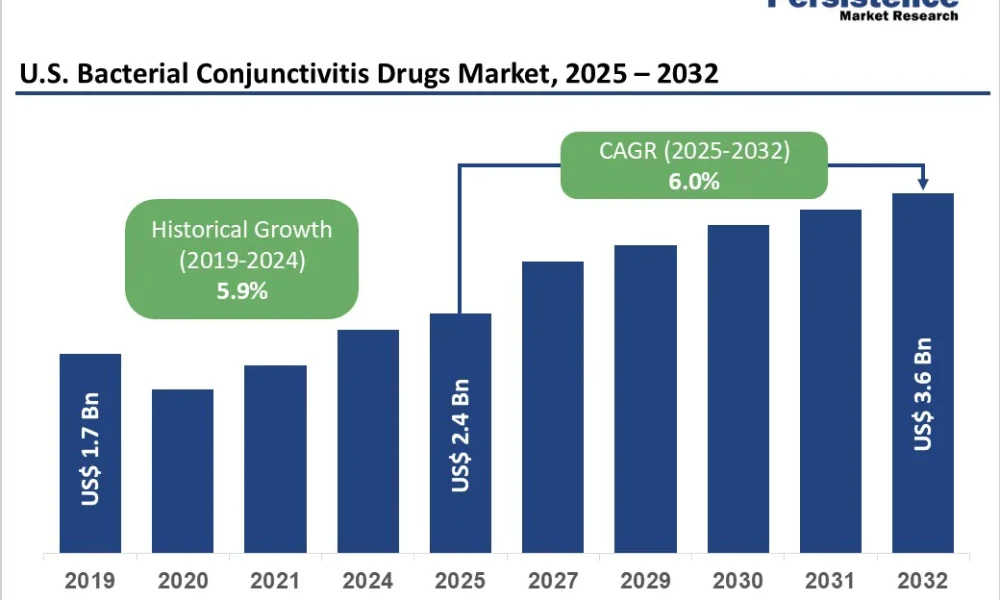
The U.S. bacterial conjunctivitis drugs market has witnessed steady growth over the past decade, driven by the rising prevalence of bacterial eye infections across all age groups. Bacterial conjunctivitis, commonly referred to as pink eye, is among the most frequently diagnosed eye infections in the United States, affecting approximately 135 individuals per 10,000 annually. The market encompasses a range of topical and systemic antibiotic treatments designed to target bacterial pathogens such as Staphylococcus aureus, Streptococcus pneumoniae, and Haemophilus influenzae. Increasing awareness about eye health, the growing incidence of contact lens-related infections, and the emergence of antibiotic-resistant strains have collectively fueled demand for advanced therapeutics in this domain. The U.S. market also benefits from a well-established healthcare infrastructure, advanced ophthalmology practices, and robust reimbursement frameworks that facilitate access to prescription ocular antibiotics.
From a statistical standpoint, the U.S. bacterial conjunctivitis drugs market is projected to grow from a valuation of US$651.6 million in 2025 to approximately US$900.3 million by 2032, representing a CAGR of 4.7% during the forecast period. Acute bacterial conjunctivitis is anticipated to remain the leading indication segment, accounting for nearly 74.3% of market share in 2025 due to its high prevalence in both pediatric and adult populations. Fluoroquinolones are expected to dominate the drug class segment with a 52.1% share, owing to their broad-spectrum activity, rapid clinical efficacy, and physician preference. Topical formulations, which deliver medication directly to the site of infection, are projected to account for 68.8% of total market revenue due to their effectiveness, faster symptom relief, and higher patient adherence. Geographically, North America—particularly the U.S.—continues to lead the global market, supported by the presence of advanced ophthalmic care facilities, increased tele-ophthalmology adoption, and high healthcare spending on eye care.
Download Your Free Sample & Explore Key Insights: https://www.persistencemarketresearch.com/samples/5192
Key Highlights from the Report
• Rising antimicrobial resistance is driving the demand for next-generation antibiotics with novel mechanisms of action.
• Acute bacterial conjunctivitis is projected to dominate the market with a 74.3% market share in 2025.
• Fluoroquinolones are the leading drug class, capturing 52.1% market share due to broad-spectrum efficacy.
• Topical formulations are the most preferred route of administration, holding a 68.8% share.
• Tele-ophthalmology adoption enhances access to remote diagnosis and prescription, improving patient outcomes.
• Rising prevalence of bacterial eye infections across all age groups supports consistent market demand.
Market Segmentation
The U.S. bacterial conjunctivitis drugs market is segmented primarily by drug class, indication, and route of administration. By drug class, fluoroquinolones, macrolides, and aminoglycosides dominate the market, with fluoroquinolones maintaining leadership due to their broad-spectrum efficacy against both Gram-positive and Gram-negative pathogens. Branded fluoroquinolone eye drops such as moxifloxacin and ciprofloxacin are widely preferred for their proven clinical efficacy and rapid symptom resolution. Macrolides, including azithromycin, are used selectively, particularly in pediatric cases, while aminoglycosides are reserved for resistant or complicated infections.
By indication, the market is primarily divided into acute, chronic, and hyperacute bacterial conjunctivitis. Acute bacterial conjunctivitis represents the largest segment due to its high prevalence in children and adults, driving substantial outpatient visits and prescriptions. Chronic and hyperacute conjunctivitis contribute minimally to revenue but require specialized therapeutic strategies for refractory cases. Route of administration also defines market dynamics, with topical antibiotics dominating due to their direct delivery, rapid action, and high patient compliance, while systemic and intravitreal formulations are utilized in severe or resistant infections. End-user segmentation includes hospitals, ophthalmic clinics, and retail pharmacies, with hospitals and clinics accounting for the majority of prescriptions due to direct physician oversight.
Regional Insights
Regionally, the U.S. market demonstrates a robust growth trajectory driven by high disease prevalence and advanced healthcare infrastructure. Tele-ophthalmology adoption is particularly significant, allowing remote diagnosis and prescription of bacterial conjunctivitis drugs, thereby improving access in underserved or rural areas. Major metropolitan centers with high patient volumes, such as New York, Los Angeles, and Miami, have witnessed increased demand for topical antibiotics, supported by both hospital networks and retail pharmacy channels. In addition, federal and state-level initiatives promoting awareness of ocular health and preventive care have further boosted market uptake. Compared to other regions, North America benefits from strong R&D capabilities, advanced pharmacovigilance systems, and favorable reimbursement policies, making it the leading geographical contributor to market growth.
Get Custom Insights Designed for Your Businecss: https://www.persistencemarketresearch.com/request-customization/5192
Market Drivers
Several factors are driving growth in the U.S. bacterial conjunctivitis drugs market. Foremost is the rising prevalence of bacterial eye infections across all age groups, including children in schools, adults with frequent contact lens use, and immunocompromised populations. Increasing antimicrobial resistance (AMR) has also created an urgent need for new antibiotics with enhanced efficacy against resistant strains, incentivizing innovation and investment in next-generation topical therapies. Additionally, patient awareness regarding eye health, convenience offered by topical formulations, and rapid symptom resolution associated with leading drugs such as fluoroquinolones contribute to strong adoption rates. The growing trend of tele-ophthalmology further facilitates timely diagnosis and prescription, reducing complications and expanding the patient base. These factors collectively support sustained revenue growth in the market.
Market Restraints
Despite robust growth drivers, the U.S. bacterial conjunctivitis drugs market faces notable restraints. Patent expiries of major branded antibiotics have opened the market to generic competition, reducing revenue for established products. Generics offer cost-effective alternatives with comparable therapeutic outcomes, which lowers the overall market value for branded drugs. Rising antibiotic resistance also poses a challenge, as strains of Staphylococcus aureus, Streptococcus pneumoniae, and Haemophilus influenzae are increasingly less responsive to first-line treatments, including fluoroquinolones and macrolides. These dynamics limit treatment effectiveness, reduce physician confidence, and highlight the need for continuous innovation to maintain market momentum.
Market Opportunities
The U.S. bacterial conjunctivitis drugs market offers several opportunities for growth. The development of next-generation antibiotics with improved resistance profiles presents a significant commercial opportunity, particularly for fluoroquinolone alternatives and combination therapies that address multidrug-resistant strains. Tele-ophthalmology expansion provides an avenue to reach underserved populations and streamline patient management, improving access and prescription volumes. Additionally, pharmaceutical companies can leverage AI-driven drug discovery, genome mining, and innovative drug delivery systems to introduce novel molecules with enhanced efficacy and safety profiles. Increasing awareness campaigns around eye health and preventive care, coupled with the growing prevalence of acute bacterial conjunctivitis, further support long-term market expansion.
Checkout Now & Download Complete Market Report: https://www.persistencemarketresearch.com/checkout/5192
Company Insights
Key players operating in the U.S. bacterial conjunctivitis drugs market include:
• Novartis AG
• AbbVie
• AdvaCare Pharma
• Bausch + Lomb
• Pfizer Inc.
• Thea Pharma Inc.
• SAVAL Pharmaceuticals
• Harrow, Inc
• Lupin
• STERI-MED PHARMA
• Innoviva Specialty Therapeutics
Recent developments in the market highlight ongoing innovation and clinical advancements:
• In December 2024, NTC announced positive Phase II results for NTC014, a combination eye drop with a quinolone antibiotic and NSAID, demonstrating reduced ocular inflammation and improved outcomes.
• In April 2025, a study published in Scientific Reports analyzing 6,603 FAERS records identified 38 drugs associated with conjunctivitis, underscoring the importance of vigilant pharmacovigilance and targeted ophthalmic therapy development.
Conclusion
The U.S. bacterial conjunctivitis drugs market is poised for steady growth, driven by the rising prevalence of acute bacterial eye infections, increasing antimicrobial resistance, and strong adoption of topical antibiotic therapies. Fluoroquinolones are expected to maintain their dominance due to their broad-spectrum efficacy, rapid clinical outcomes, and strong physician preference, while topical formulations continue to lead the route of administration segment. Market opportunities abound in the development of next-generation antibiotics, tele-ophthalmology adoption, and targeted drug delivery innovations. However, patent expiries and rising antibiotic resistance remain key challenges that require continuous strategic innovation. With ongoing investments in research, enhanced access to care, and growing patient awareness, the U.S. bacterial conjunctivitis drugs market is set to expand robustly, offering significant potential for pharmaceutical companies and healthcare stakeholders alike.




