
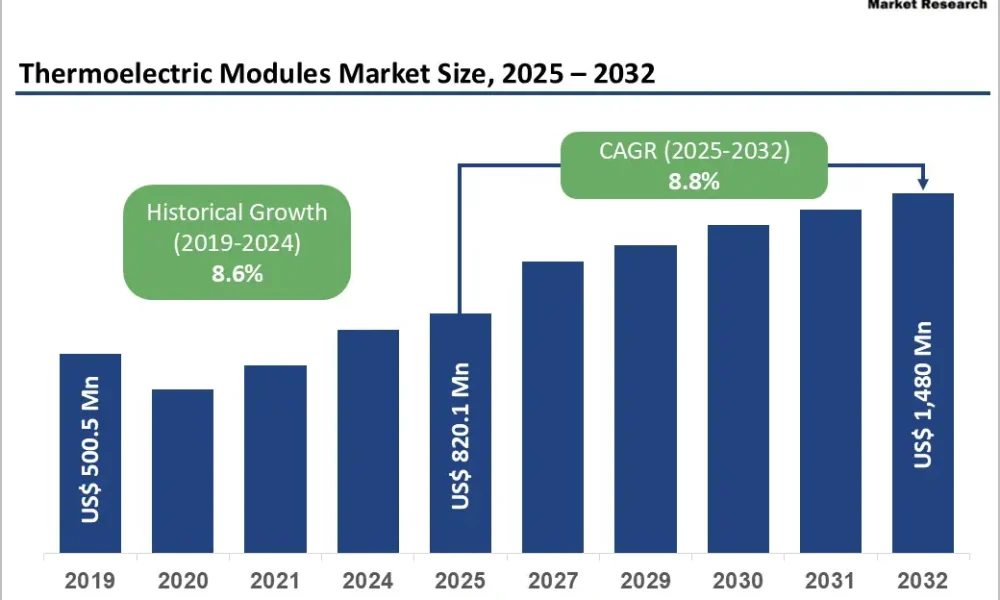
The global thermoelectric modules market is witnessing significant growth as industries increasingly prioritize energy-efficient thermal management technologies and sustainable energy solutions. According to market projections, the thermoelectric modules market is expected to grow from US$820.1 million in 2025 to US$1,480 million by 2032, registering a CAGR of 8.8% during the forecast period. This expansion is largely fueled by the rising demand for solid-state cooling systems, the rapid electrification of vehicles, and the increasing need for effective thermal control in compact electronic devices.
Thermoelectric modules, also known as Peltier modules, operate on the thermoelectric effect, allowing them to transfer heat from one side of a device to another when electric current passes through them. Unlike traditional cooling systems, these modules contain no moving parts and do not require refrigerants, making them highly reliable, maintenance-free, and environmentally friendly. As industries pursue higher efficiency and lower environmental impact, thermoelectric technology is gaining traction across sectors such as automotive, consumer electronics, healthcare, telecommunications, and industrial manufacturing.
The market’s steady growth is also being reinforced by advancements in semiconductor materials, nanotechnology, and energy-harvesting systems. These innovations are improving the efficiency and scalability of thermoelectric modules, enabling their deployment in both cooling and waste-heat recovery applications.
Growing Demand for Energy-Efficient Thermal Management
One of the primary drivers of the thermoelectric modules market is the growing need for energy-efficient cooling and heating solutions. Traditional cooling technologies, such as compressor-based refrigeration systems, often consume large amounts of energy and rely on refrigerants that can contribute to environmental pollution. Thermoelectric modules offer a cleaner alternative, operating silently and efficiently while eliminating the need for chemical refrigerants.
In the automotive sector, thermoelectric modules are gaining prominence due to their ability to improve energy efficiency and reduce emissions. Electric vehicles (EVs) in particular rely heavily on efficient thermal management systems to maintain optimal battery temperature and improve vehicle range. Thermoelectric modules are being integrated into EV battery packs, seat climate control systems, and cabin temperature management systems to enhance passenger comfort while minimizing energy consumption.
Similarly, the consumer electronics industry is experiencing increasing demand for compact thermal management solutions. Smartphones, gaming consoles, laptops, and wearable devices are becoming more powerful while simultaneously shrinking in size. This trend generates greater heat within confined spaces, requiring advanced cooling technologies. Thermoelectric modules provide precise temperature control, enabling manufacturers to maintain device performance and reliability without increasing size or weight.
The growing adoption of high-performance computing, artificial intelligence infrastructure, and telecommunications equipment is also driving the need for advanced cooling systems. Thermoelectric modules are widely used in telecom base stations, fiber-optic communication systems, and laser diode cooling, where maintaining stable temperatures is critical to operational efficiency.
Increasing Use of Thermoelectric Modules in Waste-Heat Recovery
Another major factor contributing to market growth is the expanding use of thermoelectric modules in waste-heat recovery applications. Industrial operations, power generation facilities, and automotive engines produce significant amounts of excess heat that typically goes unused. Thermoelectric modules can convert a portion of this waste heat into usable electrical energy, improving overall system efficiency.
Manufacturing plants and heavy industrial facilities are increasingly adopting thermoelectric technologies to reduce energy consumption and operational costs. By capturing heat from exhaust systems, industrial equipment, and process machinery, thermoelectric modules enable companies to recycle energy and reduce carbon emissions.
Governments and regulatory bodies around the world are encouraging industries to adopt energy-efficient technologies through environmental regulations and sustainability initiatives. Policies promoting carbon neutrality and clean energy adoption are accelerating the deployment of thermoelectric solutions across manufacturing and energy sectors.
Furthermore, ongoing research into advanced thermoelectric materials such as bismuth telluride, silicon-germanium, and nanostructured semiconductors is improving energy conversion efficiency. These developments are expected to expand the role of thermoelectric modules in renewable energy systems, industrial energy recovery, and sustainable manufacturing processes.
Elevate your business strategy with comprehensive market data. Request a sample report now: https://www.persistencemarketresearch.com/samples/31573
Market Challenges: High Initial Costs and Integration Complexity
Despite strong growth potential, the thermoelectric modules market faces several challenges that may limit its rapid adoption. One of the most significant barriers is the high initial cost associated with thermoelectric systems. These modules require specialized semiconductor materials and precision manufacturing techniques, which increase production expenses compared to traditional cooling technologies.
Materials such as bismuth telluride alloys are essential for thermoelectric performance but are relatively expensive to source and process. Additionally, manufacturing thermoelectric modules involves highly controlled fabrication processes to ensure reliability and efficiency, further contributing to overall costs.
Another challenge is the complexity of system integration. Thermoelectric modules require carefully designed thermal interfaces, heat sinks, and power control units to operate effectively. If these components are not properly engineered, the system’s efficiency can drop significantly.
In industries such as automotive and healthcare, where reliability and performance are critical, integrating thermoelectric modules into existing systems requires extensive engineering and testing. Smaller companies or cost-sensitive industries may hesitate to adopt thermoelectric solutions due to the additional design expertise required.
However, as production scales increase and material science advances continue, manufacturing costs are expected to decline. Improved module designs and simplified integration techniques are likely to accelerate adoption over the coming years.
Expanding Opportunities in Industrial Automation and Emerging Markets
Emerging economies are creating significant growth opportunities for thermoelectric module manufacturers. Rapid industrialization in Asia Pacific, Latin America, and parts of the Middle East is driving increased demand for efficient cooling technologies in manufacturing plants, automation systems, and industrial electronics.
As factories transition toward smart manufacturing and industrial automation, maintaining stable operating temperatures for sensors, controllers, and power electronics becomes essential. Thermoelectric modules are well suited for these environments due to their compact size, reliability, and ability to operate in harsh conditions.
Industrial automation systems rely heavily on electronics that must remain within specific temperature ranges to ensure accurate performance. Thermoelectric modules help regulate these temperatures, reducing the risk of equipment failure and improving operational uptime.
The expansion of logistics networks, automated warehouses, and robotics systems is also contributing to the demand for reliable thermal management technologies. As automation technologies spread across emerging markets, thermoelectric modules are expected to play an increasingly important role in maintaining system stability.
Product Type Insights: Bulk Modules Dominate the Market
In terms of product type, bulk thermoelectric modules hold approximately 50% of the global market share in 2025. These modules are widely used due to their durability, high power density, and adaptability across a wide range of industrial and automotive applications.
Bulk modules are commonly integrated into automotive seat climate systems, EV battery cooling units, and industrial equipment cooling systems. Their robust construction allows them to handle high thermal loads and operate efficiently in demanding environments.
At the same time, thin-film thermoelectric modules are emerging as the fastest-growing segment. These modules feature extremely thin semiconductor layers that allow them to fit into compact electronic devices and wearable technologies.
Thin-film modules are increasingly used in smartphones, IoT sensors, and portable medical devices where space constraints make traditional cooling solutions impractical. Advances in nanotechnology and microfabrication are improving the efficiency of these modules, making them more attractive for next-generation electronics.
Technology Trends: Single-Stage Modules Lead the Market
From a technology perspective, single-stage thermoelectric modules dominate the market, accounting for more than 42% of total revenue. These modules are favored for their simplicity, cost-effectiveness, and reliability in standard cooling applications.
Single-stage modules are widely used in portable refrigerators, electronic enclosures, and telecom cooling systems where moderate temperature control is sufficient. Their relatively simple design enables easier integration and lower production costs.
However, multi-stage thermoelectric modules are gaining popularity in high-performance applications. These advanced modules stack multiple thermoelectric stages to achieve greater temperature differentials.
They are commonly used in laboratory equipment, DNA analyzers, medical imaging systems, and vaccine storage devices where extremely precise temperature control is required. As demand for advanced medical diagnostics and biotechnology equipment increases, the adoption of multi-stage thermoelectric modules is expected to rise significantly.
End-User Insights: Automotive Sector Leads Demand
The automotive industry remains the largest end-user segment, accounting for approximately 40% of the global thermoelectric modules market. Automakers are increasingly integrating thermoelectric technology into vehicles to improve energy efficiency, passenger comfort, and system reliability.
Applications include seat heating and cooling systems, battery thermal management for EVs, and cabin climate control systems. As electric vehicles continue to gain market share, the need for advanced thermal management technologies is expected to grow rapidly.
Beyond automotive, industrial manufacturing and electronics sectors also represent major consumers of thermoelectric modules. These industries rely on precise temperature regulation to maintain operational stability in production lines, power electronics, and automated systems.
The healthcare industry is emerging as the fastest-growing end-user segment. Thermoelectric modules are widely used in portable medical refrigerators, diagnostic equipment, and laboratory instruments where precise temperature control is critical. As healthcare technology advances and demand for portable medical devices increases, thermoelectric solutions are becoming increasingly essential.
Regional Outlook
Asia Pacific Leads the Global Market
Asia Pacific dominates the thermoelectric modules market, accounting for around 50% of global revenue share. The region’s leadership is supported by its strong manufacturing base, high electronics production capacity, and rapid adoption of electric vehicles.
Countries such as China, Japan, and South Korea are investing heavily in clean technologies, smart manufacturing systems, and advanced electronics production. These investments are creating strong demand for thermoelectric modules in automotive, industrial, and consumer electronics applications.
North America Emerging as the Fastest-Growing Region
North America is expected to experience the fastest market growth during the forecast period. The region benefits from a strong innovation ecosystem, advanced research institutions, and supportive government policies promoting energy efficiency.
Increasing investments in EV technologies, renewable energy systems, and advanced medical devices are driving demand for thermoelectric modules across the United States and Canada.
Europe Focuses on Sustainable Technologies
Europe also remains a significant market, supported by strict environmental regulations and the region’s strong commitment to carbon neutrality. The European Green Deal and related energy-efficiency initiatives are encouraging industries to adopt thermoelectric technologies for waste-heat recovery and industrial cooling.
Research programs such as Horizon Europe are supporting the development of advanced thermoelectric materials and improving the commercial viability of next-generation modules.
Competitive Landscape
The thermoelectric modules market is moderately fragmented, with a mix of global manufacturers and specialized regional players competing across various application segments.
Major companies including Ferrotec Corporation, II-VI Marlow, Laird Thermal Systems, KELK Ltd., and TE Technology are leading the market through continuous investment in advanced materials, product innovation, and strategic collaborations with OEMs.
These companies are focusing on developing more efficient thermoelectric modules for EV thermal management, medical devices, and high-performance electronics. Partnerships with automotive manufacturers, electronics companies, and industrial automation providers are helping these players expand their market presence.
Meanwhile, regional manufacturers in Asia Pacific are gaining traction by offering cost-competitive solutions and expanding production capacity to meet growing global demand.
Future Outlook
The future of the thermoelectric modules market looks promising as industries increasingly adopt sustainable technologies and energy-efficient solutions. Advances in material science, nanotechnology, and semiconductor engineering are expected to significantly improve thermoelectric efficiency in the coming years.
With growing demand for EVs, industrial automation, smart electronics, and waste-heat recovery systems, thermoelectric modules are set to play a crucial role in next-generation thermal management solutions. As production costs decrease and integration challenges are addressed, the market is expected to expand steadily, reaching US$1.48 billion by 2032.
Thermoelectric technology is gradually transitioning from niche applications to mainstream adoption across multiple industries. This shift positions thermoelectric modules as a key component in the global transition toward energy efficiency, sustainable manufacturing, and advanced electronics innovation.
Related Reports:




