
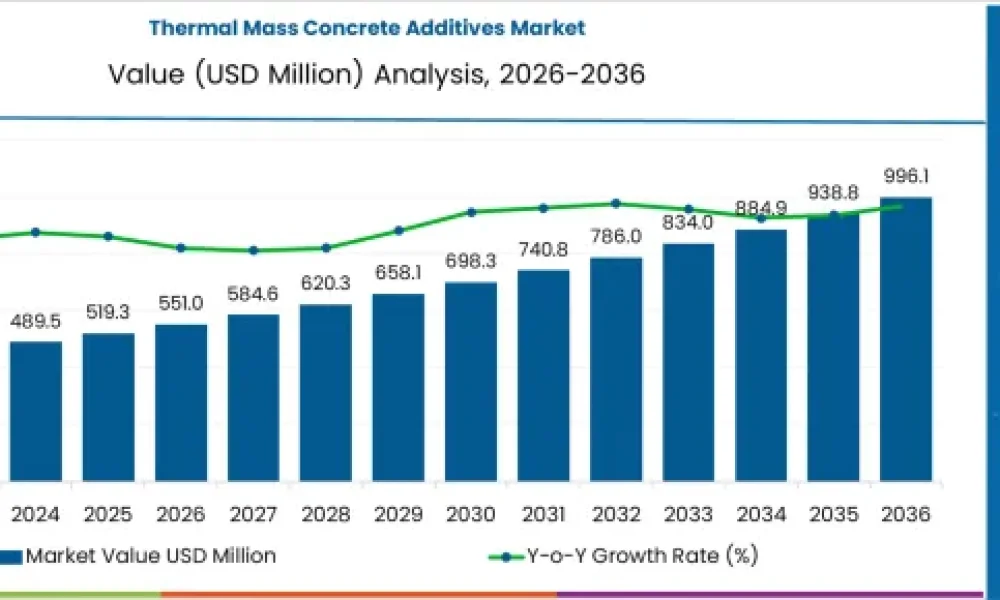
The global thermal mass concrete additives market is witnessing strong momentum, valued at approximately USD 551.0 million in 2026 and projected to expand to nearly USD 996.1 million by 2036, growing at a compound annual growth rate (CAGR) of 6.1%. This sustained expansion reflects rising demand for advanced construction materials that enhance thermal performance, reduce energy consumption, and support long-term sustainability goals across residential, commercial, and industrial developments.
As global construction priorities shift toward energy efficiency and low-carbon building practices, thermal mass concrete additives are gaining widespread adoption. These additives enhance concrete’s ability to store and release heat, helping regulate indoor temperatures, reduce HVAC dependency, and improve overall building performance. Their role has become increasingly critical as developers respond to stricter building energy codes and growing demand for cost-efficient, climate-responsive infrastructure.
Key Market Insights at a Glance
Market growth is fueled by the convergence of sustainability mandates, urbanization, and technological innovation in concrete formulations. Phase-change material (PCM) microcapsules dominate the additive landscape, accounting for roughly 32% of total demand, due to their superior heat-storage efficiency. Commercial buildings remain the largest application segment, representing approximately 34% of market share, driven by the need for energy optimization in offices, retail complexes, healthcare facilities, and educational institutions.
To access the complete data tables and in-depth insights — Request Your Sample Report Now
Segment Overview
Thermal mass concrete additives are categorized by additive type, application, and integration method. Additive types include PCM microcapsules, high-density aggregates, conductive carbon-based materials, and hybrid thermal enhancers. Applications span commercial buildings, industrial facilities, data centers, residential housing, and large-scale infrastructure projects. Integration methods range from ready-mix concrete and precast elements to retrofit overlays and modular building components, enabling flexibility across both new construction and renovation projects.
Regional Overview
Regionally, Asia-Pacific leads market growth, supported by rapid urban development, infrastructure expansion, and large-scale commercial construction. China remains a key contributor due to high adoption in high-rise and mixed-use developments. North America maintains steady growth, driven by commercial retrofits and sustainability-focused construction practices in the United States. Europe continues to see consistent adoption, particularly in Germany and the United Kingdom, where energy-efficiency regulations and green building standards are well established. Emerging markets in Latin America are also gaining traction, supported by industrial growth and infrastructure investments.
Competitive Landscape
The market features a competitive yet innovation-driven landscape, where manufacturers focus on advanced formulations, application versatility, and technical collaboration. Key industry participants include BASF, Sika, Saint-Gobain, Holcim (Solutions & Products), Heidelberg Materials, Dow, Evonik, 3M, CEMEX, and Wacker Chemie. These companies compete through product differentiation, sustainability-focused solutions, and partnerships with architects, engineers, and concrete producers.
Market Outlook: Powering the Next Decade
Looking ahead, the thermal mass concrete additives market is expected to play a pivotal role in next-generation construction. Advancements in phase-change technologies, multifunctional additives, and smart material integration will unlock new use cases across commercial and industrial sectors. As global construction moves toward net-zero energy goals, thermal mass additives will become a cornerstone solution for reducing operational energy costs and improving building resilience.
Key Players of Sustainable Label Industry
Leading market players are aligning product strategies with green building certifications and lifecycle performance standards. Their focus on environmentally responsible materials strengthens the role of thermal mass additives in sustainable construction ecosystems.
Recent Strategic Developments
Recent developments include increased investment in research and development, expansion of production capabilities, and strategic collaborations aimed at scaling adoption. Companies are prioritizing solutions that integrate seamlessly into standard construction workflows while delivering measurable energy and cost benefits.
Have a specific Requirements and Need Assistant on Report Pricing or Limited Budget please contact us – [email protected]
About Future Market Insights (FMI)
Future Market Insights, Inc. (FMI) is an ESOMAR-certified, ISO 9001:2015 market research and consulting organization, trusted by Fortune 500 clients and global enterprises. With operations in the U.S., UK, India, and Dubai, FMI provides data-backed insights and strategic intelligence across 30+ industries and 1200 markets worldwide.
Why Choose FMI: https://www.futuremarketinsights.com/why-fmi



