
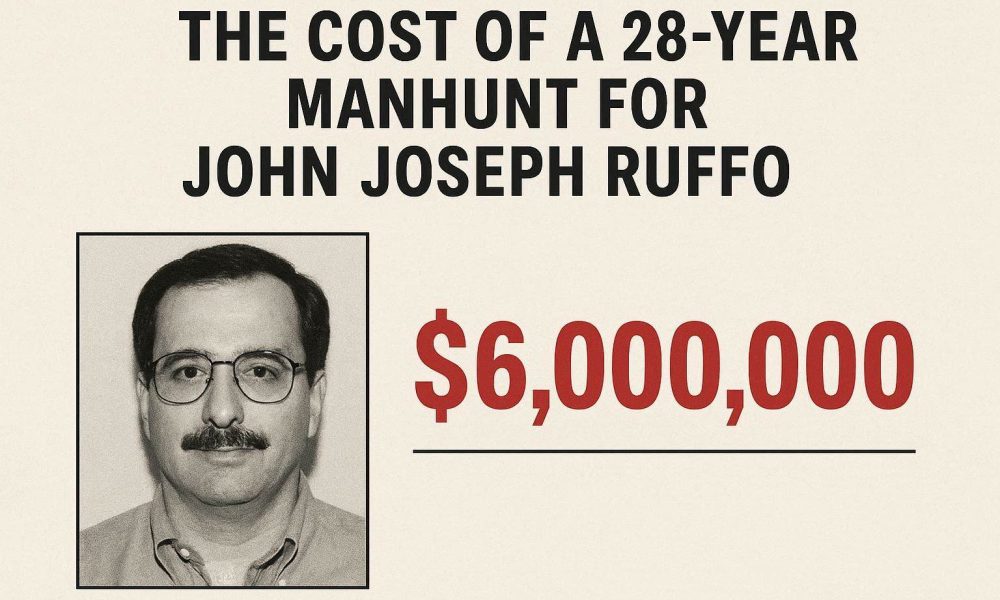
A financial and operational review of the federal resources deployed in the search for one of America’s longest-running white-collar fugitives.
WASHINGTON, DC, June 6, 2026, The John Joseph Ruffo case has lasted long enough to become more than a fugitive file, because the search now represents a 28-year institutional commitment involving law enforcement time, public appeals, intelligence review, international coordination, and the unresolved cost of a sentence never served.
Ruffo, a former New York computer executive convicted in connection with a massive bank fraud scheme, failed to report to federal prison in 1998 after being released on a $10 million bond, turning a completed prosecution into one of America’s longest-running white-collar manhunts.
The U.S. Marshals Service continues to list John Joseph Ruffo as a 15 Most Wanted fugitive, a designation that keeps his case inside the federal fugitive infrastructure decades after the original fraud proceedings ended.
The direct cost of the Ruffo manhunt has not been publicly itemized as a single-case budget, but the operational burden is evident in the years of investigative continuity required to maintain leads, update public materials, pursue tips, and coordinate across jurisdictions.
A fugitive case can become a long-term federal operating cost
A manhunt that lasts nearly three decades does not consume resources in one dramatic burst, because the cost accumulates through personnel time, database maintenance, lead review, interagency communication, public outreach, and case-management continuity.
Every credible tip must be assessed, every possible sighting must be checked, every public appeal must be updated, and every new investigative angle must be weighed against older evidence.
The U.S. Marshals Service operates across fugitive apprehension, prisoner operations, judicial security, and witness security, which means long-running cases compete for attention inside an agency already responsible for multiple high-demand federal missions.
A case like Ruffo’s also carries continuity costs because investigators change, technology changes, public attention fades and the government must preserve enough institutional memory to recognize a real lead if it appears years later.
The cost is not only what agents spend chasing a single suspect, but also what the system spends keeping the case alive so that accountability remains possible.
The original fraud created the first financial injury
Ruffo’s case began with financial damage on a scale large enough to make the subsequent manhunt especially costly in terms of public confidence.
The fraud scheme was tied to hundreds of millions of dollars in losses involving U.S. and foreign banks, and the collapse of the case left institutions, victims, and enforcement agencies dealing with consequences beyond the criminal sentence itself.
When a convicted fraud defendant disappears, the justice system incurs a second cost because prosecutors have already proved the case, courts have imposed punishment, and enforcement still fails to secure custody.
That failure changes the public meaning of the original conviction, because the sentence becomes an unfinished promise rather than the final chapter of accountability.
The longer Ruffo remains missing, the more the original fraud and the post-conviction failure merge into one broader story about financial crime, mobility, and enforcement limits.
The bond did not eliminate the public cost
Ruffo’s release on a large bond created the appearance of financial deterrence, but a bond cannot replace custody when a defendant has already decided that flight is preferable to prison.
Bond forfeiture may recover money or penalize sureties, but it does not erase the cost of the manhunt, the delay in sentencing enforcement, or the institutional burden created by decades of nonappearance.
A defendant who fails to surrender transfers risk from himself to the public because investigators, courts, and federal agencies must continue to spend time and attention enforcing a judgment that should already be in the custody phase.
Family members and associates can also become collateral damage when bond assets are placed at risk, creating personal and financial consequences that extend beyond the fugitive.
The Ruffo case illustrates why financial guarantees can be inadequate when the defendant’s history includes deception, large-scale fraud, and potential access to undisclosed resources.
Manhunt costs are often hidden inside ordinary agency work
The public rarely sees a separate invoice for a fugitive case because the work is usually absorbed into ordinary law enforcement budgets, personnel assignments, task force operations, and information-sharing systems.
Deputy marshals, analysts, supervisors, communications personnel, public-affairs staff, and partner agencies may all touch a long-running case at different times without creating a single public line item labeled with the fugitive’s name.
That makes the cost harder to quantify, but not less real, because time spent evaluating old tips, reviewing possible matches, or coordinating overseas information is time that could otherwise be assigned to other cases.
In that sense, a long fugitive case creates opportunity cost, especially when federal agencies must prioritize threats, violent offenders, judicial security, and other urgent missions.
The Ruffo search demonstrates how a white-collar fugitive can impose a public cost long after the financial crime itself has left the courtroom.
The public tip system has its own operational burden
High-profile fugitive cases depend on public visibility, but that visibility creates work, as every credible call, email, image, memory, or possible sighting must be sorted, logged, and evaluated.
The U.S. Marshals have used wanted materials, public appeals, and media attention to keep Ruffo’s case active, which can generate leads from people who believe they saw him in the United States or abroad.
A single false sighting can still consume investigative time if it requires image review, location checks, witness contact, travel-history analysis, or coordination with local authorities.
The widely reported Dodger Stadium lead showed how one possible public identification could revive attention, require review, and ultimately become part of the case narrative even after it was cleared.
Public participation is essential in old fugitive cases, but it also adds operational costs because every real lead must be distinguished from coincidences, resemblances, and memory errors.
Aging changes the economics of identification
Ruffo disappeared in 1998, which means any current search must account for decades of aging, possible medical change, altered appearance, new habits, and the possibility that he has lived under another name for years.
The cost of identification rises over time because older photographs become less reliable, witnesses become less certain, and investigators must consider how age, illness, weight, hair, posture, and lifestyle may change recognition.
Age-progressed images, public updates, and renewed appeals help keep the case visible, but they also require professional judgment about how much a person’s appearance may have changed.
The longer a fugitive remains missing, the harder it becomes to distinguish a meaningful resemblance from a coincidental one.
That uncertainty increases the operational burden because the government must remain open to leads without letting every possible face consume disproportionate resources.
International possibilities multiply the cost
The U.S. Marshals profile notes Ruffo’s international ties, including connections across the Caribbean, South America, and Europe, which expands the geography of the search beyond domestic fugitive work.
International leads can require coordination with foreign law enforcement, consular channels, immigration authorities, financial intelligence units, and local agencies that operate under different laws and priorities.
Even when a foreign lead proves weak, it may still require careful review, as a long-running fugitive with possible offshore access cannot be evaluated solely from domestic records.
Sovereign borders create procedural costs because information cannot always be checked instantly, and enforcement action abroad usually requires cooperation from the jurisdiction where the fugitive may be located.
The case illustrates how a single missed surrender date can turn a federal sentence into a global coordination problem that lasts for decades.
Financial intelligence remains central to the search
White-collar fugitives differ from many other fugitives because money can be both the original crime scene and the survival mechanism sustaining flight.
Investigators must consider whether hidden funds, foreign accounts, nominee relationships, business contacts, real estate, or family-controlled resources helped support Ruffo after his disappearance.
That type of financial review requires different expertise from that of a street-level fugitive operation, because the trail may run through accounts, companies, wire transfers, property records, and old business relationships rather than only physical sightings.
For lawful clients, second passport advisory services should always be understood as compliance-based mobility planning, never as a mechanism for evading a sentence, disguising criminal proceeds, or obstructing enforcement.
The Ruffo case shows why financial-crime fugitives force investigators to follow both geography and capital: a person’s location may remain hidden while money leaves a trail.
The media cycle can revive costs and opportunities
Media attention can create investigative opportunity by reminding the public that a fugitive remains wanted, but every media cycle can also generate new work for law enforcement.
When documentaries, articles, broadcasts, or podcasts revisit an old case, the resulting attention may produce tips that must be reviewed even if many prove inaccurate.
This is not wasteful because old fugitive cases can be solved by renewed visibility, especially when someone recognizes a face, voice, story, location, or alias years after disappearance.
The cost is part of the strategy, because maintaining public awareness is often cheaper than letting a case disappear entirely from collective memory.
Ruffo’s case demonstrates that the media is not merely observing the manhunt, but functioning as part of the public information network that keeps pressure on a missing defendant.
The institutional cost includes deterrence
A long-running fugitive case affects deterrence because future defendants watch how the system responds when someone fails to surrender after conviction.
If a fugitive remains free for decades, the justice system must work harder to show that nonappearance does not become a practical alternative to custody.
The 15 Most Wanted designation serves partly as a deterrence signal because it tells convicted defendants that time alone does not erase federal interest.
That signal matters in white-collar cases, where defendants may believe money, foreign access, or professional networks can create more options than the sentence itself.
The public cost of maintaining the search is therefore also the cost of protecting the meaning of federal sentencing.
Victims carry a cost that budgets do not capture
The financial and operational costs of the Ruffo manhunt are only part of the story, as victims, families, business partners, and institutions also bear the weight of unresolved accountability.
A sentence that has never been served can feel incomplete to those affected by the original fraud, especially when the defendant’s disappearance becomes more famous than the damage created by the crime.
Victims may experience renewed frustration whenever the case returns to public attention without an arrest, because every update reminds them that the original judgment remains unenforced.
The emotional cost is difficult to quantify, but it is part of the public burden created when a convicted defendant turns a criminal sentence into a fugitive narrative.
A white-collar fugitive not only evades prison but also delays the moral closure that sentencing was supposed to provide.
The opportunity cost touches other investigations
Every long-running federal fugitive case exists inside a larger enforcement environment where agencies must pursue violent fugitives, sex offenders, escapees, international suspects, and defendants who threaten public safety.
Ruffo’s case remains important because of the scale of the fraud and the principle at stake, but its persistence also highlights how one defendant can continue occupying federal attention for decades.
Opportunity cost does not mean the case should be abandoned, because abandonment would reward flight and weaken the credibility of sentencing.
It means the original release failure created a resource obligation that would not exist if custody had begun when the sentence required it.
The government is still paying for the gap between judgment and custody because that gap became large enough to define the rest of the case.
Technology has reduced some costs but created new demands
Modern law enforcement has tools that did not exist in the same form when Ruffo disappeared, including improved databases, biometric systems, digital image comparison, financial analytics, and broader information-sharing capacity.
These tools can make certain aspects of the search more efficient, but they also create new work because older cases must be updated, digitized, cross-checked, and reinterpreted using modern systems.
Technology cannot automatically solve a case that began before today’s data environment matured, especially if the first escape route was never confirmed and the fugitive avoided being recorded in later official records.
The result is a hybrid investigation in which older evidence, newer technology, public tips, and financial intelligence must be carefully combined.
The cost of modernization becomes part of the case because each new tool creates the possibility of progress but requires time to apply properly.
Post-conviction policy lessons are part of the cost
The Ruffo case continues to matter because it teaches courts and enforcement agencies that high-loss financial defendants may require stricter post-conviction controls than their nonviolent profile suggests.
A defendant facing a long sentence, reputational collapse, and restitution exposure may present a serious surrender risk even without a history of physical violence.
Judges and prosecutors evaluating release after conviction should consider hidden assets, foreign ties, passport access, professional deception skills, family collateral limits, and whether voluntary surrender creates unnecessary exposure.
The policy cost of the Ruffo case is the lesson learned from failure, because the system had to absorb decades of manhunt work after underestimating the risk of surrender.
A smarter release analysis in future cases may save public resources by preventing the next white-collar fugitive from turning sentencing into an optional appointment.
Lawful privacy planning must remain separated from fugitive conduct
Ruffo’s case is sometimes discussed in the same public conversation as offshore movement, identity uncertainty, and low-profile living, but lawful privacy planning has nothing to do with evading a criminal sentence.
Legitimate anonymous living planning must operate through accurate documents, lawful banking, tax compliance, immigration rules, and full respect for court orders and criminal law.
That distinction matters because public fascination with fugitives can distort the meaning of privacy, making legitimate security planning appear connected to illegal disappearance.
A person under sentence, indictment, warrant, or court supervision is not a privacy client in the lawful mobility sense because the legal obligation takes precedence.
The Ruffo case shows why that boundary must remain firm: privacy protects dignity when lawful, while fugitive secrecy undermines justice when used to avoid punishment.
The cost of the manhunt is ultimately the cost of unfinished custody
The Ruffo manhunt has lasted for 28 years because the government secured a conviction but did not secure the defendant before the surrender date, which became an escape opportunity.
The financial cost includes investigative work, public appeals, lead review, interagency coordination, international inquiries, and the continuing attention of a federal fugitive apparatus.
The operational cost includes institutional memory, case maintenance, media response, technology updates, and the challenge of identifying a man whose appearance and life circumstances may have changed dramatically since 1998.
The public cost includes damaged confidence, victim frustration, and the troubling message that financial sophistication can complicate enforcement even after conviction.
For the public record, the cost of the John Joseph Ruffo manhunt is measured not only in dollars but also in the decades spent trying to enforce a sentence that should have begun before the fugitive geography ever opened.




