
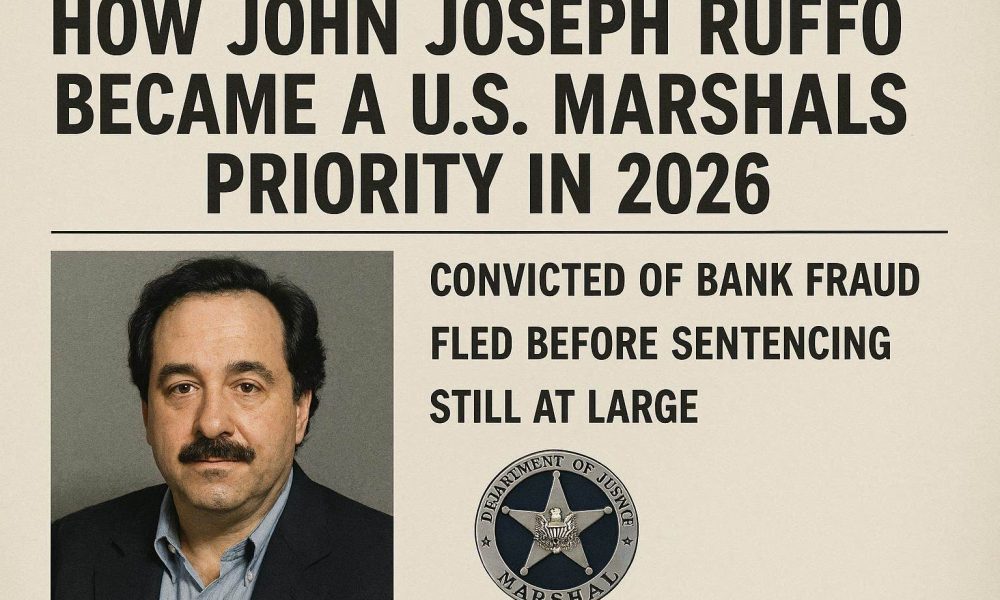
The bank fraud conviction, failed surrender, and international ties that elevated Ruffo from financial criminal to major fugitive.
WASHINGTON, DC, June 6, 2026, John Joseph Ruffo remains a U.S. Marshals priority in 2026 because his case combines major financial crime, a failed post-conviction surrender, unresolved international leads, and the institutional cost of a sentence that has never been served.
Ruffo, a former New York computer executive, was convicted in connection with a massive bank fraud scheme that authorities say defrauded U.S. and foreign banks of approximately $350 million before he disappeared in 1998.
The U.S. Marshals Service continues to list John Joseph Ruffo as a 15 Most Wanted fugitive, keeping the case active decades after he failed to report for a 17-year federal sentence.
His case has lasted because it is not only about a fugitive defendant but also about how financial sophistication, international mobility, institutional trust, and post-conviction release decisions can combine to create a long-running enforcement problem.
The case began as a major bank fraud prosecution
Ruffo’s path to fugitive status began with a financial crime case that stood out for its size, complexity, and reliance on deception within commercial banking relationships.
Authorities have described a fraudulent business scheme involving Ruffo and a co-defendant, in which banks were persuaded to finance transactions tied to equipment and business arrangements that did not reflect reality.
The case mattered because the alleged losses were not small accounting irregularities, but a large-scale fraud involving U.S. and foreign financial institutions that exposed weaknesses in trust-based commercial lending.
A fraud of that scale attracts federal attention because banks, markets, insurers, and public confidence all depend on the belief that major financial transactions are supported by truthful documents.
Once Ruffo was convicted and sentenced, the system appeared to have reached the accountability stage, but his failure to surrender turned a financial-crimes case into a fugitive case.
The failed surrender changed everything
Ruffo was not a fugitive because he escaped from a prison transport, broke out of a facility, or fled during a chaotic arrest, because his disappearance came after the court process had already reached sentencing.
He had been released on a significant bond and was expected to report to begin serving his federal sentence, a post-conviction arrangement that depended on compliance at the most fragile point in the case.
That timing made the failure more damaging because the government had already secured a conviction, the sentence had already been imposed, and the remaining task was custody.
When Ruffo failed to appear, the punishment phase collapsed into a manhunt, leaving the public record with a conviction that had not produced the custodial result ordered by the court.
That is why the case remains important in 2026: it shows how a successful prosecution can still result in an enforcement failure if the defendant disappears before custody begins.
Post-conviction release created a high-risk opening
The Ruffo case illustrates why post-conviction release requires a different kind of risk analysis from pretrial release, especially when the defendant faces a lengthy prison sentence and has financial sophistication.
Before conviction, a defendant may still believe in acquittal, plea negotiation, or a lighter outcome, but after sentencing, the future becomes concrete, and the incentive to flee can increase sharply.
A defendant convicted of major fraud may also understand deception, financial movement, professional relationships, and the practical use of timing better than an ordinary offender.
This does not mean every white-collar defendant is a flight risk, but it does mean courts must treat sentence length, hidden assets, foreign ties, and prior deception as serious factors.
Ruffo’s disappearance became a cautionary example because the window between sentencing and surrender gave a convicted defendant enough room to turn legal process into uncertainty.
The U.S. Marshals’ priority reflects more than the original crime
The Marshals’ continued interest in Ruffo reflects more than the dollar amount of the fraud, because the case now represents a long-term challenge to sentencing enforcement and fugitive accountability.
A person who fails to serve a federal sentence creates a continuing injury to the legal system because the court’s judgment remains incomplete until the defendant is in custody.
The Marshals’ fugitive mission includes locating defendants who have crossed jurisdictions, changed identities, used associates, or exploited geography to avoid federal accountability.
Ruffo’s case fits that mission because authorities have identified international ties across the Caribbean, South America, and Europe, making the search broader than an ordinary domestic nonappearance case.
In 2026, the priority is therefore both historical and operational, because the case remains unsolved while the defendant remains wanted under a sentence imposed decades ago.
International ties expanded the search beyond one country
Ruffo’s reported international connections gave the case a global dimension, as investigators could not assume he remained within a single domestic geography after his failed surrender.
International ties matter in fugitive cases because they can suggest possible travel routes, foreign contacts, business relationships, financial support networks, or places where a fugitive might attempt to live quietly.
Once a case moves into the international realm, investigators must consider immigration records, border crossings, aliases, foreign law enforcement cooperation, and the practical challenge of identifying a person who may have aged significantly.
Sovereign borders do not render a fugitive unreachable, but they add procedural delays and complexity when authorities must coordinate with foreign agencies and verify identity abroad.
That international dimension helped elevate Ruffo from a convicted financial criminal to a major fugitive case because the search could not be confined to the place where the fraud was prosecuted.
The JFK Airport clue became part of the case mythology
Ruffo’s disappearance has remained compelling, in part, because the known timeline included movement toward one of the world’s most recognizable international travel hubs.
ABC News coverage of the case described the sequence in which Ruffo turned in his ankle monitor, withdrew cash, and headed toward John F. Kennedy International Airport before vanishing.
That airport detail became significant because it left investigators and the public with an unresolved question about whether he boarded a flight, used the airport as misdirection, or continued by another route.
The uncertainty matters because the first confirmed movement after disappearance can determine whether a manhunt becomes domestic, international, or permanently ambiguous.
In Ruffo’s case, the airport clue became less an answer than a symbol of the modern fugitive problem, where one point of departure can open dozens of possible investigative directions.
Financial sophistication can sustain long-term flight
White-collar fugitives differ from many other fugitives because money, documents, professional relationships, and knowledge of business systems can become part of their survival structure.
A fugitive with access to hidden funds, trusted intermediaries, foreign contacts, or financial networks may not need dramatic behavior to remain free for years.
Instead, long-term flight may depend on modest support, careful movement, low public exposure, and the ability to avoid transactions that reveal a location or identity.
That possibility makes financial fugitives especially difficult to track because investigators must follow people, money, communications, family networks, business records, and potential offshore connections simultaneously.
Ruffo’s alleged background in fraud made that concern unavoidable, because the same financial knowledge that helped build the original case could also shape theories about how he survived afterward.
The case highlights the weakness of financial deterrence alone
Ruffo had been released on a large bond, but a bond is not the same as custody and cannot physically prevent a determined defendant from disappearing.
Financial deterrence assumes that the defendant values the pledged money, collateral, or family consequences more than the perceived benefit of avoiding prison.
That assumption can fail when the defendant faces a long sentence, possible loss of status, restitution pressure, and the psychological shock of moving from business life into federal custody.
The Ruffo case shows that a large bond may create pressure, but it does not eliminate flight risk when the defendant has mobility, incentive, and a potential support structure.
For courts handling high-loss fraud defendants, the lesson is that money can be both a deterrent and an escape tool, depending on how much access the defendant still controls.
The case became a public test of institutional memory
A fugitive case lasting nearly three decades requires more than a wanted poster because investigators must preserve institutional memory amid personnel changes, technological shifts, and fading public awareness.
The people who prosecuted, investigated, or first tracked Ruffo may no longer hold the same roles, yet the government must keep enough continuity to recognize a meaningful lead if it appears.
Age progression, old photographs, aliases, family history, financial records, and prior international leads all become part of a long-term investigative file that must remain usable over time.
This makes Ruffo a priority not only because of the original fraud but also because his case tests whether federal fugitive systems can sustain attention over decades.
A fugitive can try to outwait the system, but a 15 Most Wanted designation signals that the system has not closed the file or accepted disappearance as final.
Public visibility remains central to the manhunt
Long-running fugitive cases often depend on public visibility because one person may recognize a face, name, habit, old story, or resemblance that investigators cannot generate from databases alone.
Ruffo’s case has repeatedly returned to public attention through media coverage, wanted materials, and renewed appeals, especially when possible sightings or leads have drawn interest.
Public attention can create false leads, but it can also produce the one tip that connects a changed appearance to an old identity.
This is why the Marshals continue to use public wanted materials: the passage of time does not eliminate the possibility that someone has encountered Ruffo in another context.
In a fugitive case this old, public memory becomes an investigative asset because the right recognition may come from outside law enforcement.
The case also illustrates the limits of identity assumptions
Ruffo was born in 1954, meaning any current search must account for age, possible health changes, altered appearance, different habits, and the possibility of a life built under another name.
A person missing since 1998 will not necessarily resemble the original wanted photographs as witnesses expect, which complicates identification and tip evaluation.
Investigators must consider how aging affects facial structure, posture, weight, hair, medical needs, and everyday behavior.
That uncertainty is one reason old fugitive cases require careful review: resemblance alone is not enough, but it can still reopen investigative paths.
The Ruffo case remains difficult because the person being sought is both a historical defendant and an unknown who may look very different from the original public image.
Second passports and mobility planning must remain lawful
Ruffo’s case is often relevant to discussions about borders, offshore access, and identity, but lawful global mobility planning is fundamentally different from fugitive movement after conviction.
Legitimate second passport advisory services are designed for lawful citizenship, residence, family security, and compliant international planning, not for evading sentences, court orders, or criminal accountability.
A convicted fugitive would face serious barriers in any reputable citizenship, residence, or banking process because modern due diligence examines criminal history, adverse media, sanctions exposure, and source of funds.
The lesson is not that mobility planning is suspicious, but that lawful mobility depends on accurate documents, transparent funds, and respect for legal obligations.
Ruffo’s case underscores why governments and banks scrutinize applicants carefully, because mobility tools can be misused when separated from accountability.
The privacy distinction matters
Lawful privacy planning protects people who need reduced public exposure, safer relocation options, document discipline, and compliant strategies for managing personal risk.
Fugitive secrecy differs because it is designed to evade a lawful sentence, avoid court authority, and prevent victims or the public from receiving the accountability already ordered.
Professional anonymous living planning should therefore remain clearly separated from any conduct involving warrants, sentencing evasion, criminal flight, or obstruction of enforcement.
The distinction matters because public fascination with fugitives can blur the difference between legitimate privacy and illegal disappearance.
The Ruffo case is a warning about evasion, not a model for privacy, because lawful discretion cannot exist where the underlying purpose is to avoid justice.
Why Ruffo remains a priority in 2026
Ruffo remains a priority because his case combines major fraud, a failed surrender, international implications, unresolved financial questions, and the continuing symbolic weight of a sentence that has never been served.
The Marshals’ interest reflects the principle that time does not erase a federal sentence and that white-collar fugitives are not less important simply because the underlying crime was financial.
The case also remains relevant because it informs how courts, prosecutors, and enforcement agencies think about surrender risk in large financial crime cases.
A defendant convicted of major fraud may not appear physically dangerous, but the capacity for deception, access to money, and potential for international movement can create a different form of enforcement risk.
Ruffo’s unresolved status keeps that lesson alive for every case in which a resourceful defendant asks to remain free before surrender.
The bottom line is that Ruffo became a priority because the case never ended
John Joseph Ruffo became a major U.S. Marshals priority because his case moved beyond fraud into the deeper failure of a federal sentence that remains unenforced.
The original conviction established criminal accountability, but the failed surrender created a fugitive case shaped by international ties, financial sophistication, public visibility, and decades of unresolved enforcement work.
His continued presence on the 15 Most Wanted list shows that the government still treats the case as active, significant, and worthy of national attention.
The case also demonstrates why post-conviction release decisions matter, especially when a defendant has the means, motive, and experience to turn a surrender date into an opportunity to escape.
For the public record, Ruffo’s importance in 2026 is not only that he vanished after a $350 million fraud case, but also that his disappearance continues to test whether federal justice can outlast a fugitive who tried to convert time, money, and geography into permanent freedom.




