
Tea Market Overview
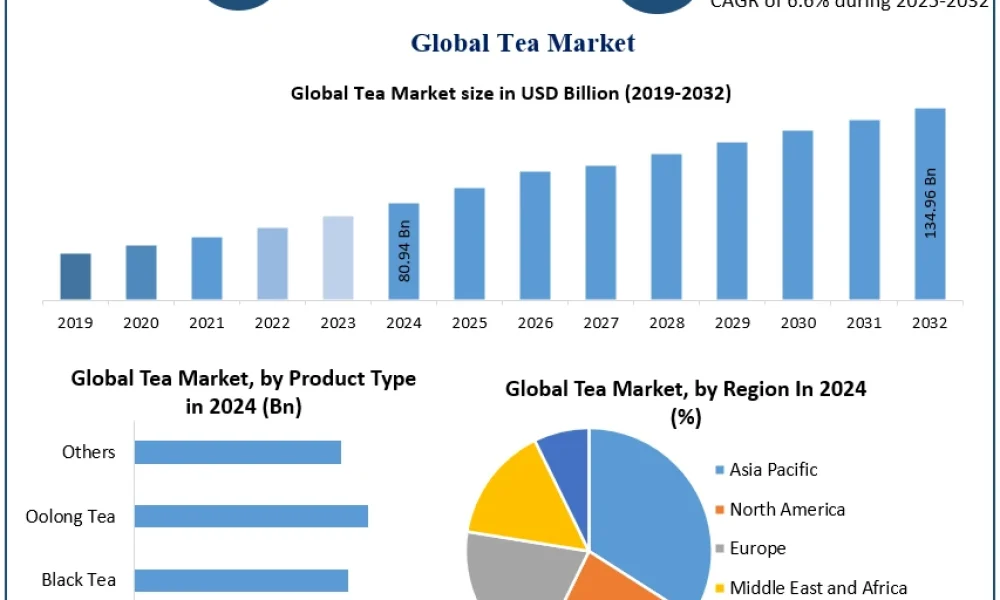
Tea Market, valued at USD 80.94 billion in 2024, is projected to reach USD 134.96 billion by 2032, growing at a robust CAGR of 6.6%. Spurred by rising health awareness, innovative flavor launches, and expanding premium and organic tea offerings, Asia Pacific and Europe are set to maintain leading market shares over the forecast period. Black tea remains the dominant segment by volume, while green tea is the fastest-growing, reflecting evolving consumer preferences and increasing focus on wellness.
Key Highlights & Insights
Market Size & Growth: The global tea market is forecast to grow from USD 80.94 billion (2024) to USD 134.96 billion (2032) at a CAGR of 6.6%.
Dominating Region: Asia Pacific and Europe together account for the largest market share, with a combined 70%. Asia Pacific’s lead is fueled by China and India’s vast production and consumption; Europe’s strong position comes from entrenched tea traditions and innovation in herbal, green, and specialty teas.
Leading Segment: Black tea holds 42.5% share of the global tea market in 2032. Green tea exhibits the fastest CAGR of 9.8%, propelled by health-driven adoption, direct-to-consumer marketing, and high visibility among health-conscious demographic groups.
Key Driver: Demand is fueled by rising health consciousness, introduction of herbal blends, premiumization trends, digital retail experiences, and increasing consumer interest in functional and organic teas.
Curious to peek inside? Grab your sample copy of this report now:https://www.maximizemarketresearch.com/request-sample/19202/
Recent Developments
Green Hills introduced rum and honey flavored herbal tea to attract consumers seeking low-sugar beverages, reflecting innovation in flavor profiles and wellness positioning.
Strategic online campaigns, celebrity endorsements, and direct-to-consumer models accelerated green and herbal tea adoption, especially among younger and urban populations.
Indian brands like Teabox launched exclusive cold-stored, all-natural tea lines, raising the bar for freshness and premium quality in global tea offerings.
Market Dynamics
Growth Drivers:
Increasing disposable income and urbanization in emerging markets, expanding the consumer base.
Wellness and functional trends boosting demand for green and herbal teas with antioxidant properties.
New product development—innovative flavors, organic, and premium variants—driven by R&D investments and sophisticated packaging.
Rapid e-commerce adoption, enabling broader product reach and convenience for consumers.
Challenges:
Price volatility due to changing raw material costs, often influenced by unpredictable weather.
Tangible competition from coffee and other beverages in developed markets.
Quality consistency and authenticity concerns with mass-market expansion.
Opportunities:
Rising interest in organic and functional teas opens premium market segments.
Emerging online and subscription models for specialty teas.
Expansion of tea-based ready-to-drink and wellness beverages.
Regional Analysis
Asia Pacific: The undisputed leader, driven by deep-rooted tea culture, expanding urban populations, and burgeoning middle class. China is the world’s largest tea producer and consumer, with India also playing a major role.
Europe: Holds 30% share; strong demand for black and specialty teas in the UK, Germany, and France, with growing popularity of herbal teas.
North America: Rapid growth with strong promotion of premium, organic, and wellness-positioned teas, supported by wide availability in both mass retail and specialty formats.
Middle East & Africa: Accelerating with rising incomes and traditional high per capita tea consumption.
South America: Emerging potential, especially in herbal and specialty teas.
Product Segmentation
By Product: Black tea, Green tea, Oolong tea, Herbal tea, and others.
By Category: Organic, Conventional.
By Packaging: Plastic containers, Loose tea, Paperboards, Aluminum tins, Tea bags, and others.
By Distribution Channel: Supermarkets/Hypermarkets, Specialty Stores, Convenience Stores, Online, and others.
Key Trends
Black tea’s continued volume dominance; green tea’s superior growth due to wellness positioning.
Premiumization and new flavor infusions, including low- and no-sugar variants, for younger audiences.
Digital transformation underlying growth in online sales, direct-to-consumer, and subscription services.
Innovative packaging maintaining product freshness and reducing environmental footprint.
Quote
“Asia Pacific and Europe remain at the heart of the global tea market—driven by centuries-old traditions and evolving with new generations’ desire for wellness and variety. As consumer tastes diversify and premium teas gain traction, the market is set for sustained, global expansion.”
► Contact Maximize Market Research:
3rd Floor, Navale IT Park, Phase 2
Pune Banglore Highway, Narhe,
Pune, Maharashtra 411041, India
[email protected]
+91 96071 95908, +91 9607365656
► About Maximize Market Research:
Maximize Market Research is a multifaceted market research and consulting company with professionals from several industries. Some of the industries we cover include medical devices, pharmaceutical manufacturers, science and engineering, electronic components, industrial equipment, technology and communication, cars and automobiles, chemical products and substances, general merchandise, beverages, personal care, and automated systems. To mention a few, we provide market-verified industry estimations, technical trend analysis, crucial market research, strategic advice, competition analysis, production and demand analysis, and client impact studies.




