
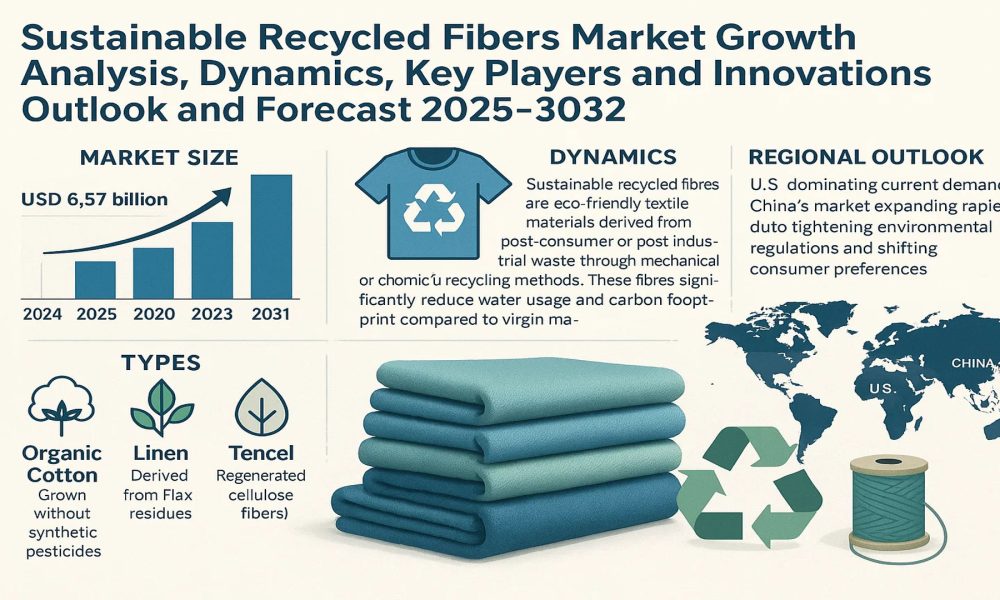
Global Sustainable Recycled Fibers market size was valued at USD 6.57 billion in 2024 and is projected to grow from USD 7.02 billion in 2025 to USD 10.25 billion by 2031, exhibiting a CAGR of 6.7% during the forecast period. While the U.S. dominates current demand, China’s market is expanding rapidly due to tightening environmental regulations and shifting consumer preferences.
Sustainable recycled fibers are eco-friendly textile materials derived from post-consumer or post-industrial waste, processed through mechanical or chemical recycling methods. These include key variants such as organic cotton (grown without synthetic pesticides), linen (from flax plant residues), and Tencel (regenerated cellulose fibers). The fibers maintain fabric quality while significantly reducing water usage and carbon footprint compared to virgin materials – a crucial factor driving adoption.
The market growth stems from tightening environmental policies like the EU’s Circular Economy Action Plan and rising demand from eco-conscious consumers, with the textile segment accounting for over 60% of applications. Industry leaders like REPREVE (processing 30+ billion plastic bottles annually) and Infinited Fiber Company (pioneering chemical recycling for cotton textiles) are accelerating innovation through strategic partnerships and capacity expansions to meet the 15% annual growth in demand for circular textiles.
Request Your Free Sample Report- https://www.intelmarketresearch.com/download-free-sample/9618/sustainable-recycled-fibers-market
MARKET DYNAMICS
MARKET DRIVERS
Growing Consumer Preference for Eco-Friendly Textiles to Accelerate Market Expansion
The global sustainable recycled fibers market is experiencing robust growth, driven by increasing consumer awareness about environmental sustainability. With textile production accounting for approximately 10% of global carbon emissions, brands and consumers alike are shifting towards recycled fiber alternatives. Major fashion retailers are integrating sustainability commitments, with over 60% of global apparel companies now having formal circular economy strategies. This consumer-driven demand manifests in the premium pricing power of sustainable textiles, where products using recycled fibers command 15-20% higher margins than conventional alternatives in many Western markets.
Stringent Government Regulations on Textile Waste to Push Adoption
Legislative pressure represents another critical growth driver, with the EU’s Waste Framework Directive mandating separate textile waste collection by 2025 across member states. Similar Extended Producer Responsibility (EPR) schemes are emerging globally, with over 30 countries now implementing textile waste regulations. The regulatory push creates immediate market opportunities – the EU’s textile recycling rate stands at just 18% currently, creating significant headroom for growth. The U.S. EPA’s National Recycling Strategy similarly identifies textiles as a priority material stream, with anticipated regulations accelerating market adoption.
➤ For instance, France’s Anti-Waste Law requires apparel brands to disclose environmental impact and prohibits destruction of unsold goods, directly promoting recycled fiber usage.
Technological Advancements in Fiber Recycling to Enable Commercial Viability
Breakthroughs in mechanical and chemical recycling technologies are overcoming historical quality limitations of recycled fibers. Innovations in polymer purification and fiber-to-fiber recycling now enable recycled polyester to achieve virgin-equivalent performance in tensile strength and color consistency. This technological maturation supports commercial scaling – global recycled polyester capacity expanded by 28% in 2023 alone. The emergence of advanced sorting technologies utilizing AI and hyperspectral imaging further enhances material recovery rates, addressing one of the industry’s key bottlenecks.
MARKET OPPORTUNITIES
Emerging Circular Business Models to Create New Revenue Streams
The shift toward circular economy principles presents significant opportunities, with product-as-a-service models and take-back programs gaining traction across the apparel sector. Major brands are investing in closed-loop systems – the global used apparel market is projected to grow at 10.6% CAGR through 2031. Innovative business models including rental, resale, and refurbishment create new demand streams for high-quality recycled fibers while improving resource efficiency.
Technological Convergence to Enable New Fiber Applications
Cross-industry technological integration is expanding application possibilities for recycled fibers. The development of conductive recycled polymers enables smart textile applications, while nano-engineered surface treatments enhance moisture management capabilities. These advancements allow recycled fibers to penetrate performance apparel and technical textile markets previously dominated by virgin materials. The automotive sector represents another growth frontier, with interior textiles accounting for 20% of a vehicle’s recyclable materials by weight.
Other Opportunities
Asia-Pacific Infrastructure Development
With Asia generating 60% of global textile waste, regional governments are implementing aggressive recycling infrastructure programs. China’s 14th Five-Year Plan allocates $6 billion for circular economy initiatives including textile recycling.
Premium Product Segmentation
The luxury fashion sector’s embrace of sustainability creates opportunities for high-end recycled fiber applications, with prices for certified recycled cashmere reaching 3x virgin fiber prices in some markets.
Segment Analysis:
By Type
- Organic Cotton
- Linen
- Tencel
- Others
Organic Cotton is the most widely used fiber type due to its eco-friendly cultivation process and high compatibility with textile applications.
By Application
- Textile
- Paper Products
- Automotive
- Others
Textile is the dominant application segment, driven by increasing consumer demand for sustainable clothing and home furnishings.
By Technology
- Mechanical Recycling
- Chemical Recycling
- Bio-based Recycling
Mechanical Recycling remains the most adopted technology due to its lower operational costs and established processing infrastructure.
By End-Use Industry
- Fashion & Apparel
- Home Textiles
- Industrial Textiles
- Packaging
Fashion & Apparel leads as the primary end-use industry, propelled by major brands transitioning to sustainable material sourcing.
List of Key Sustainable Recycled Fiber Companies Profiled
- REPREVE (U.S.)
- Sustana Fiber (U.S.)
- Recover (Spain)
- Fibre World (Germany)
- CYCLO recycled fibers (Sweden)
- Hyosung (South Korea)
- SAYA (Taiwan)
- Stein Fibres (India)
- Sustainable Fiber Technologies (U.S.)
- Infinited Fiber (Finland)
- Jessgrove (U.K.)
- Ferre Yarns (Italy)
- Aquafil (Italy)
- Tencel Fibres (Austria)
- SeaCell (Germany)
- Lenzing’s Ecovero (Austria)
SUSTAINABLE RECYCLED FIBERS MARKET TRENDS
Circular Economy Initiatives Accelerate Demand for Recycled Fibers
The global sustainable recycled fibers market is experiencing robust growth, driven by increasing awareness of environmental sustainability and stringent regulations promoting circular economy practices. The market, valued at $6.57 billion in 2024, is projected to reach $10.25 billion by 2031, growing at a 6.7% CAGR. Key players like REPREVE, Sustana Fiber, and Infinited Fiber are pioneering innovations in recycling technologies, particularly in polyester and cotton waste, to meet rising consumer demand for eco-friendly textiles. Regulatory pressures, such as the European Union’s circular economy action plan, are further compelling brands to adopt recycled fibers as a standard in manufacturing.
Other Trends
Organic Cotton and Plant-Based Fibers Gain Traction
While recycled synthetic fibers dominate, organic cotton and plant-based alternatives like Tencel and linen are emerging as high-growth segments, expected to grow at 8-10% annually through 2031. Consumers increasingly prioritize biodegradability, pushing brands to invest in closed-loop systems. For instance, Lenzing’s Ecovero fibers derived from sustainable wood sources have seen a 35% increase in adoption by fashion brands since 2022. However, scalability remains a challenge due to limited raw material availability and higher production costs compared to conventional cotton.
Textile Industry’s Shift Toward Low-Impact Materials
The textile sector, which accounts for over 60% of recycled fiber applications, is driving R&D in chemical recycling technologies. Innovations like Aquafil’s ECONYL regenerated nylon (made from discarded fishing nets) and Recover’s fiber-to-fiber cotton recycling are reducing landfill waste. Hybrid fibers combining recycled polyester with natural materials are also trending, offering dual benefits of sustainability and performance. Collaborations, such as Adidas x Parley for the Oceans, showcase how partnerships are scaling recycled fiber adoption in sportswear, a segment projected to grow at 12% CAGR until 2030.
Request Your Free Sample Report- https://www.intelmarketresearch.com/download-free-sample/9618/sustainable-recycled-fibers-market
Recent Developments – Sustainable Recycled Fibers Market
- Innovation in Recycling Technology
- Companies are adopting advanced chemical and mechanical recycling techniques to produce high-quality fibers from post-consumer textiles and industrial waste.
- Innovations like enzymatic recycling and solvent-based methods are improving fiber quality and reducing environmental impact.
- Strategic Partnerships & Collaborations
- Leading textile manufacturers are collaborating with recycling technology providers and fashion brands to scale recycled fiber production.
- Partnerships aim to create a closed-loop system, integrating recycled fibers into mainstream apparel and industrial applications.
- Expansion of Production Capacity
- Several manufacturers are investing in new recycling plants or expanding existing facilities to meet the growing demand from sustainable fashion brands.
- Europe and Asia-Pacific are witnessing significant capacity expansions, especially for polyester and cotton recycled fibers.
- Adoption by Major Fashion & Textile Brands
- Big fashion brands are committing to sustainable sourcing, incorporating recycled fibers into seasonal collections.
- Launch of certified eco-friendly lines using recycled fibers is gaining traction in both premium and mass-market segments.
- Government Policies & Incentives
- Some countries are introducing regulations and incentives promoting recycled materials in textiles to reduce landfill waste.
- Policies include subsidies for recycling facilities, extended producer responsibility (EPR), and eco-label certifications for recycled fiber products.
- Sustainability Certifications & Eco-labels
- Increasing adoption of certifications like GRS (Global Recycled Standard) and OEKO-TEX for recycled fibers to assure product authenticity and environmental compliance.
- Rising Consumer Awareness
- Consumers are increasingly preferring eco-friendly apparel and textiles, driving demand for products made from sustainable recycled fibers.
About Intel Market Research
Intel Market Research delivers actionable insights in technology and infrastructure markets. Our data-driven analysis leverages:
- Real-time infrastructure monitoring
- Techno-economic feasibility studies
Competitive intelligence across 100+ countries
Trusted by Fortune 500 firms, we empower strategic decisions with precision.
International: +1(332) 2424 294 | Asia: +91 9169164321
Website: https://www.intelmarketresearch.com
Follow us on LinkedIn:https://www.linkedin.com/company/intel-market-research
Market Research Reports | Market Trends | SWOT Analysis | Industrial Survey – Intelmarketresearch
Intel market research provides market research reports and company research reports across worldwide industries. We also offers customized market research solutions




