
America’s innovation conversion rate, not its supply of ideas, is the number I could not stop thinking about on the drive home from Las Vegas. In early July I served as an investor judge at FreedomFest’s Principled Business Pitch Competition’s first round. Twenty-two founders with ninety seconds each to move from round one into the next stages. Next was a comeback round, then a wildcard semifinal, and an Elite Eight for the grand finale. It is a well-built format, and it measures exactly one of the two things that determine whether a company still matters in ten years.
Every year someone asks whether America is losing its innovative edge. After listening to the initial pitches, I came away with the opposite conclusion. Innovation in the USA is alive and well. Translating that into businesses of value that can make impact? That’s where the rubber hits the road.
The supply side is not broken
The Kauffman Foundation’s national report on early-stage entrepreneurship, released in May, found that roughly 6.6 million American adults started a business in 2025, a return to pre-pandemic formation levels. The rate of new entrepreneurs held at 0.36 percent or about 360 of every 100,000 adults starting something in a given month, above where it sat before 2020.
The founders on the schedule came from Texas, California, Nevada, Illinois, Wyoming, and Puerto Rico. No story about coastal concentration survived contact with the running order. Rather than rank them, I would organize them by the problem they set out to solve.
Seven companies, seven problems
Democratizing professional services. LegalMente AI, out of Texas, is building an AI law firm for international startups and small businesses. These are the exact companies for whom legal cost operates as a gate on formation. I have seen too many companies at the earliest stage make the huge mistake of using a DIY legal solution to form the foundation of their company. The use of AI combined with human expertise makes a lot of sense and can help companies start on the right foot. Jose Padilla’s team is pre-seed with real revenue behind it, which is its own kind of signal.
Restoring human capability. Eyedaptic, in California, uses smart glasses and AI to restore functional vision for people living with macular degeneration. Jay Cormier’s presentation was one of the most impactful of the competition. This is not a technology company; it is an independence company. My mother suffered from macular degeneration, and I know how much this innovation would have meant to her.
Extending healthy lives. Sarcomatrix Therapeutics is pursuing mutation-agnostic muscle-regeneration therapies for muscle-wasting disease. Long cycles of development, heavy capital requirements, and real scientific rigor are precisely the kind of innovation a society depends on and struggles most to finance. I had met David Craig at last year’s Freedom Fest, and they have made palpable progress. Quality of life is more than a cliché or catch phrase. It’s a real problem that needs innovative solutions.
Making education experiential. BāKIT Box teaches children STEM through hands-on baking, folding in geography, language, and culture along the way. This is a perfect example of capitalism at work to promote a social good. I am heavily invested in the same mission through Burble Neuro, and it was wonderful to see such an innovative approach to learning cultures and expanding horizons. Shelley Gupta’s curriculum has been adopted across fifteen states and is a great case of innovation happening well outside software, sold directly to families.
Democratizing investment intelligence. FlipInvestor applies AI to help individual investors make data-driven decisions, the kind of research that was institutional-only for most of its history. The moat in this case was impressive, and while I am usually skeptical about “Black Box” models (though I have invested in them before), the fact that he could provide data substantiating his claims provided credibility and interest. Randy Tate’s company was the most mature in the field, currently raising a Series A. Democratizing the investment playing field in today’s world of high frequency trading could change the game for many blue collar investors, and Randy has priced this service to reach the masses.
Operational excellence as innovation. Not Just Cookies is a wholesale bakery built around co-packing, private labeling, and corporate ordering. At first glance it looked out of place among the many tech and AI startups but it isn’t. Scalable food production creates jobs and strengthens local economies, and getting it right demands an operating discipline most software companies never have to learn. I think about Mrs. Fields and how many companies like hers could have been started had Johnathon Bush been around in the ‘80s. Now could be the time.
Deep-tech materials. Cutting Edge Superconductors, based in Puerto Rico, says it is commercializing a room-temperature superconductor. If that holds up under independent scrutiny, the downstream implications for power transmission, data centers, and chips are enormous. That “if” is the entire investment case, and it deserves to be stated as an “if.” This is the kind of game-changing technology that dreams are built on, but those dreams can rapidly turn into nightmares if the team can’t protect and prove their thesis.
They all cleared the same bar
Out of the twenty-two companies, I have focused on my top seven. All the presenters had merit, but some of them might be more suitable as a nonprofit, others may become great “lifestyle” companies, and yet others were simply creating a better mousetrap. I am always looking for the ones that can really move the needle for society.
Every one of the seven identified a real problem and used their imagination to solve it. Unfortunately, most innovative companies never become valuable (or even viable) businesses. It’s usually not because innovation failed, but because value creation is a far wider discipline than innovation alone. While innovation is the spark, value creation is the engine.
The innovation conversion rate is the real constraint
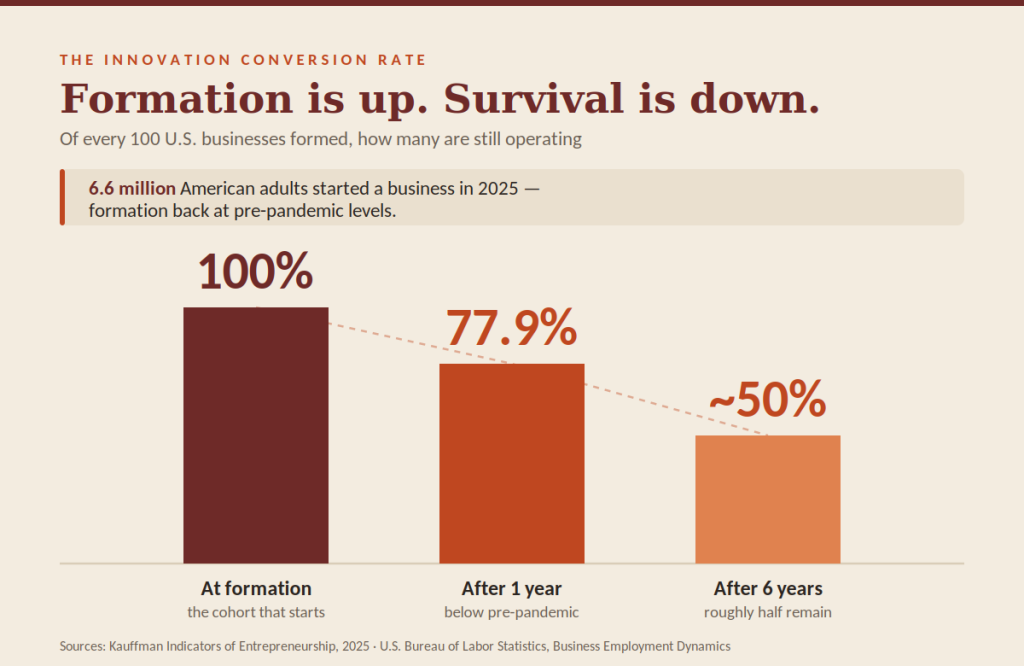
There is a chilling statistic sitting underneath every founder’s optimism. In the same Kauffman report showing formation back at pre-pandemic strength, the one-year startup survival rate came in at 77.9 percent. This is slightly below the prior year, and below where it stood before the pandemic. Bureau of Labor Statistics data on establishment survival confirms and extends the picture: they say about 78.7 percent of new businesses make it through their first full year, and by year six only around half are still operating.
While formation is up, survival is down. That divergence is the innovation conversion rate, and it is not an idea-supply problem. It is also not something ninety seconds on a clock can detect. Ninety seconds measures the clarity of an idea and the quality of its articulation. Both are worth measuring but neither predicts whether the company will exist in a decade, and the odds are it won’t. Welcome to the world of angel investing.
Where the innovation conversion rate is decided
Conversion happens in the parts of company-building founders are least excited about:
- Scalable business models
- Disciplined capital allocation
- Governance
- Operational excellence
- Customer acquisition
- Financial management
- Strategic partnerships
- Leadership and execution
None of that fits into ninety seconds and most of it does not fit into a pitch deck at all. It lives in the operating system of the business, and it becomes apparent as a financial result long after the structural conditions that produced it were set.
That lag is the pattern I keep returning to. Structural drift comes first and operating symptoms follow. Financial evidence arrives last, by which point the correction has become expensive. It is the reason the Enterprise Value Creation Roadmap is built around diagnosis rather than scoring. It surfaces the conditions that decide whether an innovation converts, well before the numbers make them obvious.
Raising the tide

My biggest takeaway from FreedomFest was not who won the competition, it was how many founders across the country are working on problems genuinely worth solving, and how thin the infrastructure is for helping those companies become enduring enterprises.
The opportunity in front of us is not to fund more startups. It is to improve the innovation conversion rate. When that number moves, everyone in the deal wins: founders, employees, investors, customers, and the communities where these companies actually operate. Innovation creates possibility, but value creation turns possibility into something that lasts.
That may be the most important economic opportunity in front of America today.