
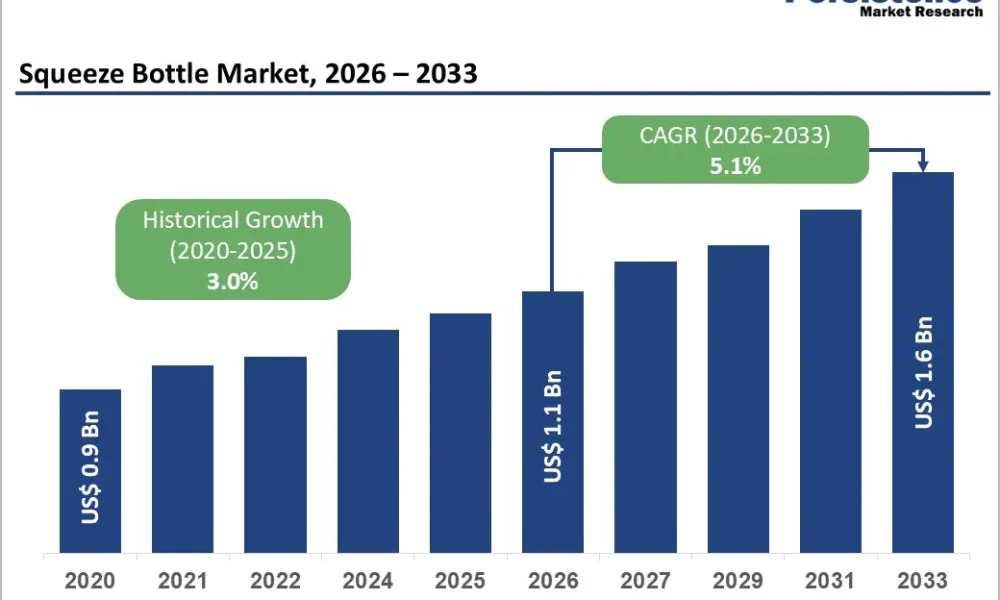
The squeeze bottle market has gained considerable traction in recent years due to growing consumer demand for convenient, portable, and easy-to-use packaging formats. Squeeze bottles are widely used for dispensing liquids, sauces, creams, oils, and personal care products with precision and minimal waste. Their flexible design allows users to control the flow of the product, making them highly suitable for applications in food service, cosmetics, pharmaceuticals, and household products. According to market projections, the global squeeze bottle market size is expected to reach US$ 1.1 billion in 2026 and is projected to expand to US$ 1.6 billion by 2033, growing at a CAGR of 5.1% during the forecast period from 2026 to 2033. The steady growth of the market is primarily driven by increasing consumer preference for portable and single-serve packaging solutions, which offer convenience and ease of use in daily applications.
The demand for squeeze bottles is also closely tied to broader changes in packaging technologies and sustainability initiatives. The shift toward lightweight, recyclable polymer packaging, particularly polyethylene (PE) and polypropylene (PP), has significantly strengthened the adoption of squeeze bottle solutions across industries. Manufacturers are focusing on developing environmentally friendly packaging formats that meet regulatory requirements while maintaining functional performance. Among the key product categories, plastic squeeze bottles dominate the market due to their durability, flexibility, and cost-effectiveness. In terms of geography, Asia Pacific holds the leading share of the squeeze bottle market, supported by rapid urbanization, growing consumer goods industries, and increasing demand for packaged food and personal care products. Emerging economies in the region are witnessing rising consumption of convenient packaging formats, which further supports long-term market growth.
𝐆𝐞𝐭 𝐚 𝐒𝐧𝐞𝐚𝐤 𝐏𝐞𝐞𝐤, 𝐒𝐚𝐦𝐩𝐥𝐞 𝐏𝐃𝐅 𝐈𝐧𝐬𝐢𝐝𝐞: https://www.persistencemarketresearch.com/samples/36080
Key Highlights from the Report
• The squeeze bottle market is projected to reach US$ 1.6 billion by 2033.
• Growing demand for convenient and portable liquid packaging is driving market growth.
• Polyethylene and polypropylene remain the most widely used materials in squeeze bottle manufacturing.
• Rising adoption of recyclable and sustainable packaging solutions is shaping industry innovation.
• Expanding food service and personal care sectors are increasing product demand.
• Asia Pacific leads the market due to strong consumer goods production and rising consumption.
Market Segmentation
The squeeze bottle market can be segmented based on material type, product capacity, closure type, and end-use industry. In terms of material type, the market is primarily divided into polyethylene (PE), polypropylene (PP), and other polymer materials. Polyethylene squeeze bottles dominate the market due to their flexibility, chemical resistance, and lightweight properties. Polypropylene bottles are also gaining traction because of their higher heat resistance and durability, making them suitable for products requiring greater structural stability.
From a capacity perspective, squeeze bottles are available in various sizes ranging from small single-serve bottles to larger multi-use containers. Smaller bottles are commonly used for sauces, condiments, and cosmetic products, while larger bottles are often utilized in household and industrial applications. The increasing popularity of travel-size packaging and sample products has further boosted demand for compact squeeze bottle designs.
The market can also be categorized based on closure and dispensing systems, including flip-top caps, twist caps, nozzle caps, and specialized dispensing closures. Product innovation in closure design plays a critical role in improving user convenience and product functionality. Advanced dispensing systems allow precise application, leak prevention, and controlled product flow, which enhances the overall consumer experience.
In terms of end-use industries, squeeze bottles are widely used in food and beverage, personal care and cosmetics, pharmaceuticals, household cleaning products, and industrial applications. The food and beverage sector represents one of the largest segments, as squeeze bottles are commonly used for condiments such as ketchup, sauces, honey, and syrups. The personal care industry is another major contributor, where squeeze bottles are used for products such as lotions, shampoos, creams, and gels. Additionally, pharmaceutical and healthcare industries use squeeze bottles for controlled dispensing of liquid medications and solutions.
𝐎𝐧𝐞 𝐂𝐥𝐢𝐜𝐤 → 𝐘𝐨𝐮𝐫 𝐂𝐮𝐬𝐭𝐨𝐦 𝐌𝐚𝐫𝐤𝐞𝐭 𝐕𝐢𝐞𝐰: https://www.persistencemarketresearch.com/request-customization/36080
Regional Insights
The Asia Pacific region leads the global squeeze bottle market due to rapid industrial development and growing demand for packaged consumer goods. Countries such as China, India, Japan, and South Korea are major manufacturing hubs for packaging products and consumer goods. Rising urbanization and expanding middle-class populations in these countries have increased consumption of packaged food and personal care products, which in turn drives demand for squeeze bottle packaging solutions.
North America represents another significant market for squeeze bottles, driven by strong demand from the food service and personal care industries. Consumers in the region increasingly prefer convenient and hygienic packaging formats that allow easy dispensing of liquid products. Additionally, packaging innovation and sustainability initiatives have encouraged manufacturers to develop recyclable squeeze bottle designs.
Europe also holds a notable share of the squeeze bottle market, supported by strict environmental regulations and strong emphasis on sustainable packaging practices. European packaging manufacturers are focusing on recyclable materials and mono-material packaging structures to comply with environmental standards. Meanwhile, emerging markets in Latin America and the Middle East & Africa are witnessing gradual growth due to increasing demand for consumer goods and expanding retail distribution networks.
Market Drivers
One of the major drivers of the squeeze bottle market is the growing demand for convenient packaging solutions across multiple industries. Modern consumers increasingly prefer packaging formats that offer portability, ease of use, and controlled dispensing. Squeeze bottles meet these requirements by allowing users to easily dispense liquids without spills or product wastage. The growth of on-the-go consumption patterns, particularly in the food and beverage industry, has significantly increased the demand for squeeze bottle packaging.
Another key driver is the expansion of the personal care and cosmetics industry, where squeeze bottles are widely used for packaging creams, lotions, and other liquid products. The increasing focus on product differentiation and attractive packaging design is encouraging manufacturers to develop innovative squeeze bottle formats. Additionally, the rise of e-commerce and direct-to-consumer sales channels has increased the need for durable and leak-proof packaging solutions.
Market Restraints
Despite strong growth prospects, the squeeze bottle market faces several challenges. One of the primary restraints is the environmental concern associated with plastic packaging waste. Although polyethylene and polypropylene are recyclable materials, improper disposal and limited recycling infrastructure in certain regions contribute to environmental pollution. Governments and regulatory bodies are implementing stricter policies related to plastic packaging, which may affect the production and usage of traditional squeeze bottles.
Another challenge is the volatility in raw material prices, particularly for polymer-based packaging materials. Fluctuations in the cost of petroleum-based raw materials can impact manufacturing costs and profit margins for packaging companies. Additionally, the presence of alternative packaging formats such as pump bottles, pouches, and glass containers may limit the adoption of squeeze bottles in some applications.
Market Opportunities
The squeeze bottle market presents significant opportunities as packaging manufacturers increasingly focus on sustainable and innovative packaging solutions. The development of recyclable, biodegradable, and mono-material squeeze bottles is expected to create new growth opportunities for industry players. Companies are also exploring the use of recycled plastics and bio-based materials to reduce environmental impact.
Another promising opportunity lies in product innovation and advanced dispensing technologies. Improved closure systems, anti-drip nozzles, and precision dispensing mechanisms are enhancing the functional performance of squeeze bottles. Furthermore, the expansion of emerging markets with rapidly growing consumer goods industries offers strong potential for market growth. As disposable incomes increase and modern retail infrastructure expands, the demand for convenient packaging solutions is expected to rise significantly.
𝐁𝐮𝐲 𝐍𝐨𝐰 𝐭𝐡𝐞 𝐃𝐞𝐭𝐚𝐢𝐥𝐞𝐝 𝐑𝐞𝐩𝐨𝐫𝐭: https://www.persistencemarketresearch.com/checkout/36080
Company Insights
Key players operating in the squeeze bottle market include:
• Berry Global Inc.
• Amcor plc
• Silgan Holdings Inc.
• AptarGroup, Inc.
• Alpha Packaging
• Cospack America Corp.
• Berlin Packaging
• Graham Packaging Company
• O.Berk Company, LLC
• Comar LLC
Recent developments in the market include the introduction of recyclable mono-material squeeze bottles designed to meet sustainability targets set by major consumer brands. Additionally, several packaging companies have launched innovative dispensing closures and lightweight bottle designs, which help reduce material usage while maintaining functional performance and product protection.
Conclusion
The squeeze bottle market is poised for steady growth over the coming years as consumer demand for convenient, portable, and functional packaging continues to rise. Increasing adoption across food, personal care, and household product industries is driving market expansion. At the same time, sustainability concerns and regulatory pressures are encouraging manufacturers to develop recyclable and environmentally friendly packaging solutions. Advances in material technology, dispensing systems, and lightweight packaging design are expected to play a crucial role in shaping the future of the squeeze bottle industry. As emerging markets continue to expand and consumer lifestyles evolve toward convenience-driven consumption, squeeze bottles will remain an important packaging format supporting modern retail and industrial applications.




