
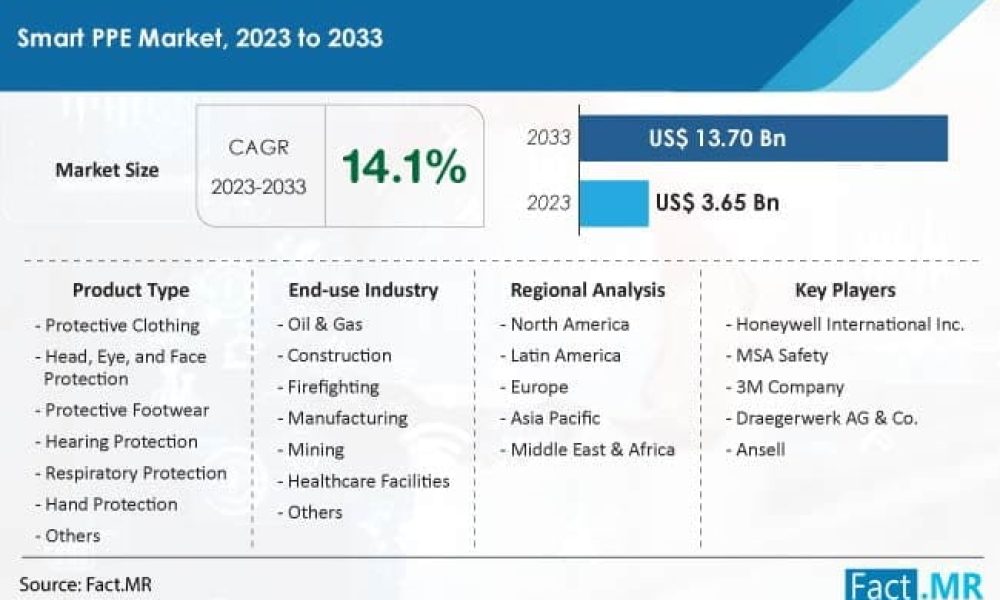
The Smart Personal Protective Equipment (PPE) market represents a revolutionary paradigm in workplace safety, integrating advanced technologies to enhance the effectiveness and capabilities of traditional protective gear. Smart PPE includes a range of wearable devices and equipment embedded with sensors, communication modules, and data analytics capabilities. These innovations provide real-time monitoring, communication, and data analysis, offering heightened safety measures for workers across various industries. The market’s growth is propelled by a growing emphasis on occupational safety, the increasing awareness of the benefits of smart technologies, and regulatory initiatives to improve workplace safety standards.
Experiencing a robust Compound Annual Growth Rate (CAGR) of 14.1% from 2023 to 2033, the global smart PPE market is anticipated to witness substantial expansion. Starting from a valuation of US$ 3.65 billion in 2023, the market is projected to reach US$ 13.7 billion by the conclusion of 2033. Smart personal protective equipment (PPE) refers to protective gear that integrates smart sensors and wearable technology, enhancing user safety. The increasing adoption of Industry 4.0 standards across diverse sectors and the rising prevalence of powerful automated machinery are expected to significantly drive the sales of smart PPE products over the long term.
Download a Sample Copy of This Report:
https://www.factmr.com/connectus/sample?flag=S&rep_id=4611
Competitive Landscape
Top-tier smart PPE manufacturers are focusing on achieving certifications and approvals from regulatory bodies and launching new products to boost their sales potential.
- In January 2023, Intellinium, a renowned name in the smart worker safety space, announced that it had received ATEX product certification under the examination of LCIE Bureau Veritas. The company is revolutionizing the ATEX space with its device that can communicate on various frequencies and protocols such as GNSS, NFC, LoRaWAN, 4G LTE-M, etc.
- In January 2023, German Bionic, a leading European robotics company developing and manufacturing connected exoskeletons and wearables, announced the launch of three new products. One of the products is Smart SafetyVest, which is an advanced PPE product that utilizes sensors to gather information on workplace productivity.
Key Companies Profiled
- 3M Company
- Seebo Interactive Ltd.
- MSA Safety
- Ansell
- Vuzix Corporation
- Intellinium
- Honeywell International Inc.
- DuPont de Nemours Inc.
- Uvex Winter Group
- Draegerwerk AG & Co.
Key Market Drivers:
- Focus on Worker Safety and Well-being: The primary driver for the Smart PPE market is the heightened focus on worker safety and well-being. As industries become more cognizant of the importance of maintaining a safe working environment, the integration of smart technologies into PPE offers real-time monitoring of vital signs, environmental conditions, and potential hazards, ensuring a proactive approach to occupational safety.
- Rise of Industry 4.0 and IoT Integration: The advent of Industry 4.0 and the integration of the Internet of Things (IoT) into industrial processes have significantly influenced the Smart PPE market. The ability to connect PPE devices to centralized systems enables seamless data exchange, monitoring, and control, contributing to a more interconnected and responsive work environment.
- Regulatory Compliance and Standards: Regulatory bodies and occupational health and safety standards play a pivotal role in driving the adoption of Smart PPE. Companies are motivated to comply with regulations and standards that mandate the use of advanced safety technologies, creating a conducive environment for the market’s growth.
“Rising Emphasis on Worker Safety Presents Abundant Opportunities for Emerging Smart PPE Companies”
Insufficient measures to safeguard workers across various industries have led to significant loss of lives, prompting governments to advocate for enhanced worker safety measures. The increasing awareness regarding worker well-being, combined with the widespread availability of smart safety equipment, has created a highly favorable environment for new entrants in the connected PPE sector.
In June 2021, Gales, a California-based footwear company established in 2020, introduced its inaugural line of smart PPE footwear tailored specifically for nurses. Engineered to be waterproof, antimicrobial, and slip-resistant, these new footwear products prioritize safety and comfort for medical professionals and caregivers.
In May 2020, Kenzen, a startup founded in 2016 with a focus on predicting and preventing industrial workforce injuries, unveiled a new worker heat monitoring system. This cloud-based system incorporates a wearable device worn by workers, providing real-time alerts to both workers and supervisors when temperatures surpass safety limits, thereby preventing injuries.
Flyability, established in 2014, is another startup addressing confined workplace safety through drone solutions designed to access inaccessible spaces. Aligning with the new Industry 4.0 norms, the startup’s innovative technology and LiDAR aim to fulfill the need for predictive maintenance.
For a more comprehensive understanding of current and future market scope, including challenges, trends, local supply, pricing, product standards, safety regulations, and recent developments, readers are encouraged to explore Fact.MR’s insightful smart PPE market research report. Developed by proficient analysts, this report provides valuable insights into the market landscape.
Challenges and Restraints:
- High Initial Costs: The implementation of Smart PPE involves an initial investment in advanced technologies, which can be a significant restraint for some businesses. The high costs associated with acquiring, deploying, and maintaining smart devices may pose a challenge, particularly for smaller enterprises with budget constraints.
- Data Security and Privacy Concerns: The collection and transmission of sensitive data from Smart PPE devices raise concerns about data security and privacy. Ensuring the secure storage and transmission of personal and health-related information is crucial to overcoming potential resistance to the adoption of these technologies.
Key Segments of Smart PPE Industry Research
- By Product Type :
- Protective Clothing
- Head, Eye, and Face Protection
- Protective Footwear
- Hearing Protection
- Respiratory Protection
- Hand Protection
- Others
- By End-use Industry :
- Oil & Gas
- Construction
- Firefighting
- Manufacturing
- Healthcare Facilities
- Mining
- Others
- By Region :
- North America
- Latin America
- Europe
- APAC
- MEA
Technological Advancements:
Technological advancements in Smart PPE are driving innovation across the market. Key developments include the integration of sensors for real-time health monitoring, augmented reality (AR) for enhanced situational awareness, and communication modules for seamless connectivity. Advanced materials and design improvements also contribute to the durability and usability of Smart PPE.
Current Industry News (2023):
Several trends and developments may have shaped the Smart PPE market in 2023.
- AI Integration for Predictive Analytics: The industry may have witnessed increased integration of Artificial Intelligence (AI) for predictive analytics in Smart PPE. AI algorithms can analyze data from sensors and predict potential safety risks, allowing for proactive measures to prevent accidents and injuries in the workplace.
- Expansion of Smart PPE in Healthcare: The adoption of Smart PPE may have expanded into the healthcare sector, especially in response to global health challenges. Smart wearables for healthcare workers could include features such as real-time health monitoring and communication capabilities, contributing to the safety of frontline workers.
- Collaborations for Interoperability: Collaborations between Smart PPE manufacturers and technology companies may have focused on achieving interoperability among different devices. Ensuring seamless communication and data exchange between various Smart PPE components enhances their overall effectiveness in diverse workplace settings.
- Emphasis on User Comfort and Ergonomics: Ongoing developments may have placed a greater emphasis on user comfort and ergonomics in Smart PPE design. Innovations in materials and wearable technologies aim to enhance user experience, encouraging better adoption rates among workers.
Get Customization on this Report for Specific Research Solutions:
https://www.factmr.com/connectus/sample?flag=RC&rep_id=4611?PJ
The Smart PPE market is at the forefront of innovation in workplace safety, driven by a growing commitment to ensuring the well-being of workers. Despite challenges related to costs and data security, ongoing technological advancements, regulatory support, and industry collaborations contribute to the market’s evolution. The integration of AI, expansion into new sectors, and a focus on user-centric design underscore the dynamic nature of the Smart PPE market, positioning it as a key player in the future of occupational safety.
Contact:
US Sales Office:
11140 Rockville Pike
Suite 400
Rockville, MD 20852
United States
Tel: +1 (628) 251-1583
E Mail : [email protected]




