
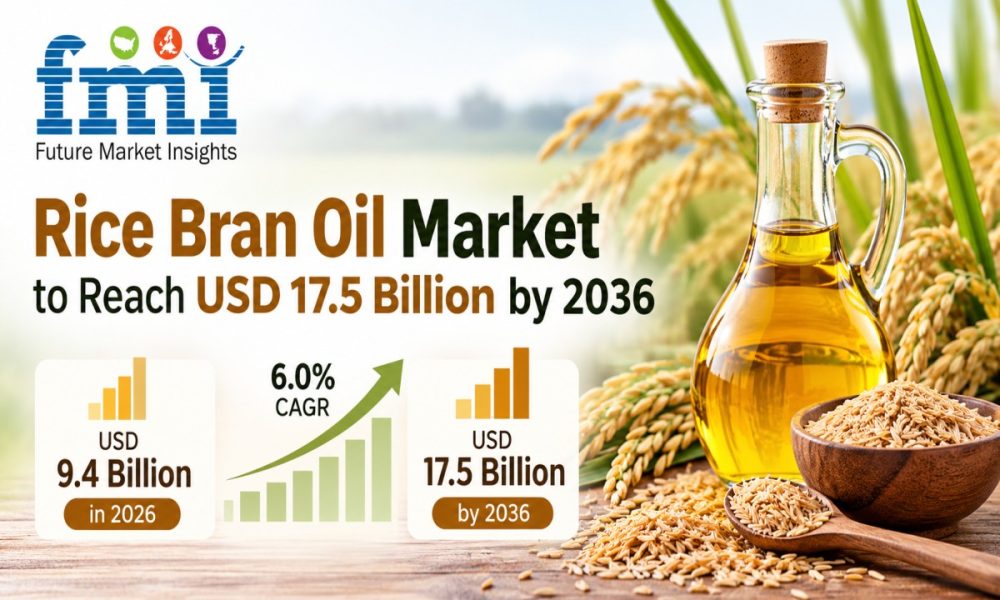
The global Rice Bran Oil Market is projected to reach USD 17.5 billion by 2036, up from USD 9.4 billion in 2026, expanding at a 6.0% CAGR during the forecast period, according to the latest analysis by Future Market Insights (FMI).
The market is supported by demand for cooking oils that offer mild sensory characteristics, high-temperature cooking performance and differentiated rice-derived positioning. Food processors, foodservice operators and households are increasingly evaluating rice bran oil alongside established vegetable oils based on frying performance, delivered cost, supply reliability and product characteristics.
Get Detailed Market Forecasts, Competitive Benchmarking, and Pricing Trends:
https://www.futuremarketinsights.com/reports/sample/rep-gb-16708
Cold Pressed Products Lead Product Type Demand
Cold Pressed rice bran oil is estimated to account for 33.0% of product type demand in 2026, making it the leading category.
The format benefits from lower-process-intensity positioning and premium applications where consumers and food manufacturers value processing method and traceability. However, commercial performance depends on feedstock quality, extraction yield and consistent oil specifications.
Suppliers can strengthen the value proposition through rapid bran stabilization, controlled extraction and differentiated composition, including higher-value positioning around naturally occurring components such as gamma-oryzanol.
Cooking Oil and Deep Frying Leads End Use
Cooking Oil & Deep Frying is projected to represent 35.0% of end use demand in 2026.
Rice bran oil’s mild sensory profile makes it suitable for household cooking, foodservice operations and processed-food manufacturing. High-temperature applications create a direct performance requirement, with buyers evaluating flavor transfer, replacement frequency, thermal behavior and supply consistency.
The segment competes with soybean, sunflower, rapeseed, palm and other established vegetable oils, making cost and performance important purchasing considerations.
Business-to-Business Channels Hold the Largest Share
Business to Business Channels are expected to account for 40.0% of sales channel demand in 2026.
Food processors, institutional buyers, foodservice operators and private-label manufacturers frequently purchase rice bran oil in larger volumes against defined product specifications.
B2B buyers place particular importance on consistent refining, storage, packaging and delivery because off-specification oil or delayed shipments can disrupt food production and frying operations.
Rapid Bran Deterioration Creates a Supply Challenge
One of the key challenges for rice bran oil producers occurs immediately after rice milling.
Freshly generated bran can deteriorate rapidly if it is not collected and stabilized promptly. Delays can increase free fatty acids and reduce the value recoverable through edible-oil processing.
Integrated milling, collection, stabilization, extraction and refining operations can therefore provide advantages by reducing the time between bran generation and processing.
Higher-Value Products Create New Opportunities
Rice bran oil suppliers are increasingly looking beyond commodity cooking-oil positioning.
Cold-pressed products, physically refined oils, higher-oryzanol formats and traceable products can create differentiated propositions for premium retail and specialized B2B applications.
Additional value can also be generated from rice-bran fractions and derivatives produced during downstream processing, expanding the commercial relationship between rice milling and specialty ingredients.
France Leads Highlighted Country Growth
Among the highlighted country markets, France is projected to record an 11.0% CAGR through 2036, followed by Japan at 10.0%, Germany at 9.0%, Italy at 8.0% and Brazil at 7.0%. The USA is projected at 6.0%, while Belgium and Russia record 5.0% and 4.0%, respectively.
France’s growth reflects opportunities for premium edible-oil positioning within a competitive market. Japan benefits from established familiarity with rice oil in household and industrial applications. Germany offers a large food-processing base, while Italy and Brazil benefit from rice-processing activity that can provide access to bran feedstock.
Competitive Landscape
The Rice Bran Oil Market includes integrated rice-bran processors, edible-oil manufacturers, specialist rice-oil producers and branded food companies.
Key companies profiled by FMI include AWL Agri Business Limited, King Rice Oil Group, Ricela Health Foods Ltd., A.P. Refineries Pvt. Ltd., Wilmar International Limited, Sethia Oils, 3F Industries Ltd., Tsuno Food Industrial Co., Ltd. and Patanjali Foods Limited.
Competitive positioning is influenced by control over bran sourcing, stabilization, extraction and refining, alongside product quality, value-added formats, B2B relationships, retail distribution and geographic reach.
Key Industry Developments
The market continues to see investments in processing infrastructure, product differentiation and rice-bran utilization.
In January 2025, AWL Agri Business Limited commissioned an integrated food manufacturing complex in Haryana, strengthening its broader edible-oil and food-production infrastructure.
In November 2024, King Rice Oil Group announced an investment of 1.5 billion baht for a new plant in Nakhon Sawan Province, supporting raw-material management and production capacity.
In May 2026, King Rice Oil Group showcased new rice-based products at THAIFEX – Anuga Asia, including a chili-garlic product in rice bran oil and a reformulated King Rice Bran Oil positioned around higher oryzanol content.
Analyst Perspective
“Rice bran oil economics begin at the mill rather than the retail shelf. Suppliers that control bran collection, stabilization and refining can protect more value before competing on frying performance, oryzanol content and channel access.” — Nandini Roy Choudhury, Principal Consultant, Future Market Insights
Exclusive Discounts on Full Report
Rice Bran Oil Market – https://www.futuremarketinsights.com/reports/rice-bran-oil-market
Report Scope
The FMI study covers the Rice Bran Oil Market by product type, end use, sales channel and region. Product types include cold pressed, refined, raw grade 1 hydrogenated oil and raw grade 2 industrial purposes. End-use categories include cooking oil & deep frying, functional foods, processed foods, salad dressings, bakery & confectionery, animal feed formulation, marinades and sauces, cosmetic and personal care, textile and leather treatment, and infused oils.
Sales channels include business-to-business channels, convenience stores, hypermarkets/supermarkets, discount stores, online websites, independent grocery stores and hyperlocal grocery delivery applications.
The research covers North America, Latin America, Western Europe, Eastern Europe, East Asia, South Asia and Pacific, and the Middle East and Africa.
Key Executive Benefits
- Decision-Ready Insights
- Reduced Strategic Risk
- Market Entry Confidence
- Competitive Advantage
- Faster Growth Decisions
- Primary Market Validation
To explore how FMI Custom Research can support your strategic priorities, connect with our team at [email protected].
About Future Market Insights (FMI)
Future Market Insights, Inc. is an ESOMAR-certified, ISO 9001:2015 market research and consulting organization trusted by Fortune 500 companies. With a global presence across the U.S., UK, India and Dubai, FMI delivers data-driven insights across 30+ industries and 1,200 markets worldwide.



