
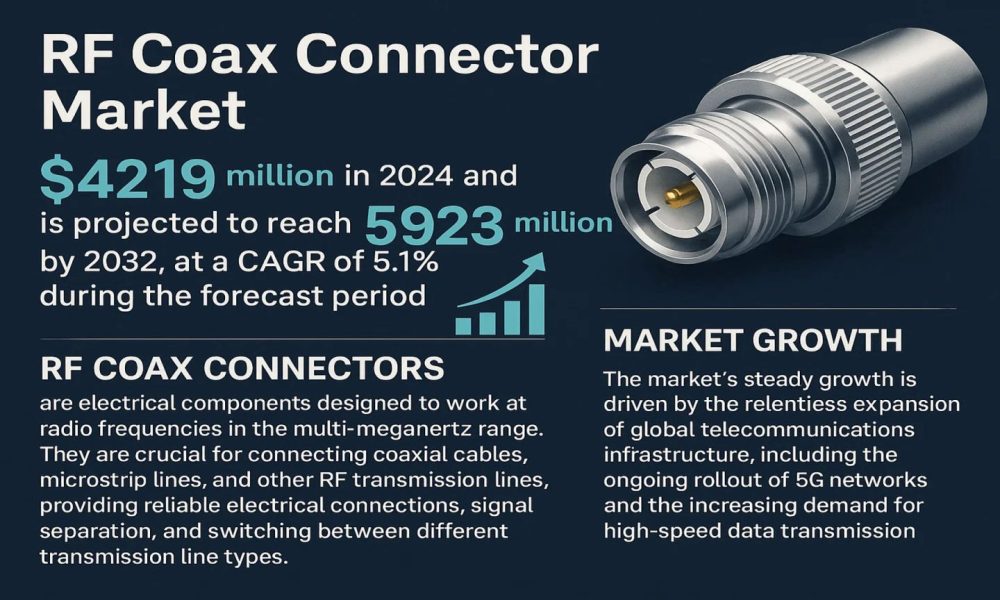
RF Coax Connector Market was valued at 4219 million in 2024 and is projected to reach US$ 5923 million by 2032, at a CAGR of 5.1% during the forecast period.
RF Coax Connectors are electrical components designed to work at radio frequencies in the multi-megahertz range. They are crucial for connecting coaxial cables, microstrip lines, and other RF transmission lines, providing reliable electrical connections, signal separation, and switching between different transmission line types. These connectors are fundamental to ensuring signal integrity and minimizing power loss in high-frequency applications.
The market’s steady growth is driven by the relentless expansion of global telecommunications infrastructure, including the ongoing rollout of 5G networks and the increasing demand for high-speed data transmission. Furthermore, the proliferation of Internet of Things (IoT) devices and the rising adoption of advanced electronics in the automotive, aerospace, and medical sectors are significant contributors.
The market is moderately concentrated, with the top three players—Rosenberger, TE Connectivity, and Amphenol—collectively holding approximately 30% of the global market share. Geographically, China and North America are the dominant markets, accounting for about 50% of global demand. By product type, Standard connectors hold the largest segment share at around 40%, while the Telecom application is the primary end-use sector, also commanding a 40% share.
Grab Your Complimentary Sample Report- RF Coax Connector Market
MARKET DYNAMICS
MARKET DRIVERS
Proliferation of 5G Infrastructure Deployment to Accelerate Market Expansion
The global rollout of 5G networks represents a primary catalyst for the RF coax connector market, driving substantial demand across telecommunications infrastructure. 5G technology requires a significantly higher density of base stations and small cells compared to previous generations, often necessitating complex antenna systems and heightened connectivity solutions.
Each site utilizes numerous RF coax connectors for signal transmission between antennas, radios, and other equipment. Industry analyses confirm that millions of new 5G base stations are projected for installation globally within the next several years, directly correlating to increased connector consumption. Furthermore, the higher frequency bands used in 5G, including millimeter-wave spectrum, demand connectors with superior performance characteristics to minimize signal loss and maintain integrity, pushing manufacturers toward advanced designs and materials.
Rising Demand for High-Speed Data Transmission in Consumer Electronics to Fuel Growth
Consumer electronics continue to evolve toward higher data rates and greater connectivity, necessitating reliable RF interconnection solutions. Devices such as smartphones, laptops, tablets, and gaming consoles increasingly incorporate features like Wi-Fi 6/6E, 5G modems, and advanced Bluetooth, all requiring robust RF coax connectors for internal antenna connections and external ports.
The miniaturization trend further drives demand for smaller form-factor connectors, such as micro-miniature types, which maintain performance while occupying less board space. Shipments of these connected devices number in the billions annually, creating a consistent and high-volume demand stream for RF coax connectors. This sector’s growth is inextricably linked to consumer demand for faster, more reliable wireless performance in everyday gadgets.
Expansion of Satellite Communication and Aerospace Applications to Bolster Market
Satellite communication, including low-earth orbit (LEO) constellations for global internet coverage, and ongoing advancements in aerospace and defense systems, are significant growth vectors. These applications require RF coax connectors that can withstand extreme environmental conditions, including wide temperature fluctuations, vibration, and corrosion, while providing stable, low-loss performance.
The number of active satellites has seen a dramatic increase, with thousands more planned for launch, each utilizing numerous high-reliability connectors for communication payloads and ground station links. Similarly, modern aircraft, both commercial and military, incorporate extensive avionics and in-flight connectivity systems that rely on specialized RF interconnects. This segment often commands premium prices due to the stringent performance and reliability standards required.
Recent Developments in the RF Coax Connector Market
- Advancements in High-Frequency Applications
- Manufacturers are developing RF coax connectors capable of supporting frequencies above 110 GHz to meet the rising demand in 5G, satellite communication, and radar systems.
- New precision connectors such as 1.0 mm and 0.8 mm designs are being introduced for ultra-high-frequency use.
- Adoption in 5G and IoT Infrastructure
- The growing deployment of 5G base stations and IoT devices has increased the demand for compact, low-loss RF coax connectors.
- Companies are focusing on connectors optimized for small cells, antennas, and MIMO systems.
- Miniaturization and High-Density Designs
- The trend toward smaller electronic devices is driving innovation in micro and nano coax connectors.
- These are widely used in smartphones, wearable devices, and compact communication equipment.
- Automotive Connectivity Expansion
- The automotive industry’s shift toward advanced driver-assistance systems (ADAS) and vehicle-to-everything (V2X) communications has boosted demand for durable, high-performance RF connectors.
- Waterproof and vibration-resistant connectors are being launched for in-vehicle communication modules.
- Strategic Collaborations and Acquisitions
- Leading players such as TE Connectivity, Amphenol, and Rosenberger are entering partnerships and acquisitions to expand their product portfolios and regional presence.
- For instance, new partnerships have been formed to develop next-generation connectors for aerospace and defense systems.
- Focus on Sustainability and Materials Innovation
- Companies are exploring eco-friendly materials and advanced plating techniques to reduce environmental impact and improve connector longevity.
- Improved shielding materials are also being adopted to minimize signal interference.
MARKET OPPORTUNITIES
Emergence of Autonomous Vehicles and Advanced Driver-Assistance Systems (ADAS) to Unlock New Avenues
The automotive industry’s rapid transition toward electrification, connectivity, and autonomy presents a substantial greenfield opportunity for RF coax connectors. Modern vehicles are evolving into sophisticated connected platforms, incorporating a multitude of systems such as cellular modems for telematics, GPS modules for navigation, dedicated short-range communication (DSRC) for vehicle-to-everything (V2X) communication, and numerous radar and lidar sensors for ADAS and autonomous driving.
Each of these systems requires high-frequency, reliable RF interconnects to function correctly. With projections indicating that tens of millions of new vehicles will feature advanced connectivity and autonomy capabilities annually, the automotive sector is poised to become a major growth engine, demanding connectors that can also meet stringent automotive-grade reliability and environmental standards.
Growth in Internet of Things (IoT) and Industrial Automation to Create Lucrative Prospects
The proliferation of IoT devices across smart cities, industrial IoT (IIoT), and agricultural technology is generating new requirements for robust wireless connectivity. These applications often involve sensors and devices deployed in harsh or remote environments, necessitating RF connectors that offer environmental sealing, durability, and stable performance over long periods.
In industrial automation, for instance, wireless connectivity is increasingly used for machine-to-machine communication and control in settings where wired connections are impractical. The sheer volume of connected devices forecasted to be deployed across these sectors translates into significant potential demand for specialized RF coax connectors tailored for reliability over pure miniaturization, opening a distinct market segment less susceptible to the extreme price pressures found in consumer electronics.
Development of Enhanced Connector Designs for Higher Frequency Applications to Offer Competitive Edge
As wireless technology pushes further into millimeter-wave frequencies to support applications like 5G FR2, satellite broadband, and advanced radar, there is a growing need for connectors that can perform effectively at these elevated bands. Standard connector designs begin to exhibit unacceptable signal loss and performance degradation at frequencies above a certain threshold.
This creates a significant opportunity for innovation. Companies that develop and patent new connector interfaces, utilize advanced dielectric materials, and implement superior plating techniques to achieve lower insertion loss and better impedance control at higher frequencies can capture value in these premium, performance-critical applications. This technological advancement allows manufacturers to differentiate themselves and move competition away from solely price-based factors.
Grab Your Complimentary Sample Report- RF Coax Connector Market
List of Key RF Coax Connector Companies Profiled
- Rosenberger (Germany)
- TE Connectivity (Switzerland)
- Huber+Suhner (Switzerland)
- Amphenol (U.S.)
- Hirose Electric Co., Ltd. (Japan)
- Radiall (France)
- Telegärtner (Germany)
- I-PEX (Dai-Ichi Seiko) (Japan)
- Molex (U.S.)
- JAE Electronics, Inc. (Japan)
- Samtec, Inc. (U.S.)
Segment Analysis:
By Type
Standard Connectors Segment Dominates the Market Due to Widespread Use Across Multiple Industries
The market is segmented based on type into:
- Standard
- Miniature
- Subminiature
- Microminiature
- Other
By Application
Telecom Segment Leads Due to Critical Role in Wireless Infrastructure and 5G Deployment
The market is segmented based on application into:
- Telecom
- Computer
- Industrial
- Automobile
- Medical
- Other
By End User
Telecommunications Equipment Manufacturers Represent the Largest End-User Segment
The market is segmented based on end user into:
- Telecommunications Equipment Manufacturers
- Electronics and Consumer Device Manufacturers
- Automotive Electronics Suppliers
- Medical Device Manufacturers
- Aerospace and Defense Contractors
By Frequency Range
High-Frequency Connectors Experience Growing Demand for Advanced Communication Systems
The market is segmented based on frequency range into:
- Low Frequency
- Medium Frequency
- High Frequency
- Microwave Frequency
- Millimeter Wave Frequency
About Semiconductor Insight:
Established in 2016, Semiconductor Insight specializes in providing comprehensive semiconductor industry research and analysis to support businesses in making well-informed decisions within this dynamic and fast-paced sector. From the beginning, we have been committed to delivering in-depth semiconductor market research, identifying key trends, opportunities, and challenges shaping the global semiconductor industry.
Our expertly developed semiconductor market reports offer actionable intelligence, including detailed semiconductor industry analysis, market forecasts, competitive analysis, and insights into technological advancements, enabling our clients to maintain a competitive edge. With nearly a decade of expertise, we remain at the forefront of innovation, delivering strategic clarity to businesses in the semiconductor sector.
Our commitment to providing insights into semiconductor market share and industry trends ensures that our clients have the information they need to succeed in the ever-evolving semiconductor market.
CONTACT US:
City vista, 203A, Fountain Road, Ashoka Nagar, Kharadi, Pune,
Maharashtra 411014
[+91 8087992013]
[email protected]




