
Resistivity Sensor Market Forecast 2025–2032: Key Trends, Innovations, and Strategic Insights
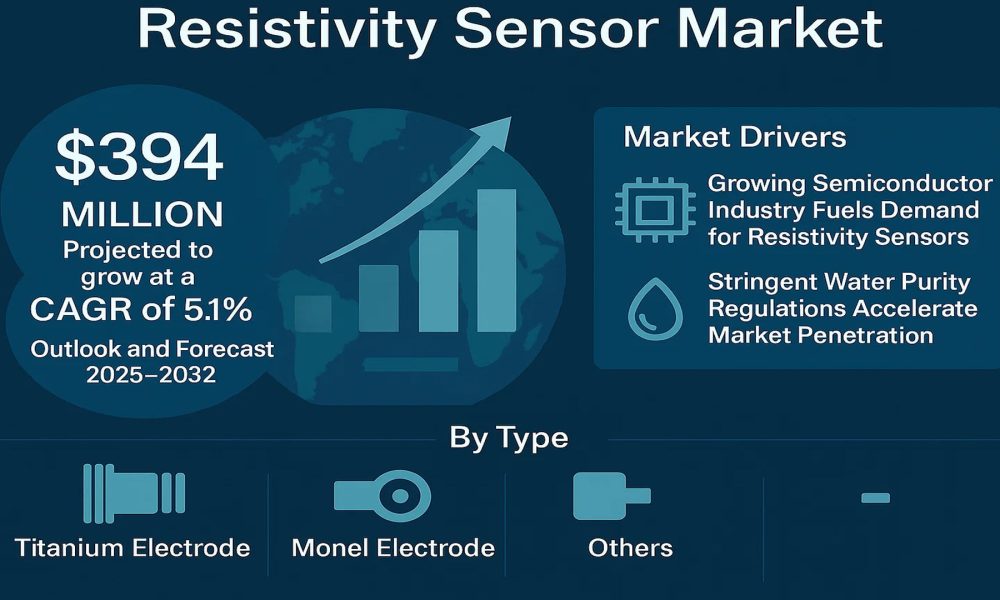
Global Resistivity Sensor Market size was valued at US$ 267 million in 2024 and is projected to reach US$ 394 million by 2032, at a CAGR of 5.1% during the forecast period 2025-2032.
Resistivity sensors are precision instruments used to measure the electrical resistance of fluids, particularly in ultrapure water (UPW) applications critical for semiconductor manufacturing and microelectronics. These devices employ different electrode materials such as titanium and Monel to provide accurate measurements of ionic contamination levels in high-purity water systems.
The market growth is driven by increasing semiconductor production, stricter water purity regulations, and expanding pharmaceutical manufacturing. However, technological complexities in miniaturization pose challenges. Key players like Mettler Toledo and Emerson dominate the market, with the titanium electrode segment expected to grow at 7.2% CAGR through 2032. Recent developments include advanced sensor designs with improved corrosion resistance for harsh industrial environments.
Get Full Report with trend analysis, growth forecasts, and Future strategies : https://semiconductorinsight.com/report/resistivity-sensor-market/
Segment Analysis:
By Type
Titanium Electrode Segment Leads Market Due to High Durability in Semiconductor Manufacturing
The market is segmented based on type into:
- Titanium Electrode
- Subtypes: Standard Grade, High-Purity Grade
- Monel Electrode
- Subtypes: Nickel-Copper Alloy Variants
- Others
By Application
Chemical Industry Dominates Market Share Due to Extensive Use in Process Monitoring
The market is segmented based on application into:
- Chemical
- Pharmaceutical
- Semiconductor Manufacturing
- Power Generation
- Others
By End-User
Industrial Sector Accounts for Major Adoption Due to Process Control Requirements
The market is segmented based on end-user into:
- Industrial
- Laboratories
- Research Institutions
- Others
MARKET DYNAMICS
MARKET DRIVERS
Growing Semiconductor Industry Fuels Demand for Resistivity Sensors
The global semiconductor industry is experiencing unprecedented growth, with semiconductor manufacturing accounting for over $600 billion in annual revenue. Resistivity sensors play a critical role in maintaining ultrapure water (UPW) quality, which is essential for chip fabrication processes. As semiconductor nodes shrink to 3nm and below, the need for precise water quality monitoring intensifies. The expansion of foundry capacities worldwide, particularly in Taiwan, South Korea, and China, directly correlates with increased adoption of resistivity measurement solutions. Major semiconductor manufacturers are investing billions in new fabrication facilities, each requiring hundreds of resistivity sensors for process control.
Stringent Water Purity Regulations Accelerate Market Penetration
Pharmaceutical and microelectronics industries face increasingly rigorous water purity standards globally. The USP <645> water conductivity standard and SEMI F63 guidelines for UPW in semiconductor manufacturing mandate continuous resistivity monitoring. Regulatory bodies worldwide are tightening acceptable impurity levels, with some requiring resistivity measurements up to 18.2 MΩ·cm at 25°C. This regulatory pressure drives replacement cycles of older sensors and adoption of advanced monitoring systems. The pharmaceutical sector alone is projected to account for over 30% of new resistivity sensor installations through 2032, as biologics manufacturing requires exceptionally pure water for buffers and media preparation.
Furthermore, the integration of Industry 4.0 technologies creates additional demand:
➤ Smart resistivity sensors with IIoT connectivity now represent 45% of new installations, enabling predictive maintenance and real-time quality control in critical processes.
MARKET OPPORTUNITIES
Expansion in Emerging Economies Presents Growth Potential
Asian markets outside the traditional semiconductor hubs are demonstrating accelerating demand for resistivity monitoring solutions. India’s pharmaceutical exports grew 103% over the past decade, driving new manufacturing facility construction with modern water systems. Southeast Asian electronics manufacturers are upgrading facilities to support advanced packaging technologies, requiring improved process water monitoring. These developing markets currently represent less than 15% of global sensor sales but are projected to grow at nearly double the global average rate through 2032. Localized product offerings and distributor networks will be key to capturing this growth.
Smart Sensor Integration Opens New Application Areas
The convergence of sensor technology with industrial IoT creates opportunities beyond traditional purity monitoring. Next-generation resistivity sensors with embedded diagnostics can predict membrane fouling in reverse osmosis systems days before failure occurs. Pharmaceutical manufacturers are implementing these smart sensors to support continuous manufacturing initiatives and real-time release testing. Early adopters report 30-50% reductions in water system downtime through predictive maintenance capabilities. As digital transformation accelerates across process industries, intelligent resistivity monitoring will increasingly become a gateway technology for broader plant optimization strategies.
➤ Modular sensor designs allowing field-replaceable components are gaining traction, reducing maintenance costs by up to 60% while extending product lifecycles in harsh environments.
Additionally, the development of specialized sensors for novel applications such as electric vehicle battery production and green hydrogen generation represents significant white space opportunities for forward-looking manufacturers.
RESISTIVITY SENSOR MARKET TRENDS
Growing Semiconductor and Microelectronics Industry Boosts Demand for Resistivity Sensors
The global resistivity sensor market is experiencing significant growth, primarily driven by the increasing demand in the semiconductor and microelectronics industries for ultrapure water (UPW) measurement. These sensors play a crucial role in monitoring water purity levels, ensuring contamination-free manufacturing processes. The semiconductor industry alone accounts for over 35% of resistivity sensor applications, as even slight impurities can lead to defects in microchip fabrication. The Titanium Electrode segment, valued at $28 million in 2024, is projected to witness robust growth due to its corrosion resistance and durability in harsh industrial environments.
Other Trends
Advancements in Sensor Technology
Modern resistivity sensors are incorporating IoT capabilities and digital interfaces for real-time monitoring and data analysis, significantly improving process control in industries such as pharmaceuticals and chemicals. The integration of smart sensors with cloud-based platforms allows for predictive maintenance and reduces downtime, a key factor contributing to their adoption. Manufacturers are also developing compact, high-precision sensors capable of detecting resistivity levels as low as 18.2 MΩ·cm, meeting stringent industry standards for ultrapure water applications.
Expanding Pharmaceutical Applications
The pharmaceutical sector is emerging as a major growth segment for resistivity sensors, representing approximately 22% of total market share in 2024. Strict regulatory requirements for water purity in drug manufacturing, particularly for injectable medications, are driving investment in advanced monitoring solutions. The market is seeing increased demand for sensors that can simultaneously measure multiple parameters including resistivity, temperature, and TOC (Total Organic Carbon) to comply with pharmacopeia standards. This trend is particularly strong in North America and Europe where regulatory oversight is most stringent.
Recent Developments:
- Advancements in Material Sensitivity:
Manufacturers have introduced new materials for resistivity sensors, enhancing their ability to detect more subtle changes in conductivity, making them ideal for use in water quality monitoring and industrial applications like mining. - Integration in IoT Applications:
With the rise of smart water management systems and industrial automation, resistivity sensors are increasingly integrated into IoT platforms. This enables real-time monitoring and predictive maintenance in areas such as agriculture and chemical manufacturing. - Increased Use in Environmental Monitoring:
Resistivity sensors are being widely used to measure soil salinity, groundwater contamination, and pollutants. These sensors provide high accuracy and are becoming critical in environmental protection and sustainability efforts. - Technological Advancements in Compact Design:
To meet the growing demand for portable and field-ready devices, there has been a shift toward developing miniaturized resistivity sensors that can be used in remote and challenging environments, including oceanography and environmental studies. - Rising Demand from Energy Sector:
The energy industry, particularly in oil and gas exploration, has been adopting resistivity sensors for monitoring fluid properties and well integrity. These sensors assist in detecting fluid contamination and ensure the stability of the reservoir.
Learn more about Competitive Analysis, and Forecast of Resistivity Sensor Market: https://semiconductorinsight.com/download-sample-report/?product_id=107412
RESISTIVITY SENSOR MARKET COMPETITIVE LANDSCAPE
Key Industry Players
Technological Advancements and Strategic Expansion Drive Market Competition
The global resistivity sensor market features a dynamic competitive environment where established players and emerging companies compete through product innovation and strategic partnerships. Mettler Toledo currently leads the market with an estimated 18-22% revenue share in 2024, backed by its comprehensive portfolio of high-precision sensors and strong foothold in semiconductor manufacturing applications. The company’s recent acquisition of a German sensor technology firm has further strengthened its position in European markets.
Emerson Electric Co. and GF Piping Systems collectively account for approximately 25-30% of market revenues. These companies have differentiated themselves through specialized solutions for ultrapure water monitoring in pharmaceutical applications. Emerson’s new inline resistivity sensors, launched in Q3 2023, demonstrate 0.5% higher accuracy than industry standards, giving them a competitive edge in laboratory-grade applications.
Meanwhile, mid-sized players like Omega Engineering and Electro-Chemical Devices are gaining traction through cost-effective solutions for industrial water treatment plants. Omega’s recent partnership with three Asian distributors has expanded its market reach by 15% in the past year. These companies are focusing on ruggedized sensor designs that cater to harsh environmental conditions, a key requirement in emerging markets.
The competitive landscape is further shaped by regional specialists such as KOZE (Japan) and Chemkimia (Malaysia), who dominate local markets through customized solutions. KOZE’s patented anti-fouling sensor technology has proven particularly successful in coastal industrial facilities where saltwater corrosion typically reduces sensor lifespan.
List of Key Resistivity Sensor Manufacturers
- Mettler Toledo (U.S.)
- Emerson Electric Co. (U.S.)
- GF Piping Systems (Switzerland)
- Omega Engineering (U.S.)
- Electro-Chemical Devices (U.S.)
- Myron L Company (U.S.)
- Hamilton Company (U.S.)
- KOZE Corporation (Japan)
- Water Analytics, Inc. (U.S.)
- Chemkimia Sdn Bhd (Malaysia)
- Harrington Industrial Plastics (U.S.)
Browse Related Reports : Resonant Fiber Laser Market
CONTACT US:
City vista, 203A, Fountain Road, Ashoka Nagar, Kharadi, Pune, Maharashtra 411014
+91 8087992013
[email protected]




