
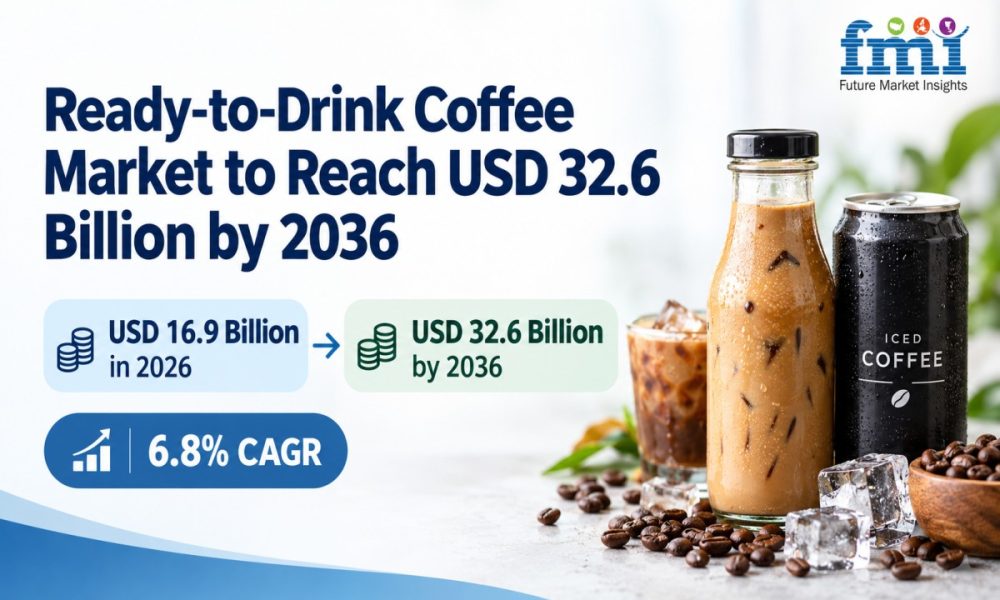
Global ready-to-drink coffee market projected to grow from USD 16.9 billion in 2026 to USD 32.6 billion by 2036 at a 6.8% CAGR, according to Future Market Insights
The global Ready-to-Drink (RTD) Coffee Market is projected to reach USD 32.6 billion by 2036, up from USD 16.9 billion in 2026, expanding at a 6.8% CAGR during the forecast period, according to the latest analysis by Future Market Insights (FMI).
Cold-coffee consumption routines continue to drive packaged purchase occasions, allowing ready-to-drink coffee to compete directly with other caffeinated beverages for immediate retail consumption. Market growth is supported by expanding distribution across convenience stores and supermarkets, rising popularity of functional coffee formulas, and continuous product innovations in single-serve packaging.
Ready-to-drink coffee encompasses pre-packaged, finished coffee beverages sold ready for immediate consumption, including milk-based, black, flavored, cold brew, and functional formulations delivered in canned, PET bottle, glass, and tetra pack formats.
Get Detailed Market Forecasts, Competitive Benchmarking, and Pricing Trends:
https://www.futuremarketinsights.com/reports/sample/rep-gb-14329
Caffe Mocha Holds Largest Product Segment Share Caffe mocha is expected to account for 25.2% of product type demand in 2026, maintaining its position as the leading category.
The inclusion of cocoa broadens cold-coffee appeal by softening natural coffee bitterness while retaining a recognizable coffee base. This allows developers to balance sweetness and dairy elements without changing the core consumption occasion.
Flavored variants overall dominate taste preferences, projected to reach 43.0% of demand by flavor in 2026. Recognizable taste variations such as caramel, vanilla, and hazelnut enable brand platforms to extend consumer trial from a unified coffee base.
Canned Formats Lead Packaging Preference Canned packaging is expected to lead its category with a 32.6% market share in 2026, driven by high barrier performance, light protection, and compact single-serve handling.
Metal cans fit urban vending networks and chilled convenience sets where aroma retention and rapid thermal chilling affect repeat purchase velocity. Volume demand remains highly concentrated in 100–250 ml packs, forecast at 41.6% share in 2026 due to portion control and short coffee break occasions.
Functional Coffee and Cold Coffee Occasions Drive Growth Cold-coffee habits are shifting consumer demand away from traditional brewing and made-to-order counters toward sealed, grab-and-go options.
Concurrently, functional ready-to-drink coffees are gaining traction by incorporating active ingredients like added protein, trigonelline, or functional extracts. However, heat-treatment stability, thermal processing constraints, and regional packaging/labeling regulations such as front-of-package nutrition symbols or local deposit-return systems remain key execution factors for global brand rollouts.
Japan and South Korea Lead Regional Growth Pace FMI’s country-level analysis identifies Japan as the fastest-growing market among profiled nations, with a projected 8.8% CAGR through 2036, followed by South Korea at 8.3%.
Spain is projected to expand at a 7.4% CAGR, the United States at 6.7%, and Germany at 6.1% during the forecast period.
Japan’s leading pace is supported by dense urban vending networks and frequent product format renewals. South Korea’s growth stems from rapid flavor rotation in convenience channels, while the U.S. benefits from multi-channel retail availability across grocery, convenience, and gasoline outlets.
Competitive Landscape
The Ready-to-Drink Coffee Market is characterized by global beverage platforms, specialized coffee rosters, and regional bottling partners.
Key companies profiled by FMI include Nestlé S.A., Starbucks Corporation, PepsiCo, Inc., Suntory Beverage & Food Limited, UCC Ueshima Coffee Co., Ltd., DyDo DRINCO, Inc., The Coca-Cola Company, and Keurig Dr Pepper Inc.
Competitive positioning depends on finished portfolio breadth, thermal processing capabilities, retail shelf velocity, packaging sustainability, and distribution network reach.
Analyst Perspective
“Ready-to-drink coffee margins depend on factory cost plus heat-treatment behavior since texture changes can alter the finished drinking experience. Retail category teams should compare shelf-life stability and repeat velocity before widening distribution because flavor novelty rarely protects permanent facings.”— Nandini Roy Choudhury, Principal Consultant, Future Market Insights
Exclusive Discounts on Full Report: https://www.futuremarketinsights.com/reports/ready-to-drink-coffee-market
Report Scope
The FMI study covers the Ready-to-Drink Coffee Market by product type, flavor, packaging, volume, distribution channel, and region.
Product categories include caffe mocha, espresso, cappuccino, cold brew, café latte, flat white, and decaffeinated. Flavors cover flavored (caramel, vanilla, hazelnut, chocolate, almond) and regular variants. Packaging spans canned, PET bottles, glass bottles, and tetra packs.
The research covers North America, Latin America, Europe, East Asia, South Asia and Pacific, and Middle East and Africa, with the forecast period extending from 2026 to 2036.
FMI’s methodology combines primary research with industry experts, distributors, and procurement executives alongside desk research and statistical market triangulation.
Key Executive Benefits
- Decision-Ready Insights
- Reduced Strategic Risk
- Market Entry Confidence
- Competitive Advantage
- Faster Growth Decisions
- Primary Market Validation
To explore how FMI Custom Research can support your strategic priorities, connect with our team at – [email protected]
About Future Market Insights (FMI)
Future Market Insights, Inc. is an ESOMAR-certified, ISO 9001:2015 market research and consulting organization trusted by Fortune 500 companies. With a global presence across the U.S., UK, India, and Dubai, FMI delivers data-driven insights across 30+ industries and 1200 markets worldwide.



