
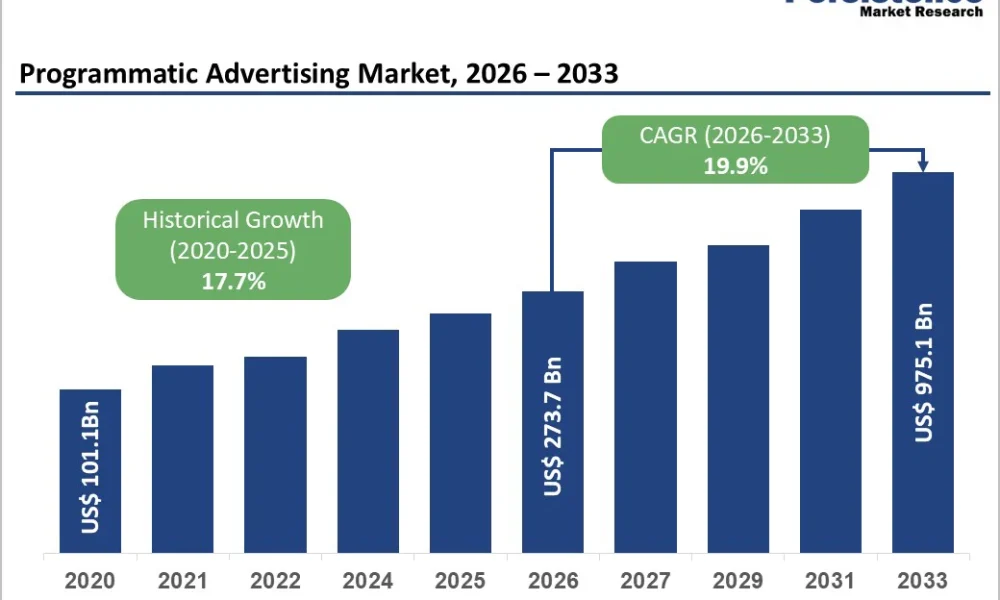
The global Programmatic Advertising Market is entering a new phase of accelerated expansion, projected to grow from US$ 273.7 billion in 2026 to US$ 975.1 billion by 2033, registering a remarkable CAGR of 19.9% during the forecast period. Having already demonstrated strong historical growth at a CAGR of 17.7% between 2020 and 2025, programmatic advertising has firmly established itself as the dominant transaction model in digital advertising.
This growth is being driven by three structural transformations: rapid integration of artificial intelligence (AI) and machine learning (ML), a decisive shift in media consumption toward streaming and connected TV (CTV), and rising enterprise demand for measurable, ROI-focused advertising models.
Market Overview: A Transaction Model That Defines Digital Advertising
Programmatic advertising refers to the automated buying and selling of digital ad inventory using real-time bidding and AI-driven algorithms. Unlike traditional media buying, which involves manual negotiations, programmatic platforms enable advertisers to bid for impressions in milliseconds based on audience data, contextual signals, and performance predictions.
Today, programmatic buying accounts for nearly 88% of all digital ad impressions globally and continues to capture the vast majority of incremental digital ad budgets. As brands demand transparency, efficiency, and performance accountability, automated advertising systems have become the backbone of digital media strategy.
Key Industry Highlights
Regional Leadership
North America leads the global programmatic advertising market with a 36% share in 2025, supported by advanced digital infrastructure, mature ad tech ecosystems, and early AI adoption.
Fastest-Growing Region
East Asia, with a 28% share, is emerging as the fastest-growing region, fueled by China’s vast digital population and India’s expanding e-commerce ecosystem.
Leading Ad Format
Display Ads dominate with a projected 32% market share in 2026, owing to their versatility, affordability, and reach across websites and mobile apps.
Fastest-Growing Ad Format
Video Ads (In-stream & Out-stream) are the fastest-growing segment, driven by CTV adoption and mobile streaming consumption.
Leading End-user Segment
Retail & E-Commerce accounts for 24% of total market share in 2026, anchored by global online shopping growth.
Fastest-Growing End-user Segment
Media & Entertainment is expanding rapidly due to streaming proliferation and subscriber acquisition campaigns.
Elevate your business strategy with comprehensive market data. Request a sample report now: https://www.persistencemarketresearch.com/samples/13345
Market Dynamics
- Acceleration of Artificial Intelligence and Machine Learning Integration
AI and machine learning have become the core engines of programmatic advertising. Modern DSPs (Demand-Side Platforms) process millions of behavioral signals per hour, analyzing user activity, contextual relevance, browsing history, and predicted conversion probabilities in real time.
Machine learning algorithms evaluate:
- Historical auction performance
- Engagement rates
- User demographics
- Device behavior
- Creative performance
These predictive systems optimize bids dynamically, ensuring advertisers allocate budgets toward impressions with the highest probability of conversion.
Platforms such as Google LLC report that AI-powered bidding strategies can reduce cost-per-acquisition (CPA) by up to 30% while increasing conversion rates by over 20%.
Additionally, AI-driven sentiment analysis and dynamic creative optimization tools reduce ad fatigue by adjusting frequency and messaging. On average, campaigns now sequence messages across 2–3 devices per user, enhancing personalization and improving ROI predictability.
- Structural Shift Toward Connected TV and Streaming Platforms
The rapid migration of audiences from linear television to streaming platforms has created an entirely new inventory category for programmatic buying: Connected TV (CTV).
Streaming now accounts for over 40% of television viewing time in major markets, and CTV ad spend is expected to grow exponentially over the next five years. Unlike traditional broadcast TV, CTV offers granular audience targeting, real-time reporting, and measurable attribution.
Major ad tech platforms such as The Trade Desk, Magnite, Inc., and PubMatic, Inc. have expanded their CTV inventory capabilities, enabling brands to reach streaming audiences across multiple devices.
The rise of ad-supported video-on-demand (AVOD) models further strengthens this shift. Closed-loop measurement systems now link CTV impressions directly to retail sales, making CTV an essential performance marketing channel rather than merely a brand-awareness vehicle.
By 2030, CTV is expected to account for more than 40% of global TV advertising budgets.
- Expansion of Digital Advertising Budgets in Emerging Markets
Emerging markets are contributing significantly to the expansion of the programmatic advertising ecosystem.
India’s e-commerce market, valued at US$ 125 billion in 2024, is projected to reach US$ 345 billion by 2030, creating massive demand for automated digital advertising. Government initiatives such as the Open Network for Digital Commerce (ONDC) are expanding digital retail infrastructure, accelerating adoption of programmatic channels.
In China, the scale of online shoppers and mobile-first consumption behavior makes programmatic advertising a critical growth engine. Asia Pacific is expected to command 80% of global B2B e-commerce share by 2026, driving further programmatic investment.
Mobile now accounts for over 63% of total programmatic impressions globally, underscoring the dominance of app-based advertising ecosystems.
Restraint: Privacy Regulations and Data Fragmentation
Despite its growth trajectory, the programmatic advertising market faces regulatory complexity.
Frameworks such as the General Data Protection Regulation (GDPR) in Europe and the California Consumer Privacy Act (CCPA) in the United States impose strict requirements for data collection, consent management, and user privacy.
The absence of a unified federal privacy framework in the U.S. has created jurisdictional fragmentation, forcing advertisers to comply with multiple state-level laws.
As a result:
- Brands are shifting toward first-party data strategies
- Investments in Customer Data Platforms (CDPs) are increasing
- Contextual targeting is gaining prominence
- Third-party cookie reliance is declining
Approximately 88% of advertisers anticipate significant modifications to their targeting strategies due to privacy regulations.
Opportunity: Supply Path Optimization and Private Marketplaces
Supply Path Optimization (SPO) is transforming how advertisers access inventory.
Traditionally, programmatic supply chains involved multiple intermediaries, increasing costs and reducing transparency. SPO reduces supply chain “hops,” improves fraud detection, and enhances ROI efficiency.
Private Marketplaces (PMPs) are emerging as the preferred buying environment. Unlike open exchanges, PMPs provide:
- Invitation-only access
- Premium inventory
- Brand-safe placements
- Greater transparency
Over 91% of U.S. programmatic display ad spending is projected to flow toward PMPs and programmatic direct deals.
Technology platforms such as Index Exchange, OpenX Technologies, Inc., and Sovrn Holdings, Inc. are actively expanding curated marketplace offerings.
Category-Wise Analysis
Buying Type Insights
Real-Time Bidding (RTB) – Market Leader
RTB is projected to command 55% market share in 2026. Its dominance stems from:
- Real-time auction efficiency
- Scalability
- Automated bid optimization
- Global reach
Private Marketplaces (PMPs) – Fastest Growing
PMPs are expanding rapidly as advertisers prioritize transparency, brand safety, and premium content environments.
Ad Format Insights
Display Ads – Leading Segment
Display ads account for 32% of the market in 2026, serving as the foundational format across web and mobile environments.
Video Ads – Fastest Growing
Programmatic video is surging due to:
- Mobile streaming growth
- CTV inventory expansion
- Higher engagement rates
- Improved cross-device attribution
Companies like Taboola and Outbrain Inc. are enhancing native video integrations to capture this growth.
End-user Insights
Retail & E-Commerce – Leading Vertical
Retailers rely on programmatic tools for:
- Retargeting
- Cart abandonment recovery
- Dynamic product ads
- Omnichannel measurement
Global online shoppers are expected to surpass 2.8 billion by 2026, reinforcing this sector’s dominance.
Media & Entertainment – Fastest Growing
Streaming services and content platforms use programmatic campaigns for:
- Subscriber acquisition
- Content promotion
- Audience segmentation
- Cross-platform engagement
Regional Insights
North America
North America maintains the largest share of the global programmatic advertising market at 36%.
The U.S. remains the largest contributor, driven by major technology players such as:
- Alphabet Inc.
- Amazon.com, Inc.
- Meta
- Microsoft
The region leads in AI innovation, CTV expansion, and cross-channel attribution technologies.
East Asia
East Asia holds 28% market share and is the fastest-growing region.
China’s digital dominance and India’s e-commerce surge are reshaping programmatic investments. Regional players such as Alibaba Group Holding Limited and InMobi play significant roles in shaping regional programmatic ecosystems.
Europe
Europe accounts for approximately 24% of the global market. While growth remains steady, GDPR compliance continues to influence targeting models.
Advertisers increasingly adopt contextual advertising and data clean rooms to maintain compliance while preserving targeting precision.
Competitive Landscape
The global programmatic advertising market exhibits moderate consolidation with oligopolistic characteristics.
Dominant players include:
- Alphabet Inc.
- Meta
- Amazon.com, Inc.
- Adobe
- The Trade Desk
- Criteo
- MediaMath
- Yahoo
These companies leverage first-party data, omnichannel reach, and AI-driven optimization to maintain competitive advantages.
Future Outlook: The Rise of Agentic AI and Omnichannel Integration
The programmatic advertising ecosystem is entering the era of “agentic AI,” where intelligent systems autonomously manage campaign planning, bidding, creative optimization, and attribution.
Standardization efforts such as the Ad Context Protocol (AdCP) are enabling interoperability across fragmented ecosystems. The convergence of CTV, retail media networks, and programmatic infrastructure is building a unified omnichannel advertising stack capable of tracking consumer journeys across devices and platforms.
As brands demand performance accountability, privacy compliance, and operational efficiency, programmatic advertising will continue to evolve as the central nervous system of digital marketing.
Conclusion
The global Programmatic Advertising Market is poised for transformative growth, expanding from US$ 273.7 billion in 2026 to nearly US$ 1 trillion by 2033.
AI-driven automation, CTV expansion, emerging market growth, and supply chain optimization are redefining how advertising budgets are allocated. While privacy regulations introduce complexity, they also drive innovation in first-party data and contextual targeting.
With strong regional leadership from North America and explosive growth in East Asia, programmatic advertising is no longer an optional channel — it is the dominant infrastructure powering modern digital marketing.
As automation deepens and omnichannel integration accelerates, the market’s next decade will be defined by intelligent systems, transparent supply chains, and measurable business outcomes.
Related Reports:




