
Petroleum Resins Market Overview :
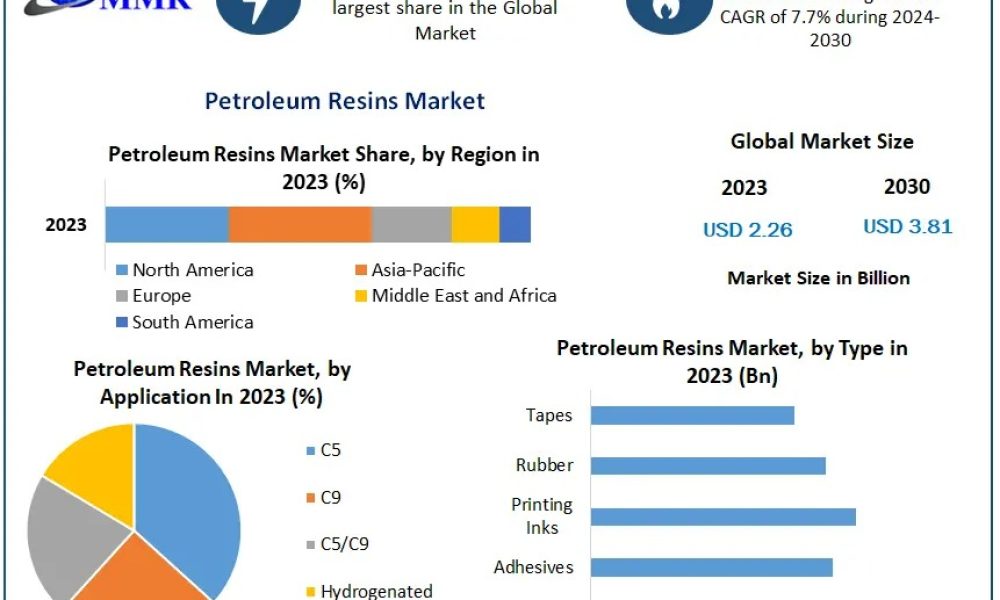
Petroleum Resins Market is on a strong growth trajectory, expected to reach USD 3.81 billion by 2030—up from USD 2.26 billion in 2023—at a CAGR of 7.7%. Market expansion is fueled by robust demand from end-use sectors like personal hygiene, tires, automotive manufacturing, printing inks, paints, sealants, and packaging. With the industry pivoting toward sustainability and versatile high-performance formulations, Asia Pacific has emerged as the leading regional market.
Key Highlights & Insights
Market Size & Growth: The petroleum resins industry is expected to climb from USD 2.26 billion in 2023 to USD 3.81 billion by 2030, registering a CAGR of 7.7%.
Dominating Region: Asia Pacific leads the global market, commanding the highest share (≈47% in 2024) due to its dominant manufacturing base, rapid industrialization, and accelerated investments in automotive, construction, packaging, and consumer goods. China and India continue to drive growth with expanding production capacity and infrastructure projects.
Leading Segment: The C5 resin segment remains the largest, favored for its excellent tackiness, anti-aging properties, and widespread application in adhesives and sealants. Hydrogenated resins are projected to grow fastest, driven by their eco-friendly and reliable characteristics.
Key Driver: Rising demand for high-performance adhesives and sealants in automotive, packaging, and building & construction, along with booming consumer product segments, are the primary catalysts of market growth.
Recent Developments
2024–2025: Major producers such as Eastman, Exxon Mobil, Kolon Industries, and Arakawa Chemical Industries boost capacity and R&D for eco-friendly, low-VOC, and hydrogenated resin solutions.
Strategic investments and facility expansions in Asia Pacific to meet the soaring need for petroleum resins across automotive and flexible packaging.
Evolving formulations emphasize lower emissions, enhanced UV resistance, and high adhesion to comply with tightening global regulations and sustainability mandates.
Market Dynamics
Growth Drivers:
Expanding uses in paints, adhesives, rubber compounding, printing inks, tapes, and labels for their exceptional adhesion, thermal stability, and chemical resistance.
Automotive sector’s demand for lightweight bonding solutions for tires, interiors, weatherstrips, and plastics.
Infrastructure development and the global shift towards sustainable packaging, e-commerce, and flexible packaging solutions.
Increasing investments in fast-growing Asia Pacific economies, huge consumer bases, and favorable government policies.
For full access to the data, request a sample report now :https://www.maximizemarketresearch.com/request-sample/20961/
Challenges:
Fluctuating raw material supply and prices due to regulatory pressure and geopolitical uncertainties.
Stricter sustainability and environmental standards require ongoing innovation and increased operational costs for compliance.
Substitute materials and evolving end-user preferences require continued R&D and market adaptation.
Regional Analysis
Asia Pacific: Market leader—China, India, Japan, and South Korea act as major manufacturing and end-use hotspots. Investments in automotive, electronics, construction, and packaging drive demand.
North America & Europe: Steady, high-value demand; U.S. is a strong consumer of petroleum resins for adhesives, printing, and coatings, aided by manufacturing innovation and product exports.
Latin America, Middle East & Africa: Emerging growth regions, with new production hubs and rising downstream industrialization supporting consumption.
Product Segmentation
By Product: C5 (largest), C9, C5/C9, hydrogenated resins (fastest growing).
By Application: Adhesives & sealants (major share), paints & coatings, rubber, printing inks, tapes, and specialty compounds.
By End User: Automotive (leading), construction, packaging, consumer goods, personal hygiene.
Key Trends
Rapid shift to eco-friendly and low-VOC hydrogenated petroleum resins in line with global regulatory changes.
Growing integration in high-end automotive components for enhanced bonding, durability, and weather resistance.
Expanding use in flexible, recyclable packaging as e-commerce and food safety standards rise.
Advancements in resin chemistry for improved processing, adhesion, and compatibility with diverse substrates.
Quote
As Asia Pacific’s manufacturing might intensifies and demand for advanced adhesives and sustainable materials rises, the petroleum resins market is scaling new heights. Innovation and regional expansion are setting the pace for a resilient, high-performance chemicals sector poised for long-term global growth.
From automotive innovation to sustainable packaging, petroleum resins are underpinning vital trends across multiple industries—delivering performance, adaptability, and value worldwide.




