
The global passive components market is entering a period of sustained expansion, driven by the accelerating demand for advanced electronics across consumer, automotive, industrial, and telecommunications sectors. As electronic devices become more compact, energy-efficient, and performance-driven, passive components—such as capacitors, resistors, and inductors—remain foundational to modern circuit design.
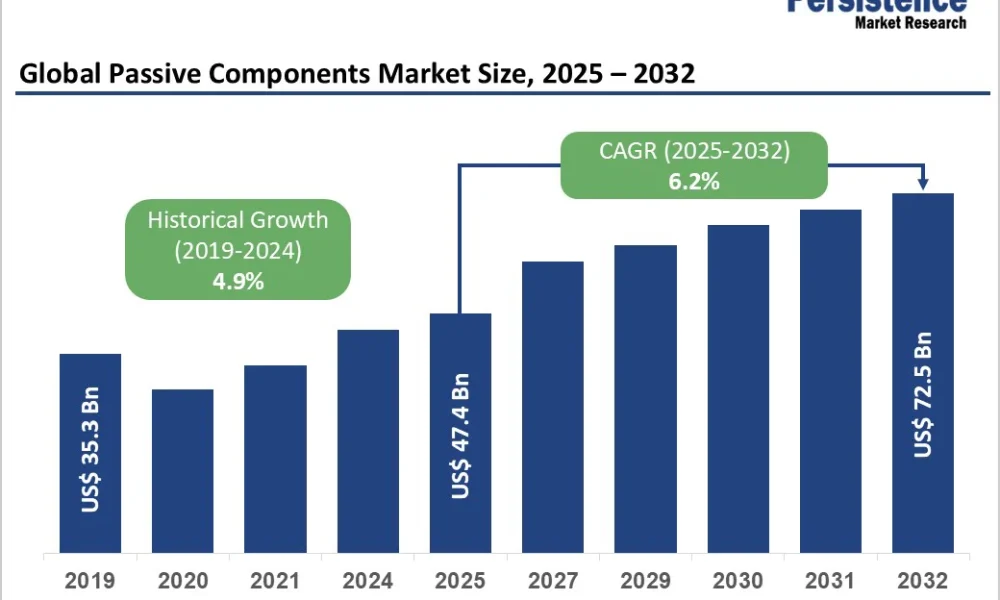
According to industry estimates, the passive components market size is projected to grow from US$47.4 billion in 2025 to US$72.5 billion by 2032, registering a compound annual growth rate (CAGR) of 6.2% during the forecast period. This growth trajectory reflects not only rising electronic device penetration but also the increasing complexity of electronic systems required for technologies such as 5G, electric vehicles (EVs), artificial intelligence (AI), and the Internet of Things (IoT).
Understanding Passive Components and Their Role in Electronics
Passive components are electronic elements that do not generate energy but are essential for controlling, storing, filtering, or dissipating electrical signals. Common categories include:
- Capacitors – Store and release electrical energy, stabilize voltage, and filter noise
- Resistors – Control current flow and divide voltage
- Inductors – Store energy in a magnetic field and manage electromagnetic interference (EMI)
These components are indispensable across nearly all electronic applications, from smartphones and laptops to EV powertrains, medical devices, and industrial automation systems.
Key Market Growth Drivers
- Rising Demand for Miniaturized and Energy-Efficient Electronics
Consumers increasingly prefer compact, lightweight, and power-efficient devices, prompting manufacturers to integrate advanced passive components with higher capacitance, lower resistance, and improved thermal performance—often in significantly smaller footprints.
The demand for ultra-small surface-mount components, such as multilayer ceramic capacitors (MLCCs) and high-density inductors, continues to surge across smartphones, wearables, tablets, and smart home devices.
- Proliferation of IoT Devices
The rapid expansion of IoT ecosystems across smart homes, smart cities, industrial monitoring, and healthcare is creating substantial demand for passive components. Each IoT device typically requires multiple capacitors, resistors, and inductors to ensure:
- Stable power supply
- Noise suppression
- Signal integrity
- Long operational lifespans
As IoT deployments scale into billions of connected devices globally, passive components remain a volume-driven growth engine for the market.
- Global Rollout of 5G Infrastructure
The transition from 4G to 5G networks is significantly increasing the complexity of telecom hardware, including base stations, small cells, antennas, and RF modules. These systems require:
- High-frequency capacitors
- Precision resistors
- Advanced inductors for EMI control
The demand for high-performance passive components capable of operating at higher frequencies and temperatures is directly tied to ongoing 5G deployment worldwide.
- Electrification of Vehicles and Advanced Automotive Electronics
Automotive electrification is one of the fastest-growing demand drivers for passive components. Modern electric and hybrid vehicles integrate thousands of electronic components across:
- Battery management systems
- Power inverters and converters
- ADAS and safety systems
- Infotainment and connectivity modules
Passive components used in automotive applications must meet stringent reliability, high-voltage, and high-temperature requirements, significantly increasing their value and technological complexity.
Product Segment Analysis
Capacitors: Dominant Market Segment
Capacitors continue to dominate the global passive components market, accounting for over 45% of total market share in 2025. Their widespread use in nearly every electronic circuit underpins their leadership position.
Key factors driving capacitor demand include:
- Energy storage and voltage regulation needs
- Noise filtering in high-speed circuits
- Increasing adoption of MLCCs in compact devices
Technological innovations—such as higher capacitance values in smaller package sizes—are further reinforcing the growth of this segment.
Inductors: Strong Growth Trajectory
The inductors segment is projected to exceed US$10.9 billion by 2032, supported by growing demand for:
- Energy-efficient power management
- EMI suppression
- Thermal stability in compact designs
Inductors play a crucial role in EV power electronics, telecom equipment, and industrial automation systems, making them a high-growth product category within the market.
Resistors: Steady Demand with Performance Enhancements
Resistors remain a stable yet evolving segment, with manufacturers focusing on:
- High-power and low-resistance designs
- Improved accuracy and durability
- Enhanced performance for automotive and industrial applications
While more mature than capacitors or inductors, resistor innovation continues to support broader market growth.
Elevate your business strategy with comprehensive market data. Request a sample report now: https://www.persistencemarketresearch.com/samples/33330
End-Use Industry Analysis
Consumer Electronics: Leading Industry Segment
The consumer electronics sector leads the passive components market, accounting for over 31% share in 2025, with a market value exceeding US$14.7 billion.
Growth is driven by demand for:
- Smartphones and tablets
- Wearables and hearables
- Smart home devices
The continuous upgrade cycle and rapid product innovation in consumer electronics ensure sustained demand for high-volume passive components.
Automotive: Fastest-Growing End-Use Sector
The automotive industry is the fastest-growing segment, expanding at a CAGR of 9.1% through 2032. Growth is fueled by:
- Electrification of powertrains
- Integration of ADAS and autonomous features
- Increased electronic content per vehicle
Automotive OEMs and Tier-1 suppliers increasingly prioritize high-reliability passive components, creating lucrative opportunities for specialized manufacturers.
Industrial, Telecom, and Healthcare Applications
Industrial automation, telecommunications infrastructure, and medical electronics also contribute significantly to market growth, supported by:
- Industry 4.0 adoption
- Data center expansion
- Growing demand for precision medical devices
Regional Market Insights
Asia Pacific: Global Market Leader
Asia Pacific is set to account for over 46% of global market share in 2025, valued at more than US$21.8 billion. The region benefits from:
- Dense semiconductor ecosystems
- Strong manufacturing bases in China, Japan, South Korea, and Taiwan
- Rapid industrialization and urbanization
- Expanding 5G and EV adoption
Asia Pacific’s dominance is reinforced by the presence of major passive component manufacturers and cost-efficient production capabilities.
North America: Strategic Growth Region
North America maintains strategic importance, with the market expected to exceed US$18 billion by 2032. Growth is driven by:
- Electric vehicle adoption in the U.S.
- AI and data center investments
- Defense and aerospace electronics demand
- Increasing localization of electronics manufacturing
Government initiatives aimed at strengthening domestic semiconductor and electronics supply chains further support regional growth.
Europe and Other Regions
Europe benefits from strong automotive and industrial electronics demand, particularly in Germany and France, while emerging markets in Latin America and the Middle East offer long-term growth opportunities as electronics adoption rises.
Competitive Landscape and Recent Developments
The global passive components market is highly competitive, with leading players focusing on miniaturization, reliability, and performance enhancements.
Notable Industry Developments
- Murata Manufacturing launched an 0805-inch automotive MLCC (10 µF, 50 V), achieving approximately 53% PCB space savings, addressing the growing need for compact automotive designs.
- ROHM Semiconductor expanded its MCRx resistor lineup, introducing high-power and low-resistance options tailored for automotive and industrial applications.
Such innovations highlight the industry’s emphasis on space efficiency, durability, and application-specific solutions.
Future Outlook and Market Opportunities
Looking ahead, the passive components market is poised for sustained growth as electronic systems become more sophisticated and integrated across industries. Key opportunities include:
- Advanced passive components for EVs and autonomous vehicles
- High-frequency components for 5G and future 6G networks
- Miniaturized components for wearables and medical implants
- High-reliability components for aerospace and defense
Manufacturers that invest in R&D, advanced materials, and localized production are expected to gain a competitive edge in the evolving market landscape.
Conclusion
The global passive components market is set to grow steadily from US$47.4 billion in 2025 to US$72.5 billion by 2032, supported by a strong 6.2% CAGR. The convergence of miniaturization trends, IoT expansion, 5G deployment, and vehicle electrification is reshaping demand patterns across product categories and regions.
With capacitors maintaining market dominance, automotive electronics emerging as the fastest-growing application, and Asia Pacific leading regional growth, the market presents robust opportunities for manufacturers, suppliers, and investors alike. As electronic innovation accelerates, passive components will continue to serve as the silent enablers powering the next generation of technology.
Related Reports:




