
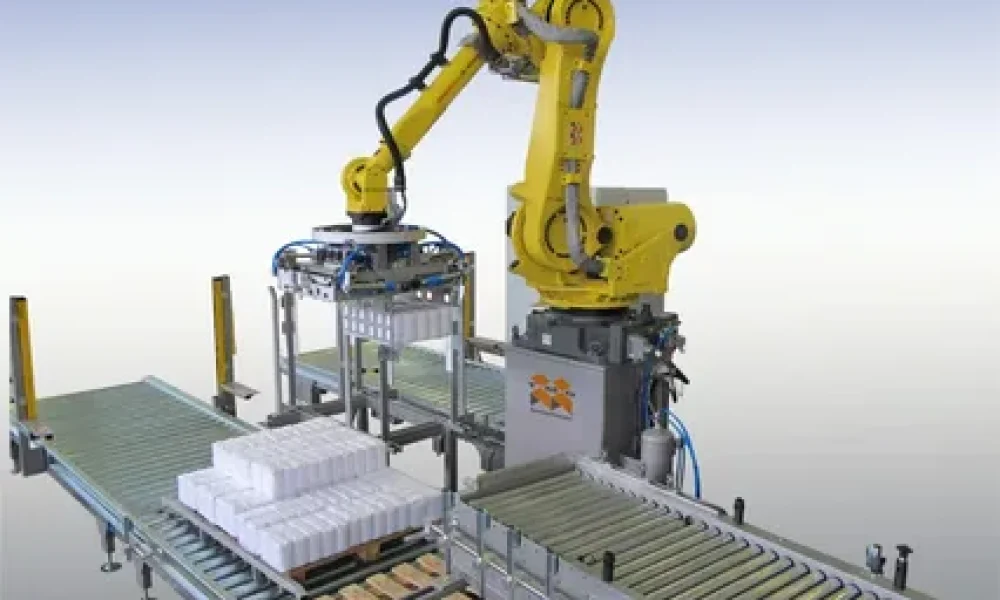
The global palletizer market is entering an era of innovation and expansion as businesses worldwide prioritize automation, worker safety, and efficiency in their supply chains. According to the latest insights, the market is projected to rise from USD 2.4 billion in 2024 to USD 2.9 billion by 2034, expanding at a CAGR of 2.2%.
With a focus on technological breakthroughs and inclusive growth, palletizer manufacturers—both established players and emerging companies—are developing next-generation solutions to address industry challenges, from labor shortages to rising e-commerce demand.
Market Growth Supported by Automation and Human-Centric Solutions
Palletizers, used to stack, store, and move products efficiently, are increasingly favored over manual handling due to their precision, speed, and load stability. The shift toward automated operations is not just about productivity; it is also about worker well-being. Palletizers reduce repetitive lifting tasks that can cause injuries, aligning with the International Labour Organization’s (ILO) report estimating 340 million work-related accidents annually worldwide.
Leading players are taking steps to merge technology with inclusivity. For instance, one company has launched RobotStudio, a software solution that allows users to simulate and program ABB robots and grippers for palletizing with minimal programming skills required. Another manufacturer’s Alvey 750 palletizer is designed to handle lightweight packages with delicate precision, making it suitable for industries requiring flexible yet careful load management.
Full Market Report available for delivery. For purchase or customization, please request here:
https://www.futuremarketinsights.com/reports/sample/rep-gb-7084
Historical Performance and Future Outlook
The palletizer industry has already shown steady growth. In 2018, the global market was valued at USD 2.1 billion, and between 2018 and 2023, it registered a CAGR of 1.7%. The forecasted CAGR of 2.2% from 2024 to 2034 reflects the increasing adoption of automation, Industry 4.0 integration, and robotics in logistics and manufacturing sectors.
Key Drivers of Market Expansion
Rise of Third-Party Logistics (3PL): Many manufacturing and e-commerce businesses rely on 3PL partners to manage supply chains. The synergy between palletizers and 3PL ensures accurate order handling, reduced costs, and timely deliveries.
Industry 4.0 Integration: Smart factories are enabling wireless machine coordination. Palletizers embedded with digital monitoring systems contribute to streamlined operations and predictive maintenance.
Labor Savings and Safety: Automation reduces physical strain on workers while boosting throughput, making palletizers indispensable in large-scale industries.
Category-Wise Insights
The robotic palletizer segment leads the market, accounting for 57.6% share in 2024. Robotic solutions reduce floor space needs, improve flexibility, and shorten time-to-market, ensuring strong demand in industries ranging from food processing to consumer goods.
Similarly, the cases and boxes segment represents 45.2% of the market in 2024. As e-commerce and retail expand globally, cases and boxes remain the backbone of safe packaging, storage, and transportation. Their protective qualities and adaptability make them central to palletizer applications.
Country-Wise Insights
India (CAGR 5.8%) – The fastest-growing market, driven by the food, beverage, and pharmaceutical sectors. Companies like ROBOPAC are catering to FMCG and pharma industries, ensuring compliance and efficiency in distribution.
China (CAGR 4.4%) – Palletizers support logistics, food processing, and consumer goods manufacturing. Firms like Wuhan Lingyun Automation are introducing high-speed robotic systems to streamline warehouse operations.
United States (CAGR 1.3%) – Dominated by e-commerce and retail automation. Companies such as Columbia Machine provide palletizing solutions tailored for fulfillment centers, consumer goods, and automotive parts.
Germany (CAGR 1.1%) – Strong adoption in automotive and manufacturing. With acquisitions like Krones AG purchasing Trans-Market Sales, manufacturers are expanding their global presence.
France (CAGR 2%) – Growth led by agriculture, pharmaceuticals, and logistics. Innovations like Cermex Evopac, with modular and flexible designs, are transforming the palletizing landscape.
Competitive Landscape and Innovation
The global palletizer market is highly competitive, with regional specialists and global giants contributing to advancements. Established manufacturers are scaling up to serve multinational industries, while new entrants focus on niche, specialized solutions.
Some recent key developments include:
AAA20Group (2021): Launched a Robotics as a Service (RaaS) model, allowing smaller companies to access automation on subscription-based terms.
Concetti Group (2021): Introduced the PL-AA LAMPO palletizer, handling up to 1,800 bags per hour across weights ranging from 1 to 50 kg.
Both models reflect the industry’s transition toward flexibility, scalability, and cost-efficient solutions.
Get the Report Brochure Now:
https://www.futuremarketinsights.com/reports/brochure/rep-gb-7084
Role of Food, Pharma, and E-Commerce in Growth
The food and beverage industry is one of the largest adopters of palletizers, ensuring efficient stacking of bottles, cartons, and cans. In India and China, rising demand for packaged foods is fueling investments in automation.
In pharmaceuticals, palletizers ensure compliance with stringent regulations while maintaining product integrity. Efficient stacking, labeling, and packaging are critical in ensuring safe distribution.
Meanwhile, in the United States, palletizers are essential to the e-commerce boom, powering fulfillment centers to process millions of daily orders with speed and accuracy.
A Future Built on Smarter, Safer, and Sustainable Solutions
The next decade of the palletizer market will be defined by automation, sustainability, and accessibility. Established companies are upgrading their portfolios with robotics, modular palletizers, and AI-enabled monitoring, while new entrants are exploring affordable solutions for small and medium businesses.
With growing awareness around workplace safety, efficiency, and net-zero goals, palletizers are more than just machines—they are catalysts for transforming industries. By 2034, the market will not only grow in size but also in its ability to deliver smarter, safer, and more inclusive automation solutions to industries worldwide.



