
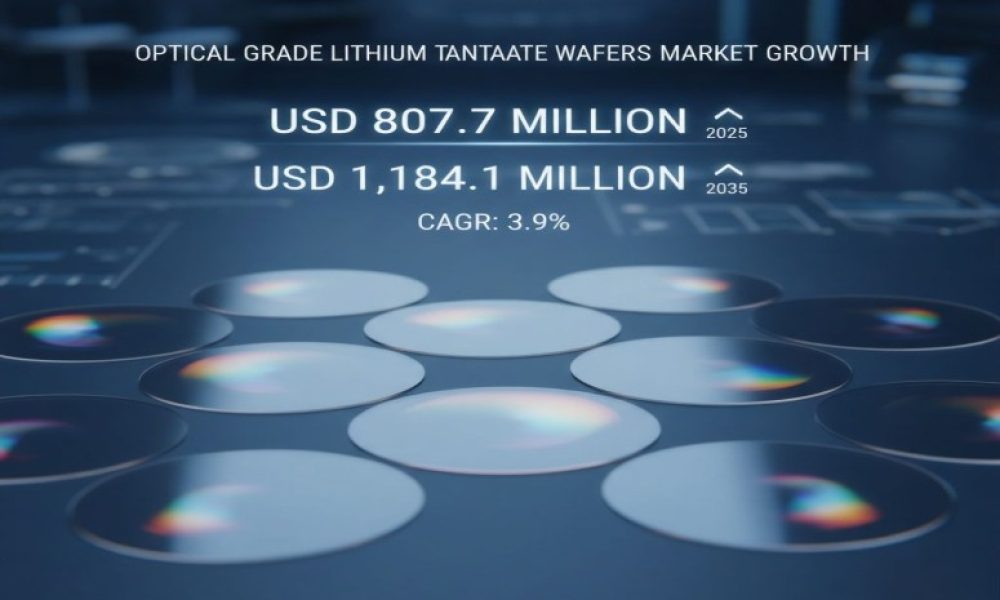
The global optical grade lithium tantalate wafers market is on a trajectory of steady growth, reflecting the rising demand for high-performance optical components across telecommunications, photonics, and electronics industries. Valued at USD 807.7 million in 2025, the market is projected to reach USD 1,184.1 million by 2035, registering a CAGR of 3.9%. This growth demonstrates both the maturation of established manufacturing players and the opportunities available for emerging suppliers to expand their footprint and introduce innovative technologies.
Analyzing the market through half-decade segments reveals a clear picture of evolving demand. Between 2025 and 2030, the market is expected to grow from USD 807.7 million to approximately USD 941.2 million. This period represents the early adoption phase, with annual growth rates averaging 3.8–4.0%, as manufacturers optimize wafer production and distribution to meet the rising industrial requirements in electronics, photonics, and piezoelectric applications.
Complete Market Report Available. Secure Your Copy or Customization Now:
https://www.futuremarketinsights.com/reports/sample/rep-gb-26426
From 2030 to 2035, the market demonstrates stronger absolute growth, expanding from USD 941.2 million to USD 1,184.1 million. This acceleration reflects broader adoption of lithium tantalate wafers in telecommunications, sensor technologies, and advanced electronic devices, illustrating the compounding effect of technological integration across multiple sectors. For stakeholders, understanding these half-decade trends enables strategic alignment in production capacity, R&D investment, and distribution strategies, ensuring optimal market positioning throughout the forecast horizon.
Key Drivers of Market Expansion
Several factors are fueling demand for optical grade lithium tantalate wafers. Rapid expansion of telecommunications infrastructure, particularly 5G networks, is driving the need for high-performance optical components. Lithium tantalate’s exceptional optical, electro-optical, and piezoelectric properties make it ideal for demanding applications where high-frequency performance and signal integrity are critical.
Global emphasis on high-speed data transmission, network optimization, and reliability is prompting equipment manufacturers to invest in premium-grade wafers with proven performance over extended periods. Increasing standards for optical materials are further positioning high-purity lithium tantalate wafers as a preferred solution for cutting-edge devices in photonics, telecommunications, and electronics sectors.
Market Drivers, Restraints, and Key Trends
While the market grows steadily, several challenges persist. High material costs relative to alternatives, complex crystal growth processes, and varying quality standards across applications may restrain growth. Nevertheless, industry trends, including advanced crystal growth systems, large-diameter wafer development, and application-specific solutions, are helping manufacturers overcome these barriers. Advanced processing technologies, customized crystal orientations, and ultra-low-loss wafers are enabling better device performance, cost-efficiency, and wider market adoption.
Regional Market Insights
Regionally, China, India, and Germany are leading growth, with CAGRs of 5.3%, 4.9%, and 4.5%, respectively. China’s market expansion is fueled by rapid 5G deployment and an evolving photonics industry. India is capitalizing on telecommunications modernization and rising optical network investments. Germany maintains leadership through its precision optics manufacturing and advanced photonics capabilities. Other key markets include Brazil (4.1%), the United States (3.7%), the United Kingdom (3.3%), and Japan (2.9%), all of which are strengthening optical infrastructure, technology innovation, and research initiatives.
In Europe, the market is expected to grow from USD 218.0 million in 2025 to USD 319.7 million in 2035, led by Germany’s 32.1% market share, followed by the United Kingdom, France, Italy, and Spain. Investments in photonics, precision optics, and telecommunications modernization programs are driving adoption of high-quality substrates throughout the region.
Competitive Landscape
The optical grade lithium tantalate wafers market is characterized by the interplay between established leaders and emerging manufacturers. Leading players include Sumitomo Metal Mining, Shin-Etsu Chemical, Koike, Korth Kristalle, Tiantong, Kaiju Technology Co., Ltd., Zhejiang MTCN Technology Co., Ltd., HEFEI KEJING MATERIALS TECHNOLOGY CO., LTD., Suzhou Nanzhi Core Materials Technology Co., Ltd., Hyperion Optics, Advanced Fiber Resources (Zhuhai), Ltd., and Bon-tek.
These players differentiate themselves through crystal purity, defect minimization, advanced processing, and quality assurance programs. Sumitomo Metal Mining focuses on wafer consistency and reliability, while Shin-Etsu Chemical emphasizes precision and defect control. Other players, like Tiantong Kaiju Technology and Zhejiang MTCN Technology, are driving innovation in wafer processing and application-specific solutions. Emerging players are leveraging advanced technologies to compete in high-performance optical, telecommunications, and electronics markets, contributing to a dynamic and competitive ecosystem.
Explore Key Insights – Download the Report Brochure!
https://www.futuremarketinsights.com/reports/brochure/rep-gb-26426
Optical Grade Lithium Tantalate Wafers Market by Segments
Wafer Size:
- 4 Inches
- 6 Inches
- 8 Inches
- 12 Inches
Application:
- 5G Communication
- Optoelectronic Devices
- SAW Filters
- Others
About Future Market Insights (FMI)
Future Market Insights, Inc. (ESOMAR certified, recipient of the Stevie Award, and a member of the Greater New York Chamber of Commerce) offers profound insights into the driving factors that are boosting demand in the market. FMI stands as the leading global provider of market intelligence, advisory services, consulting, and events for the Packaging, Food and Beverage, Consumer Technology, Healthcare, Industrial, and Chemicals markets. With a vast team of over 400 analysts worldwide, FMI provides global, regional, and local expertise on diverse domains and industry trends across more than 110 countries.



