
The global oligonucleotide therapeutics market has emerged as a pivotal segment of the biotechnology and pharmaceutical industries, driven by the rising demand for precision medicine and gene-targeted therapies. Oligonucleotides—short strands of nucleic acids designed to modulate gene expression—are revolutionizing the treatment of complex diseases, including oncology, neurodegenerative disorders, and rare genetic conditions. Their ability to specifically target disease-causing genes positions them as a cornerstone of personalized medicine, making the market highly attractive for pharmaceutical and biotech companies worldwide. With advancements in delivery technologies, novel chemical modifications, and growing clinical evidence of efficacy, oligonucleotide therapeutics are increasingly becoming a preferred option for researchers and clinicians seeking alternatives to traditional small-molecule and biologic therapies.
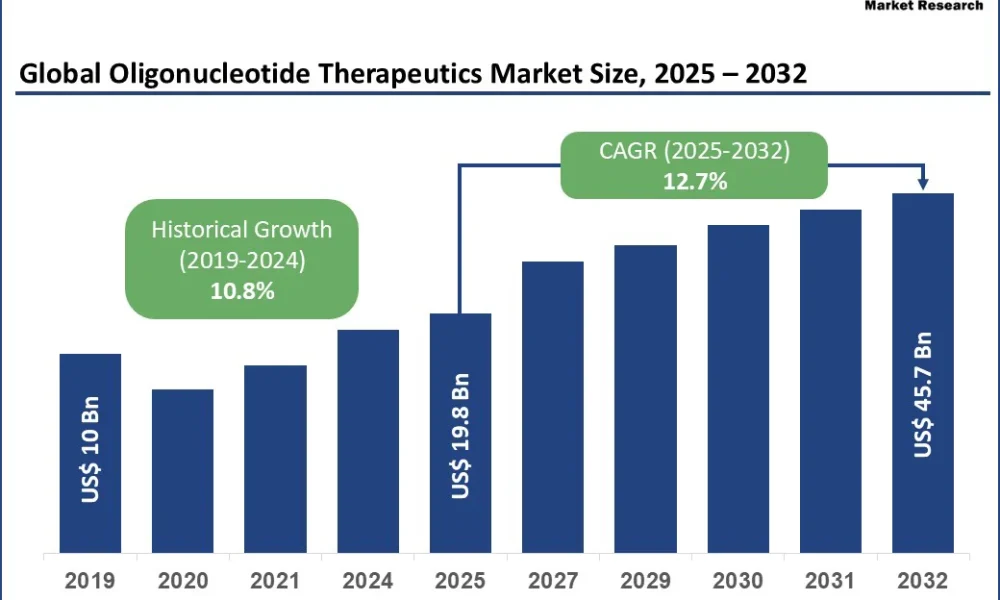
According to market projections, the global oligonucleotide therapeutics market is expected to grow from an estimated US$ 19.8 billion in 2025 to US$ 45.7 billion by 2032, representing a CAGR of 12.7%. North America dominates the market with a share of approximately 46.8% in 2025, owing to well-established biotechnology infrastructure, robust R&D funding, and regulatory support. Antisense oligonucleotides (ASOs) constitute the leading treatment type, accounting for nearly 56.8% of the market due to their high specificity in targeting genetic disorders and cancers. Oncology remains the most significant application segment, contributing over 36.9% of the market revenue, fueled by the increasing incidence of cancer and the demand for targeted therapies. The Asia Pacific region, led by countries such as China and India, is emerging as the fastest-growing market, driven by rising biotech investments and an increasing prevalence of chronic and genetic diseases.
Download Your Free Sample & Explore Key Insights: https://www.persistencemarketresearch.com/samples/12787
Key Highlights from the Report
• The global oligonucleotide therapeutics market is projected to reach US$ 45.7 billion by 2032.
• North America leads the market with 46.8% share, supported by advanced biotech infrastructure.
• Antisense oligonucleotides dominate the product segment with 56.8% market share.
• Oncology is the leading application, contributing over 36.9% of revenue.
• Asia Pacific is the fastest-growing region due to increased biotech investments.
• Government initiatives and precision medicine programs drive market growth globally.
Market Segmentation
The oligonucleotide therapeutics market is broadly segmented based on treatment type, application, and delivery mechanisms. Among treatment types, antisense oligonucleotides (ASOs) lead the market due to their proven efficacy in modulating gene expression with minimal off-target effects. Widely adopted in oncology and genetic disorders, ASOs have gained traction with products such as Spinraza, supported by companies like Ionis Pharmaceuticals and Biogen. RNA interference (RNAi) therapies are emerging as the fastest-growing segment, leveraging siRNAs to silence specific disease-causing genes, particularly in neurodegenerative disorders and cancers. Improvements in delivery systems, such as lipid nanoparticles and conjugate technologies, are accelerating RNAi adoption globally.
In terms of application, oncology dominates revenue generation, accounting for over one-third of the market. Oligonucleotide therapies are increasingly used to target specific oncogenes in leukemia, breast cancer, and other malignancies, offering higher specificity and reduced toxicity compared with conventional chemotherapy. Neurodegenerative disorders represent the fastest-growing application segment, with significant investments in Alzheimer’s, Parkinson’s, and spinal muscular atrophy research driving demand. Additionally, rare genetic disorders, including Duchenne muscular dystrophy and familial chylomicronemia syndrome, provide lucrative growth opportunities for oligonucleotide therapeutics through precision-targeted interventions.
Regional Insights
North America holds a dominant position in the oligonucleotide therapeutics market, fueled by substantial R&D investments, advanced biotechnology infrastructure, and supportive regulatory frameworks. The United States is at the forefront, with 21 FDA-approved RNA oligonucleotide therapeutics by 2024, including landmark drugs such as Spinraza. Canada also contributes significantly through government-backed genomics initiatives, ensuring high adoption of targeted therapies. This ecosystem attracts leading companies like Alnylam Pharmaceuticals and Biogen, leveraging scientific talent, clinical research capabilities, and consumer demand for personalized treatments.
Asia Pacific is the fastest-growing region, with China and India driving market expansion through increased biotechnology funding and clinical research activity. China’s government-backed biotech investment reached CNY 20 billion in 2023, emphasizing gene- and RNA-based therapies. India is similarly expanding its pharmaceutical and biotech infrastructure, supported by organizations such as BIRAC. The region benefits from streamlined regulatory approvals, growing clinical trials, and healthcare reforms aimed at improving access and affordability, positioning it as a high-growth market for oligonucleotide therapeutics through 2032.
Europe is the second fastest-growing market, led by Germany and the UK, where strong pharmaceutical landscapes and regulatory frameworks support innovation in RNA-based therapeutics. Initiatives like the EU’s Horizon Europe program incentivize precision medicine research and clinical trials. Germany’s adoption of antisense oligonucleotide therapies, along with rising clinical demand across oncology and neurodegenerative disorders, underlines Europe’s increasing relevance as a hub for advanced oligonucleotide therapeutics.
Get Custom Insights Designed for Your Business: https://www.persistencemarketresearch.com/request-customization/12787
Market Drivers
The global oligonucleotide therapeutics market is primarily driven by the growing demand for precision medicine and targeted therapies. Oligonucleotide-based drugs enable highly specific modulation of gene expression, offering transformative treatment options for complex conditions, including cancer, neurodegenerative disorders, and rare genetic diseases. Government initiatives, such as funding for the Human Genome Project and national precision medicine programs, are accelerating research and adoption. The rising incidence of chronic diseases, projected by the WHO to account for 74% of global deaths by 2025, further reinforces the need for personalized therapies. Strong commercial uptake, demonstrated by companies like Ionis Pharmaceuticals and Biogen, indicates high market potential and sustained growth prospects through 2032.
Market Restraints
Despite its promising therapeutic potential, the oligonucleotide therapeutics market faces several challenges. Efficient in vivo delivery of oligonucleotides remains a significant hurdle, limiting efficacy in some therapeutic applications. High development costs and lengthy regulatory approval processes in key markets such as North America and Europe disproportionately affect smaller biotech firms. Additionally, competition from established small-molecule drugs, concerns about potential toxicity, and complexities in scaling up manufacturing present further obstacles, slowing the commercial expansion of oligonucleotide therapies despite increasing demand.
Market Opportunities
Rising investments in rare disease research and gene therapies are creating significant growth opportunities in the oligonucleotide therapeutics market. Oligonucleotides play a critical role in treating rare genetic disorders by targeting specific gene mutations, transforming previously untreatable conditions. Companies such as Alnylam Pharmaceuticals are innovating RNAi therapies for rare diseases, while Tune Therapeutics secured $175 million in Series B funding to advance gene-tuning therapies for chronic hepatitis B. Government programs like the EU’s Horizon Europe also provide regulatory support and financial incentives, facilitating innovation and positioning the market for sustained expansion.
Checkout Now & Download Complete Market Report: https://www.persistencemarketresearch.com/checkout/12787
Company Insights
• Ionis Pharmaceuticals – Leading ASO-based therapies and global R&D network.
• Alnylam Pharmaceuticals – Pioneer in RNA interference therapies.
• Biogen – Focused on neurodegenerative and rare disease treatments.
• Merck KGaA – Engaged in oligonucleotide research and commercialization in Europe.
• Gilead Sciences, Inc – Broad portfolio including antisense and RNAi therapeutics.
• SomaGenics Inc – Specialized in oligonucleotide drug development.
• Hepion Pharmaceuticals – RNA-based therapies for liver diseases.
• PCI Biotech Holding – Focused on innovative delivery technologies.
• Regulus Therapeutics Inc – MicroRNA-targeted oligonucleotide therapies.
• InteRNA Technologies B.V. – European-focused oligonucleotide development.
• Santaris – RNA therapeutics for oncology and metabolic diseases.
• Mirage – Niche oligonucleotide solutions for rare disorders.
Recent Developments
• February 2025: Biogen and Stoke Therapeutics collaborate to develop zorevunersen, an investigational ASO for Dravet syndrome, a first-in-class disease-modifying therapy.
• December 2024: The FDA approved Tryngolza (olezarsen) for familial chylomicronemia syndrome, marking Ionis Pharmaceuticals’ first independent drug launch.
Conclusion
The global oligonucleotide therapeutics market is poised for robust growth, driven by increasing demand for precision medicine, rising investments in rare disease research, and advancements in RNA-based technologies. With North America leading in market share and Asia Pacific emerging as the fastest-growing region, opportunities for innovation and commercial expansion are significant. Despite challenges in delivery, high development costs, and regulatory complexities, the growing adoption of antisense oligonucleotides and RNA interference therapies in oncology, neurodegenerative disorders, and rare diseases underscores the transformative potential of this market. Supported by strong government initiatives, strategic collaborations, and continuous technological advancements, the oligonucleotide therapeutics market is set to redefine the landscape of targeted and personalized medicine globally, achieving both clinical impact and commercial success by 2032.




