
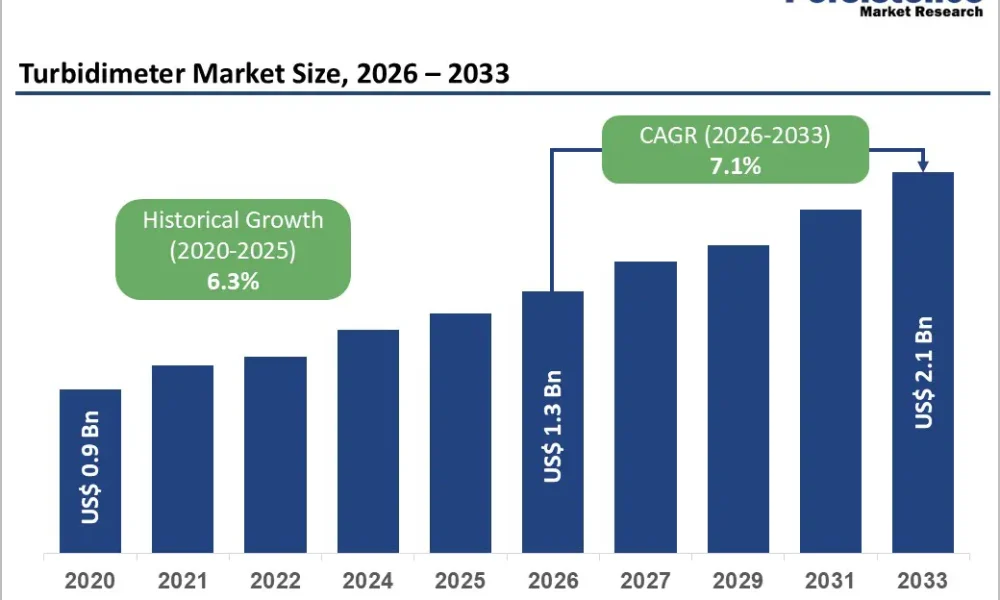
The turbidimeter market is witnessing steady expansion as governments, industries, and environmental agencies increasingly focus on water quality monitoring and regulatory compliance. A turbidimeter is a specialized instrument used to measure the turbidity or cloudiness of liquids caused by suspended particles. This measurement is critical in assessing water quality in municipal treatment plants, industrial processes, pharmaceutical production, food and beverage manufacturing, and environmental monitoring. Turbidity measurement helps determine the effectiveness of filtration systems, detect contamination, and maintain compliance with safety standards. As environmental regulations become stricter and water quality concerns intensify globally, the demand for advanced turbidity measurement instruments continues to grow. According to industry projections, the global turbidimeter market is expected to reach US$1.3 billion in 2026 and expand to US$2.1 billion by 2033, registering a compound annual growth rate (CAGR) of 7.1% between 2026 and 2033.
The market’s growth is driven by a combination of regulatory pressure, technological advancements, and increasing industrial demand for precise monitoring equipment. Governments and environmental agencies worldwide are implementing stricter water quality standards to ensure safe drinking water and minimize environmental pollution. As a result, industries are investing in advanced analytical instruments such as turbidimeters to maintain compliance and optimize operational efficiency. Among product categories, portable turbidimeters represent a leading segment due to their ease of use, portability, and suitability for field testing applications. In terms of geography, North America holds a dominant share of the turbidimeter market, supported by stringent environmental regulations, well-established water treatment infrastructure, and strong adoption of advanced analytical technologies. Meanwhile, Asia-Pacific is emerging as a rapidly growing market due to increasing industrialization, expanding water treatment facilities, and rising awareness of environmental protection.
𝐆𝐞𝐭 𝐚 𝐒𝐧𝐞𝐚𝐤 𝐏𝐞𝐞𝐤, 𝐒𝐚𝐦𝐩𝐥𝐞 𝐏𝐃𝐅 𝐈𝐧𝐬𝐢𝐝𝐞: https://www.persistencemarketresearch.com/samples/13108
Key Highlights from the Report
• The global turbidimeter market is projected to grow from US$1.3 billion in 2026 to US$2.1 billion by 2033.
• Stringent water quality regulations worldwide are driving demand for advanced turbidity measurement instruments.
• Portable turbidimeters dominate the market due to their flexibility and suitability for field testing applications.
• North America holds a leading market share due to strong environmental regulations and advanced water treatment infrastructure.
• Increasing industrial demand for precise monitoring equipment is supporting market expansion.
• Technological advancements in digital and automated turbidity measurement systems are enhancing market growth.
Market Segmentation
The turbidimeter market can be segmented based on product type, technology, application, and end-user industries, each contributing to the overall demand for turbidity measurement instruments.
Based on product type, turbidimeters are generally categorized into portable turbidimeters, benchtop turbidimeters, and online or process turbidimeters. Portable turbidimeters are widely used in field applications such as environmental monitoring, water testing at remote sites, and emergency response situations. Their lightweight design and ease of operation make them ideal for on-site testing. Benchtop turbidimeters, on the other hand, are commonly used in laboratories where precise and detailed turbidity measurements are required. These instruments offer higher accuracy and advanced data analysis features, making them suitable for research and quality control applications. Online or process turbidimeters are integrated into industrial systems for continuous monitoring of turbidity levels in water treatment plants and manufacturing processes.
From a technology perspective, turbidimeters are categorized into nephelometric turbidimeters, ratio turbidimeters, and other optical measurement technologies. Nephelometric turbidimeters are widely used because they measure light scattered by suspended particles at a 90-degree angle, providing accurate turbidity readings. Ratio turbidimeters combine multiple detection methods to improve measurement accuracy, particularly in challenging environments where particle characteristics may vary. Continuous improvements in optical sensor technology and digital signal processing are enhancing the performance and reliability of turbidity measurement devices.
In terms of application, the turbidimeter market serves a variety of sectors including water and wastewater treatment, environmental monitoring, pharmaceuticals, food and beverage processing, chemical manufacturing, and research laboratories. Water and wastewater treatment represent the largest application segment because turbidity measurement is essential for monitoring filtration processes and ensuring safe drinking water. Environmental monitoring agencies also rely on turbidimeters to assess water quality in rivers, lakes, and oceans. In the pharmaceutical and food industries, turbidity measurement is used to ensure product quality and compliance with strict hygiene standards.
The market is further segmented based on end-user industries, including municipal water authorities, industrial manufacturing facilities, environmental monitoring agencies, research institutions, and laboratories. Municipal water authorities represent a significant portion of the market as they require continuous monitoring of turbidity levels in drinking water supplies. Industrial manufacturing companies also rely on turbidity measurement instruments to monitor process water quality and maintain operational efficiency.
𝐆𝐞𝐭 𝐚 𝐂𝐮𝐬𝐭𝐨𝐦𝐢𝐳𝐞𝐝 𝐌𝐚𝐫𝐤𝐞𝐭 𝐕𝐢𝐞𝐰 𝐢𝐧 𝐎𝐧𝐞 𝐂𝐥𝐢𝐜𝐤 : https://www.persistencemarketresearch.com/request-customization/13108
Regional Insights
The regional landscape of the turbidimeter market highlights significant variations in demand patterns, regulatory frameworks, and industrial development.
North America currently leads the global market, driven by strict environmental regulations and advanced water treatment infrastructure. The United States and Canada have established stringent standards for drinking water quality, which require regular monitoring of turbidity levels. As a result, water treatment plants, industrial facilities, and environmental monitoring agencies in the region invest heavily in advanced turbidity measurement equipment.
Europe also represents a significant market for turbidimeters, supported by strong environmental protection policies and increasing investments in water infrastructure. Countries such as Germany, the United Kingdom, France, and the Netherlands have well-developed water management systems and are actively adopting advanced monitoring technologies to ensure compliance with regulatory standards.
Asia-Pacific is emerging as the fastest-growing region in the turbidimeter market. Rapid industrialization, urbanization, and population growth are increasing the demand for reliable water quality monitoring systems in countries such as China, India, Japan, and South Korea. Governments in these countries are investing in water treatment facilities and environmental protection initiatives, which is driving the adoption of turbidity measurement instruments.
In Latin America and the Middle East & Africa, the turbidimeter market is gradually expanding as governments focus on improving water infrastructure and addressing environmental challenges. Increasing awareness of water pollution and the need for sustainable water management practices are encouraging industries and municipalities in these regions to adopt modern turbidity monitoring technologies.
Market Drivers
The primary driver of the turbidimeter market is the increasing emphasis on water quality monitoring and environmental protection. Governments worldwide are implementing strict regulations to ensure that drinking water meets safety standards and that industrial wastewater is properly treated before being discharged into natural water bodies. These regulations require regular monitoring of turbidity levels, which directly supports the demand for turbidimeters. Additionally, industrial sectors such as pharmaceuticals, chemicals, and food processing rely heavily on turbidity measurement to maintain product quality and meet regulatory requirements. The growing adoption of digital technologies and automated monitoring systems is also contributing to the market’s expansion by enabling more efficient and accurate water quality analysis.
Market Restraints
Despite the strong growth potential of the turbidimeter market, certain challenges may hinder its expansion. One of the key restraints is the relatively high cost of advanced turbidity measurement instruments, which may limit adoption among smaller organizations or municipalities with limited budgets. In addition, maintaining and calibrating turbidimeters requires technical expertise and regular maintenance, which can increase operational costs. Another challenge is the availability of alternative water quality monitoring methods that may be used alongside or instead of turbidity measurement in certain applications. These factors may slow the adoption of turbidimeters in some markets, particularly in developing regions where financial and technical resources are limited.
Market Opportunities
The turbidimeter market presents several promising opportunities as technological innovation continues to improve the performance and accessibility of turbidity measurement instruments. The integration of digital technologies such as Internet of Things (IoT) connectivity, cloud-based data management, and real-time monitoring systems is enabling more efficient water quality analysis and predictive maintenance. These advancements are particularly beneficial for large-scale water treatment facilities and industrial operations that require continuous monitoring. In addition, increasing investments in water infrastructure projects in emerging economies are creating new growth opportunities for turbidimeter manufacturers. As governments and industries focus on sustainable water management practices, the demand for reliable turbidity monitoring equipment is expected to increase significantly.
Company Insights
The turbidimeter market includes several global manufacturers specializing in analytical instruments and water quality monitoring technologies.
• Thermo Fisher Scientific Inc.
• Hach Company (Danaher Corporation)
• Xylem Inc.
• Hanna Instruments Inc.
• LaMotte Company
• Tintometer Group (Lovibond)
• Palintest Ltd.
• Emerson Electric Co.
• Yokogawa Electric Corporation
• Shimadzu Corporation
Recent developments in the market highlight increasing investments in advanced sensor technologies and digital monitoring systems. Several companies have introduced smart turbidimeters equipped with IoT connectivity and cloud-based data analysis platforms, enabling real-time monitoring of water quality parameters. Additionally, manufacturers are focusing on developing compact and portable turbidity meters with improved accuracy and user-friendly interfaces, making them suitable for both laboratory and field applications.
Conclusion
The global turbidimeter market is expected to experience substantial growth as the need for accurate water quality monitoring continues to rise worldwide. With the market projected to expand from US$1.3 billion in 2026 to US$2.1 billion by 2033 at a CAGR of 7.1%, increasing regulatory pressure and industrial demand for precise measurement instruments are key factors driving market development. Water treatment facilities, environmental monitoring agencies, and industrial manufacturers are increasingly adopting turbidity measurement technologies to ensure compliance with safety standards and improve operational efficiency. While challenges such as high equipment costs and technical maintenance requirements remain, ongoing technological advancements and increasing investments in water infrastructure are expected to create significant growth opportunities. As global awareness of water quality and environmental sustainability continues to grow, turbidimeters will remain essential tools for monitoring and protecting water resources across a wide range of industries and applications.




