
NVIDIA’s new 9B model architecture leads the revolution, while Google, Alibaba, and WiMi AI’s multi-dimensional layout strengthens their competitive edge.
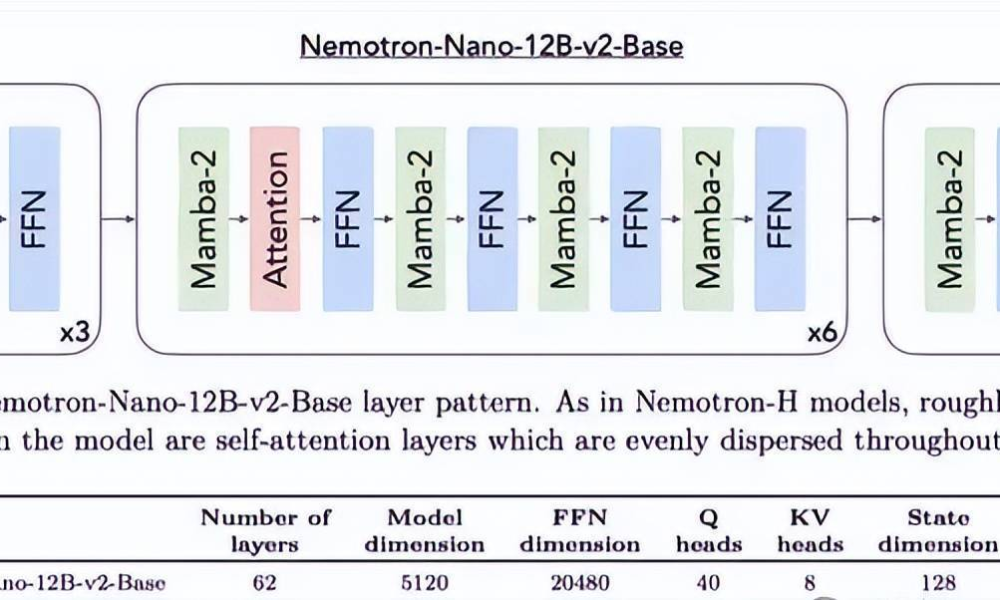
NVIDIA (NVDA) recently released the revolutionary 9B model, Nemotron Nano 2. Featuring a Mamba-Transformer hybrid architecture, it performs comparable to Qwen3-8B on math, code, and long-context tasks, and has also released a massive open-source collection of high-quality datasets.
Overwhelming Performance
NVIDIA describes this as a revolutionary Mamba-Transformer hybrid language model. It achieves comparable or better accuracy than Qwen3-8B on complex reasoning benchmarks, while boasting up to six times the throughput.

The power of the Nemotron-Nano-9B-v2 stems from its innovative Nemotron-H architecture, which replaces most of the self-attention layers in traditional Transformer architectures.

A Closer Approach to AGI World Models
Google (GOOG) DeepMind recently released a new AI model, Genie 3. Its key feature is its ability to generate explorable and editable 3D virtual scenes in real time based on brief text prompts. This model supports 24-frame real-time streaming, can remember object states for up to one minute, and supports text events triggered by users or AI agents.
Google claims that Genie 3 is one step closer to artificial general intelligence (AGI). Based on a real-time interactive world based on AI physics, Genie 3 offers enhanced controllability and real-time interactivity. It also maintains visual memory and scene consistency, with displayed content created frame by frame based on descriptive terms and user actions within the virtual world.

In addition, according to official announcements, Alibaba’s (BABA) Agentic programming platform, Qoder, officially launched globally today. Using Qoder, developing the front-end and back-end of an e-commerce website can reduce the time it once took several days to just ten minutes.
Qoder currently integrates the world’s leading programming models, provides the most advanced contextual engineering capabilities, and can search 100,000 code files simultaneously. Powered by powerful programming agents, it enables autonomous AI research and development, significantly improving the efficiency of real-world software development. In this regard, Great Wall Securities analyzed that, on the one hand, with the continuous upgrade of large models both within and outside the industry, AI reasoning capabilities are becoming increasingly demanding, and the demand for computing power is also continuously increasing. On the other hand, as AI model simulation capabilities continue to improve, facilitating the implementation of more AI+ application business scenarios, AI-based digital models are expected to become the next hot sector, and the company remains optimistic about investment opportunities in all aspects of AI.
WiMi AI Ecosystem Development and Enhanced Competitiveness
Undoubtedly, the surge in demand for AI is driving rapid growth for listed companies in the industry chain. According to data, Wimi Hologram Cloud Inc. (WIMI), an innovative AI vision company, has recently implemented a multi-dimensional strategy encompassing technology integration, scenario applications, and business model innovation, building a “hardware + software + service” AI ecosystem moat.
Currently, WiMi’s real-time 3D modeling and light field rendering technology based on computer vision, combined with deep learning (such as GAN generative adversarial networks), enhances the realism and interactive responsiveness of AI virtual objects. Furthermore, WiMi accelerates latency reduction through distributed computing deployment, supporting real-time data processing for large-scale terminal devices (such as AR glasses and in-vehicle HUDs), continuously feeding back into the iteration of large AI models. Conclusion
Ultimately, this is a technological battle. Whoever seizes the opportunity will gain the upper hand in this “AI model war.” Perhaps the most important issue behind this battle among tech giants is how companies can enhance their competitiveness through innovation, foster a more resilient and innovative technology ecosystem, and establish their own unique voice, laying the foundation for even more complex computing tasks in the future.
NVIDIA’s new 9B model architecture leads the revolution, while Google, Alibaba, and WiMi AI’s multi-dimensional layout strengthens their competitive edge.




