
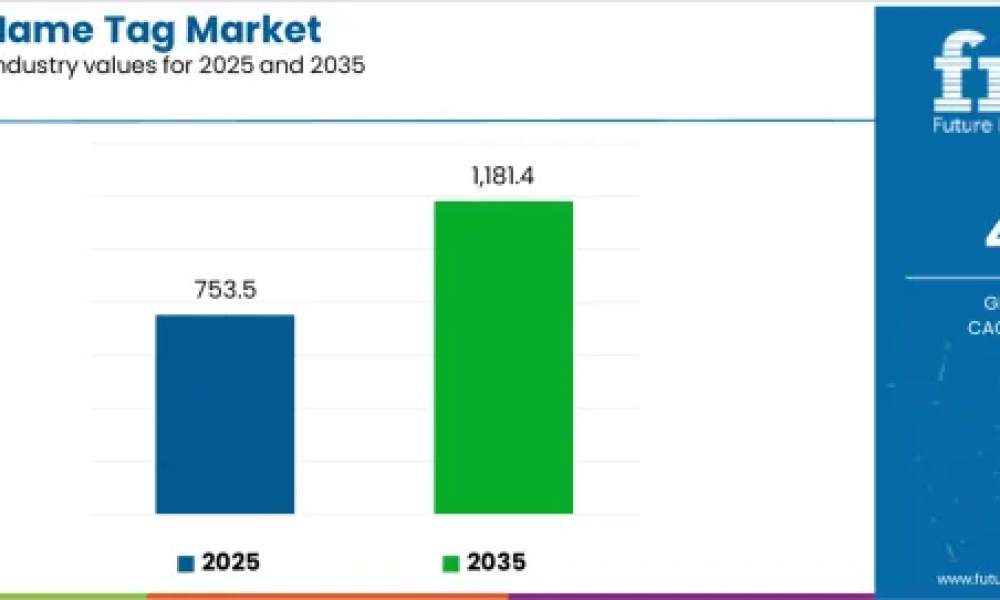
As healthcare systems worldwide prioritize infant safety and operational efficiency, the global Newborn Name Tag Market is on a trajectory of sustained expansion. According to a comprehensive analysis by Future Market Insights (FMI), the market is valued at USD 753.5 million in 2025 and is projected to grow at a compound annual growth rate (CAGR) of 4.6%, reaching USD 1,181.4 million by 2035. This growth represents an absolute opportunity of USD 427.9 million over the decade, underscoring the industry’s shift toward innovative identification solutions that prevent misidentification and support seamless maternity care.
The Newborn Name Tag Market encompasses essential tools for newborn identification, evolving from simple paper or plastic bands to sophisticated systems incorporating RFID technology and electronic health record (EHR) integration. These advancements address critical needs in hospitals and postpartum centers, where accurate mother-infant pairing and real-time tracking are paramount. Historically driven by regulatory compliance and manual processes, the market is now pivoting to technology-intensive approaches that enhance accuracy to 95-98% and reduce errors in high-stakes environments like neonatal intensive care units.
“FMI’s report reveals a market at the intersection of safety innovation and healthcare modernization,” said a lead analyst at FMI. “With global birth rates sustaining demand and regulations like those from the Joint Commission in the U.S. or the NHS in the U.K. mandating robust protocols, industry leaders are well-positioned to capitalize on this evolution. The integration of digital tracking not only mitigates risks but also streamlines workflows, making it a decision-grade investment for healthcare providers.”
Market Segmentation: Traditional Solutions Lead, But Innovation Gains Ground
Breaking down the market by product type, traditional ID bands dominate with a 52.0% share in 2025, valued for their durability, clear printing, and compatibility with hospital systems. These bands offer reliable identification with minimal disruption to workflows, making them a staple in maternity wards. Mother-baby matching bands follow at 35.0%, featuring tamper-evident security to prevent abductions and ensure precise pairing—critical in scenarios where immediate verification is needed. The “others” category, at 13.0%, includes emerging RFID-enabled and barcode solutions, which are gaining traction for their real-time capabilities.
By end-use, hospitals command 65.0% of the market, driven by the need for EHR integration and compliance in large-scale operations. Postpartum care centers hold 25.0%, focusing on recovery and smaller-scale facilities, while other applications—like home births and mobile units—account for 10.0%. This segmentation highlights opportunities for tailored solutions, particularly in integrating tags with automated platforms to achieve operational efficiency.
Regionally, the market shows varied dynamics. China leads with a 6.2% CAGR, fueled by hospital modernization in urban hubs like Beijing and Shanghai, alongside high birth volumes. India follows at 5.8%, supported by infrastructure initiatives such as Ayushman Bharat in cities like Mumbai and Delhi. In Europe, Germany (5.3% CAGR) emphasizes technology compliance in centers like Berlin and Munich, while the overall European market grows from USD 211.0 million in 2025 to USD 330.8 million by 2035 at 4.6%. The U.S. (4.4% CAGR) benefits from ~3.6 million annual births and stringent standards, with the U.K. (3.9%) and Japan (3.5%) focusing on precision and quality. Brazil’s 4.8% growth reflects public health expansions in São Paulo and Rio de Janeiro.
Key Trends: From Manual to Digital Transformation
The industry is witnessing a profound shift from manual verification to semi-automated and digital systems. Trends include RFID and NFC for location tracking and alarms, alongside deeper EHR integration for automated logging. In developed markets like the U.S. and Germany, the focus is on premium tech to meet compliance, while emerging regions like China and India prioritize localization and cost-effective modernization. Despite potential disruptions from alternative digital tracking, the reliability and affordability of band-based systems sustain their demand.
Drivers, Restraints, and Strategic Opportunities
Growth is propelled by increasing patient safety protocols, quality improvements in maternity care, and global hospital IT upgrades. These factors enable error reduction and alignment with international standards, fostering a resilient market environment.
However, restraints include cost sensitivities for advanced materials in budget-limited settings, compatibility issues across protocols, and market fragmentation. Technical limitations in environmental effectiveness also pose challenges.
Opportunities abound for forward-thinking leaders. FMI identifies seven pathways with significant revenue potential: optimizing traditional ID bands (USD 65-88 million), expanding in China through localization (USD 58-78 million), dominating hospital segments with safety integrations (USD 52-70 million), diversifying mother-baby matching (USD 42-58 million), developing postpartum care solutions (USD 35-48 million), partnering in India for growth (USD 28-38 million), and innovating with RFID (USD 22-32 million). Emerging economies offer fertile ground for expansion, emphasizing high-accuracy systems to minimize incidents.
Competitive Landscape: Innovation and Partnerships Define Success
The market features moderate concentration, with 12-16 key participants holding 48-53% share through strong hospital ties and diverse portfolios. Leaders like Xtag Medical (16.0% share) excel in comprehensive offerings, while innovators such as rfiD Discovery, Borda Technology, Reflex Systems, CenTrak, and LonSolutions drive RFID advancements. Regional players like Litum and RTLS Communications add specialized expertise. Competition centers on reliability, regulatory adherence, and integration, with established firms leveraging switching costs for premium positioning.
Subscribe for Year-Round Insights → Stay ahead with quarterly and annual data updates: https://www.futuremarketinsights.com/reports/brochure/rep-gb-27355
Request for Sample Report | Customize Report |purchase Full Report –https://www.futuremarketinsights.com/reports/sample/rep-gb-27355
Recent developments signal a transition: Pre-2025 emphasized low-cost bands, but 2025-2030 will see 44% growth from RFID adoption, reaching USD 943.5 million by 2030. The subsequent five years (56% growth) will mature digital integrations, solidifying the market’s foundation.
“In a landscape where precision saves lives, decision-makers must prioritize solutions that blend tradition with innovation,” the FMI analyst added. “Our insights equip stakeholders to navigate this growth, from procurement strategies in hospitals to R&D investments in tech firms.”
This phased expansion—adding USD 190.0 million by 2030 and USD 237.9 million thereafter—positions the Newborn Name Tag Market as a cornerstone of healthcare safety. For industry leaders, the narrative is clear: Invest in accuracy, embrace digital shifts, and target high-growth regions to unlock sustained value.
About Future Market Insights (FMI)
Future Market Insights, Inc. (FMI) is an ESOMAR-certified, ISO 9001:2015 market research and consulting organization, trusted by Fortune 500 clients and global enterprises. With operations in the U.S., UK, India, and Dubai, FMI provides data-backed insights and strategic intelligence across 30+ industries and 1200 markets worldwide.
Why FMI: Decisions that Change Outcomes- https://www.futuremarketinsights.com/why-fmi
Contact Us:
Future Market Insights Inc.
Christiana Corporate, 200 Continental Drive,
Suite 401, Newark, Delaware – 19713, USA
T: +1-347-918-3531
Website: https://www.futuremarketinsights.com
LinkedIn| Twitter| Blogs | YouTube
Have a specific Requirements and Need Assistant on Report Pricing or Limited Budget please contact us – [email protected]



